Designing a Predictive Model of Spiritual Leadership Based on Behavioral Variables Among Managers of the National Construction Engineering Organization
Keywords:
: Spiritual Leadership, Behavioral Variables, Managers, Engineering OrganizationAbstract
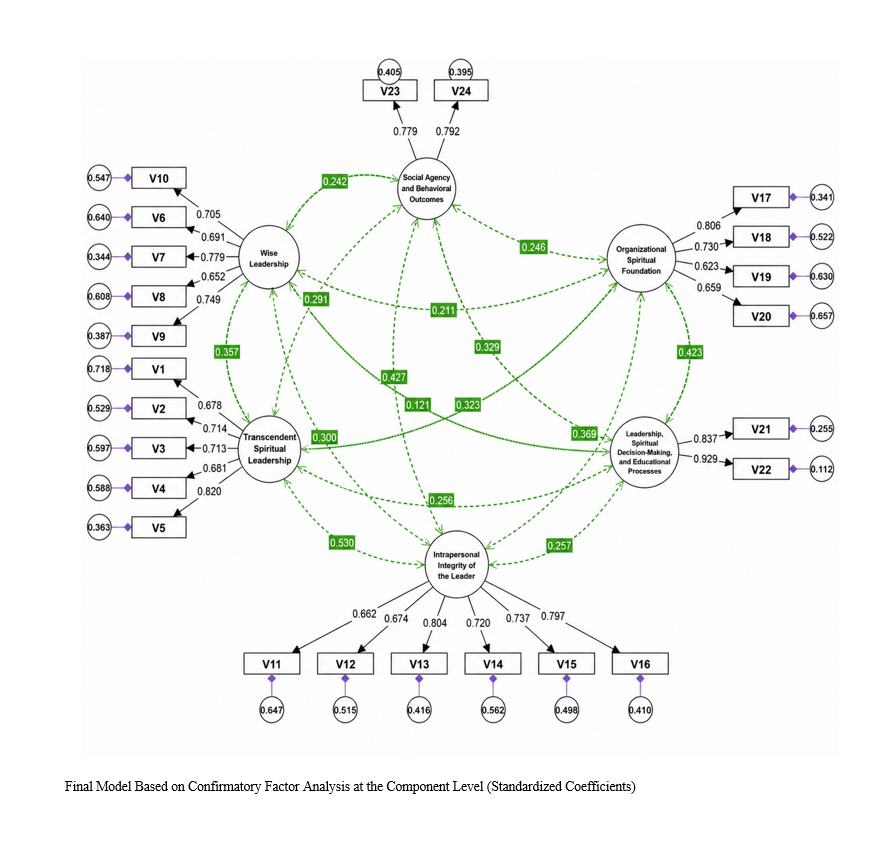
The purpose of the present study was to design a predictive model of spiritual leadership based on behavioral variables among managers of the National Construction Engineering Organization. In terms of purpose, this research was developmental, and in terms of approach, it employed a mixed-methods design (quantitative–qualitative). The qualitative phase was conducted using thematic analysis, while the quantitative phase utilized a correlational design with a structural equation modeling (SEM) approach. The statistical population in the qualitative phase consisted of experts, public administration faculty members, and managers of the National Construction Engineering Organization. Participants were selected through purposive sampling, and sampling continued until theoretical saturation was achieved (15 participants). In the quantitative phase, the statistical population included all managers and employees of the National Construction Engineering Organization, from whom 250 individuals were selected using convenience sampling. In the qualitative phase, data were collected through semi-structured interviews, whereas in the quantitative phase, a researcher-developed questionnaire derived from the qualitative interviews was utilized. The instrument employed in this study was a researcher-developed questionnaire consisting of six dimensions and twenty-four components. The questionnaire was designed based on interview data and corresponded to the themes identified during the qualitative analysis. Data analysis in the qualitative phase was conducted using the thematic analysis approach proposed by Brown and Clarke (2006). In the quantitative phase, structural equation modeling was performed using PLS software. Based on the results of the thematic analysis, the organizing themes were classified into six final themes: “Transcendent Spiritual Leadership,” “Wise Leadership,” “Leader’s Intrapersonal Integrity,” “Organizational Spiritual Foundation,” “Leadership, Spiritual Decision-Making and Educational Processes,” and “Social Agency and Behavioral Outcomes.” These themes were identified and developed as the core dimensions of spiritual leadership based on behavioral variables among managers of the National Construction Engineering Organization. Furthermore, the results of the structural equation modeling indicated that the proposed research model demonstrated satisfactory validity and goodness-of-fit indices. The findings of the confirmatory factor analysis also supported the model of factors influencing the prediction of spiritual leadership based on behavioral variables among managers of the National Construction Engineering Organization at the level of the principal components.
References
[1] L. W. Fry et al., "The relevance of spiritual leadership to public health: Values, meaning and purpose," Frontiers in Public Health, vol. 13, p. 1632959, 2026, doi: 10.3389/fpubh.2025.1632959.
[2] A. De Silva, I. Peiris, and U. Kumara, "Spiritual leadership: Sustainability and spiritual leadership," in The Palgrave Encyclopedia of Leadership and Organizational Change, 2026, pp. 1-10.
[3] Y. Meng, "Spiritual leadership at the workplace: Perspectives and theories: Review," Biomedical Reports, vol. 5, pp. 408-412, 2016, doi: 10.3892/br.2016.748.
[4] J. Oh and J. Wang, "Spiritual leadership: Current status and agenda for future research and practice," Journal of Management, Spirituality and Religion, vol. 17, no. 3, pp. 223-248, 2020, doi: 10.1080/14766086.2020.1728568.
[5] R. Malik, J. Yadav, and D. Yadav, "Role of spiritual leadership in enhancing employees' job performance: A study of organized retail sector in India," International Journal of Innovative Technology and Exploring Engineering, vol. 8, no. 2S, pp. 122-128, 2018.
[6] P. V. Nguyen, K. T. Tran, K. H. Dao, and H. P. Dinh, "The role of leader's spiritual leadership on organisation outcomes," Asian Academy of Management Journal, vol. 23, no. 2, pp. 45-68, 2018, doi: 10.21315/aamj2018.23.2.3.
[7] J. M. Yusof, S. N. A. Zulkiffli, and M. S. Muda, "The influence of spiritual leadership on intention to leave of the employees," International Journal of Applied Business and Economic Research, 2016.
[8] C. Chen and C. Li, "Assessing the spiritual leadership effectiveness: The contribution of follower's self-concept and preliminary tests for moderation of culture and managerial position," The Leadership Quarterly, vol. 24, pp. 240-255, 2013, doi: 10.1016/j.leaqua.2012.11.004.
[9] M. Elias, S. Ezanee, N. Othman, and N. A. Yaacob, "Relationship of spirituality leadership style and SMEs performance in halal supply chain," International Journal of Supply Chain Management, vol. 6, no. 2, pp. 166-176, 2017. [Online]. Available: https://pdfs.semanticscholar.org/36a4/ebc36d3595815decb772ed1a1fb5600e30c0.pdf.
[10] G. Baser and R. Ehtiyar, "The understanding of workplace spirituality among a group of human resource managers: Meaning, influencing factors and practices," Egitimde Nitel Arastirmalar Dergisi - Journal of Qualitative Research in Education, vol. 7, no. 2, pp. 668-687, 2019, doi: 10.14689/issn.2148-2624.1.7c.2s.9m.
[11] B. Baskar, "Mediating effect of workplace spirituality on emotional intelligence organization culture and dimensions of employee job attitude," Vellore Institute of Technology, Vellore, Centre of Business School, 2023.
[12] N. K. A. Wahid and N. Mohd Mustamil, "Ways to maximize the triple bottom line of the telecommunication industry in Malaysia: The potentials of spiritual well-being through spiritual leadership," Journal of Organizational Change Management, vol. 30, no. 2, pp. 263-280, 2017, doi: 10.1108/JOCM-07-2015-0105.
[13] N. A. Al Eid, B. A. Arnout, and A. A. Almoied, "Leader's spiritual intelligence and religiousness: Skills, factors affecting, and their effects on performance: A qualitative study by grounded theory," Journal of Public Affairs, p. e2129, 2020, doi: 10.1002/pa.2129.
[14] J. Egunjobi, "Spiritual Intelligence," 2025. [Online]. Available: https://www.researchgate.net/publication/393872575_SPIRITUAL_INTELLIGENCE.
[15] V. Silingiene and S. Skeriene, "Links between the spiritual intelligence of the leader and an organization's service quality: A theoretical approach," Engineering Economics, vol. 27, no. 1, 2016, doi: 10.5755/j01.ee.27.1.8863.
[16] B. S. Pawar, "Leadership spiritual behaviors toward subordinates: An empirical examination of the effects of a leader's individual spirituality and organizational spirituality," Journal of Business Ethics, vol. 122, no. 3, pp. 439-452, 2014, doi: 10.1007/s10551-013-1772-5.
[17] L. Zsolnai and K. Illes, "Spiritually inspired creativity in business," International Journal of Social Economics, vol. 44, no. 2, pp. 195-205, 2017, doi: 10.1108/IJSE-06-2015-0172.
[18] F. Bagis, W. Adawiyah, and A. Sudjadi, "Examining the role of spiritual leadership and Islamic spiritual well-being in mitigating workplace deviant behaviour," Qubahan Academic Journal, vol. 6, no. 1, pp. 395-408, 2026, doi: 10.48161/qaj.v6n1a1860.
[19] S. G. Heyler, A. A. Armenakis, A. G. Walker, and D. Y. Collier, "A qualitative study investigating the ethical decision making process: A proposed model," The Leadership Quarterly, 2016, doi: 10.1016/j.leaqua.2016.05.003.
[20] M. Yang and L. W. Fry, "The role of spiritual leadership in reducing healthcare worker burnout," Journal of Management, Spirituality and Religion, vol. 15, no. 4, pp. 305-324, 2018, doi: 10.1080/14766086.2018.1482562.
[21] A. Sharma, "Role of spiritual intelligence in preventing burnout amongst managers," Pandit Deendayal Petroleum University, School of Management, 2022.
[22] E. Baykal and C. Zehir, "Mediating effect of psychological capital on the relationship between spiritual leadership and performance," E&M: Ekonomie a Management, vol. 21, no. 3, pp. 124-140, 2018, doi: 10.15240/tul/001/2018-3-008.
[23] K. Piwowar-Sulej and Q. Iqbal, "A systematic literature review on spiritual leadership: Antecedents, mechanism, moderators and outcomes," Journal of Organizational Change Management, 2024, doi: 10.1108/JOCM-11-2023-0483.
[24] V. Chaturvedi, R. Singhi, S. Bansal, D. Aggarwal, and A. Ramachandran, "Identifying critical factors for developing spirituality-based leadership in health sector: An interpretive structure modelling (ISM) approach with MICMAC analysis," Journal of Health Management, vol. 27, pp. 317-332, 2025, doi: 10.1177/09720634251332781.
[25] M. Azzuhri, M. Huang, and D. Irawanto, "Reinventing spiritual leadership from an Indonesian perspective," International Journal of Cross Cultural Management, vol. 24, pp. 289-308, 2024, doi: 10.1177/14705958241245245.
[26] M. Mehraban, A. Amirkhani, and A. Abolqasemi, "Identification of spiritual leadership factors and indicators in secondary schools," Iranian Journal of Educational Sociology, vol. 2, no. 1, pp. 82-91, 2019, doi: 10.29252/ijes.2.1.82.
[27] M. Samiei Zafarghandi, E. Yousefi, and Z. Taleb, "Explaining the dimensions and components of the spiritual leadership model: Case study of Farhangian University of Isfahan," Iranian Political Sociology, pp. 818-829, 2022.
[28] R. Davari, M. Oladian, and M. Imani, "Designing a model for developing spiritual leadership among upper-secondary school principals in Tehran education system," Teaching Research, vol. 111, no. 1, pp. 1-21, 2023.
[29] A. Saadatfar, "Ranking Bank Saderat branches in Ilam Province based on behavioral variables," Payame Noor University, Malayer, 2023.
Downloads
Publication Timeline
- Submitted
- Revised
- Accepted
Issue
Section
License
Copyright (c) 2025 Mandana Dehghan Ghale (Author); Zolfaghar Rashidi (Corresponding author); Asghar Sharifi (Author)

This work is licensed under a Creative Commons Attribution-NonCommercial 4.0 International License.