Analyzing the Components of International Educational Systems in Alignment with Iran’s Fundamental Transformation Document of Education
DOI:
https://doi.org/10.61838/msesj.498Keywords:
Comparative education, Fundamental Transformation Document of Education, International educational systems, LocalizationAbstract
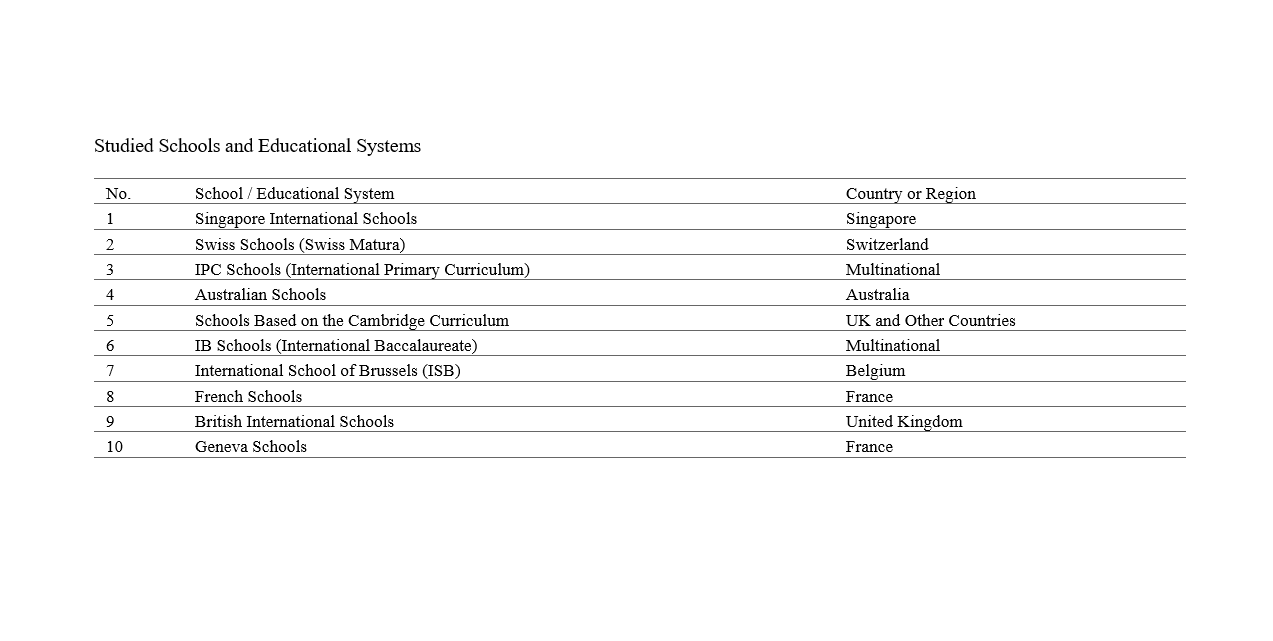
This study aimed to analyze the components of international educational systems and explain their alignment with Iran’s Fundamental Transformation Document of Education. The study was applied in purpose and employed a qualitative approach within an interpretive–critical paradigm using a comparative–analytical design. Data were collected through document analysis of official documents and policy reports of ten international educational systems—including Singapore, Swiss Matura, the International Primary Curriculum, Australia, Cambridge, the International Baccalaureate, Brussels, France, Britain, and Geneva—interviews with ten principals, teachers, and graduates of these schools, and the views of experts in the philosophy of education, curriculum planning, and educational policy obtained through interviews and focus groups. Data were analyzed using directed content analysis, deductive thematic analysis, and comparative matrix analysis. The findings revealed four main components across all systems: curriculum, student characteristics, teacher and principal characteristics, and educational leadership and management, with common emphasis on active learning, competency development, process-oriented assessment, teacher professionalization, instructional leadership, and evidence-based decision-making. Components such as active learning, interactive instruction, participatory management, and teacher professionalization are potentially compatible with the Fundamental Transformation Document. However, elements that weaken national and religious identity or prioritize transnational standards over indigenous objectives require revision or exclusion. The study concludes that international experiences should be utilized through critical localization, selective adaptation, and conceptual reconstruction within the cultural and identity-based foundations of Iran’s education system.
References
[1] M. Ruhal, "From Tradition to Modernity: China’s Education System ‘‘A Product of Legal Design”," Journal of Global Research in Education and Social Science, vol. 19, no. 1, pp. 62-80, 2025, doi: 10.56557/jogress/2025/v19i19143.
[2] M. Sardarabadi, "A comparative study of the education systems of Iran and Sweden," 2024.
[3] M. T. Roudi, "A comparative study of Iran's teacher education system and South Korea, with an emphasis on recruitment and training processes," Iranian Journal of Comparative Education, vol. 7, no. 3, pp. 3128-3153, 2024. [Online]. Available: https://journal.cesir.ir/article_184709_7bdda9d7a427646ef923c906e968984b.pdf.
[4] S. Karakaş Mısır and M. Thomas, "Gifted but Misunderstood? An Interpretive Systematic Review of Gifted Education Policy, Practice, and Socio-Emotional Experience in England," (in English), Journal of Intelligence, vol. 14, no. 3, p. 34, 2026, doi: 10.3390/jintelligence14030034.
[5] A. A. Motavalli and T. Shiri, "Macro Policies of the Fundamental Transformation Document and Their Impact on the Development of the National Education System," Education, Training and Sustainable Development, vol. 4, no. 2, pp. 1-15, 2026.
[6] F. Nabi, N. Mirsepasi, and A. Zamani Moghaddam, "The General Policies for Transforming the Education System and Diagnosing Its Current Challenges," Quarterly Journal of The Macro and Strategic Policies, vol. 12, no. 46, pp. 364-391, 2024.
[7] M. Namdari Pejman, "The standard school from the perspective of transformation documents of the education system: In search of the ideal model," Islamic Educational Sciences, vol. 12, no. 25, pp. 5-35, 2024.
[8] A. Khosh Eghbal Fard, H. Mozaffar, A. Alikhanzadeh, and M. a.-R. Ghaemi, "The Problem System of Governance in the Education System of the Islamic Republic of Iran over a Five-Year Horizon and an Examination of Its Internal Dynamics," Excellence Governance, vol. 6, no. 4, 2025.
[9] A. Abbaspour, "Dynamizing the Secondary Education System," Policy Recommendations of Allameh Tabataba'i University to National Executive Agencies, vol. 6, no. 6, pp. 186-201, 2025.
[10] A. Norbakhsh, N. Hassanmoradi, and F. Ahmadbeigi, "Presenting a Change Management Model in the Structure of the Iranian Education System," Personal Development and Organizational Transformation, pp. 1-16, 2026. [Online]. Available: https://journalpdot.com/index.php/jpdot/article/view/272.
[11] M. Mohammadi and F. Dimehkar Haghighi, "Out-of-Rule Behaviors of Students in the Education System - A Meta-Synthesis Model of Theorizing," Applied Sociology, vol. 35, no. 4, pp. 121-158, 2024. [Online]. Available: https://jas.ui.ac.ir/article_29027_en.html.
[12] J. Pourkarimi and Z. Ghamoushi, "Good Governance in the National Education System: A National Survey," Science and Technology Policy, vol. 18, no. 4, pp. 93-110, 2025.
[13] M. Hosseini, F. Kazemi, and M. Rezaei, "Examining the Dimensions of Good Governance in the Education System and Its Impact on Achieving Educational Justice," Quarterly Journal of Learning, Education and Research, vol. 2, no. 1, pp. 81-97, 2026.
[14] L. D. Parker, J. Guthrie, and A. Martin‐Sardesai, "Performance Management in the Australian Higher Education System – A Historically Informed Critique," Accounting History, vol. 29, no. 2, pp. 215-235, 2024, doi: 10.1177/10323732241230348.
[15] K. Kunwar, "Algorithmic governance in lifelong learning systems: Artificial intelligence, educational policy transformation, and human development," ed, 2026.
[16] J. Yang and M. Valcke, "Flipped Classroom Design as a Driver of Digital Transformation and Sustainable Education in Higher Education: A Systematic Review of Reviews," Sustainability, vol. 18, no. 7, p. 3582, 2026, doi: 10.3390/su18073582.
[17] Z. Khosravi, Z. Nazari, and F. Aminnejad, "Innovative virtual learning models in Iran's education system," in First International Conference on New Horizons in Learning Psychology and Education from the Teacher's Perspective, 2025.
[18] S. H. Al-Hosseini, An introduction to distance education (in the education system of Iran). Tehran: Monadi Tarbiyat Cultural Institute, 2025.
[19] A. Mohammad Aziz, M. Doustar, M. Akbari, and K. Yakideh, "A Conceptual Framework for Digital Transformation Based on E-Leadership in the Higher Education System: A Study of the Kurdistan Region of Iraq," Human Resource Studies, vol. 14, no. 3, pp. 88-117, 2024.
[20] I. A. Fardous and A. Bennadji, "Integrating dynamic facade design into architectural education and practice through Mashrabiya-inspired kinetic systems," Discover Education, 2026.
[21] N. Chotisarn and T. Phuthong, "Reducing Gaps in Digital Entrepreneurship Education: A Systematic Review of Innovative Learning Strategies and Their Institutional Impact," The International Journal of Management Education, vol. 24, no. 1, p. 101283, 2026, doi: 10.1016/j.ijme.2025.101283.
[22] F. Rezaei and A. Faghih Abdollahi, "Investigating the Application of Artificial Intelligence in the Education System," in Presented at the 8th National Conference on New Approaches in Education and Research, 2024. [Online]. Available: https://en.civilica.com/doc/1953722/.
[23] S. Salehnezhad Behrastaghi, R. Sekalsh, T. Rahali Tayefeh Ajirlou, and Tohid, "Proposing a Model for the Application of Artificial Intelligence in the National Education System with a Teaching-Learning Approach," Quarterly Journal of Novel Ideas in Psychology, vol. 21, no. 25, pp. 1-14, 2024. [Online]. Available: http://jnip.ir/article-1-1146-fa.html.
[24] A. Sargazi, M. Akati, G. Bolaqi, Fatemeh, and Z. Kikha Jaleh, "The Role of Artificial Intelligence in Transforming Personalized Learning Methods in Iran's Education System," presented at the Third International Conference on Smart Technologies in Educational Sciences, Psychology, and Counseling, 2025.
[25] P. Sihag and V. Vibha, "Transforming and Reforming the Indian Education System With Artificial Intelligence," Digital Education Review, no. 45, pp. 98-105, 2024, doi: 10.1344/der.2024.45.98-105.
[26] D. Y. Long, S. Wang, S. Md Rashid, and X. T. Lu, "Artificial Intelligence in Higher Education: A Systematic Review of Its Impact on Student Engagement and the Mediating Role of Teaching Methods," presented at the Frontiers in Education, 2026. [Online]. Available: https://doi.org/10.3389/feduc.2025.1648661.
[27] J. Wang and A. Shapii, "Teachers' content knowledge and pedagogical content knowledge of reading instruction: A systematic review (2019-2024)," European Journal of Educational Research, vol. 15, no. 1, pp. 341-355, 2026, doi: 10.12973/eu-jer.15.1.341.
[28] M. Rezvani, H. Rezaei Kilidbari, and B. Abbasi, "Analyzing the performance evaluation model of human resources in the higher education system with an ethics-oriented approach," Ethics in Science and Technology, vol. 19, no. 4, pp. 178-190, 2025. [Online]. Available: http://ethicsjournal.ir/article-1-3060-fa.html.
[29] F. Ordo and E. Arabzadeh, "Ideation in the academic education system; a culture-oriented comparison with verses of the Holy Quran," Educational Sciences, vol. 31, no. 1, pp. 241-258, 2024.
[30] B. Z. Nasiri, "Education policy as a recursive system of gendered power," Journal of Educational Research and Practice, vol. 4, no. 1, pp. 128-143, 2026, doi: 10.70376/jerp.v4i1.436.
[31] J. Mohremi, J. Keyhan, and M. Samari, "Designing and Validating a Multicultural Education Policy Model in Iran's Public Education System," Curriculum Planning Research, vol. 83, no. 21, pp. 48-67, 2025.
[32] H. Najafpour and B. Rezaei, "Discourse analysis of skill-oriented education policymaking in Iran's higher education system," Public Policy, 2025, doi: 10.22059/jppolicy.2026.404157.2806.
Downloads
Publication Timeline
Issue
Section
License
Copyright (c) 2026 Nooraldin Mirzaei (Corresponding author); Ali Hosseini Tavasol, Naghi Kamali (Author)

This work is licensed under a Creative Commons Attribution-NonCommercial 4.0 International License.