Evaluation of Cybersecurity Strategies for Improving Information Technology Services: Design and Quantitative Testing of an Integrated Model
DOI:
https://doi.org/10.61838/msesj.554Keywords:
Cybersecurity, cybersecurity strategy, information technology services, cybersecurity governance, digital resilience, integrated model, structural equation modelingAbstract
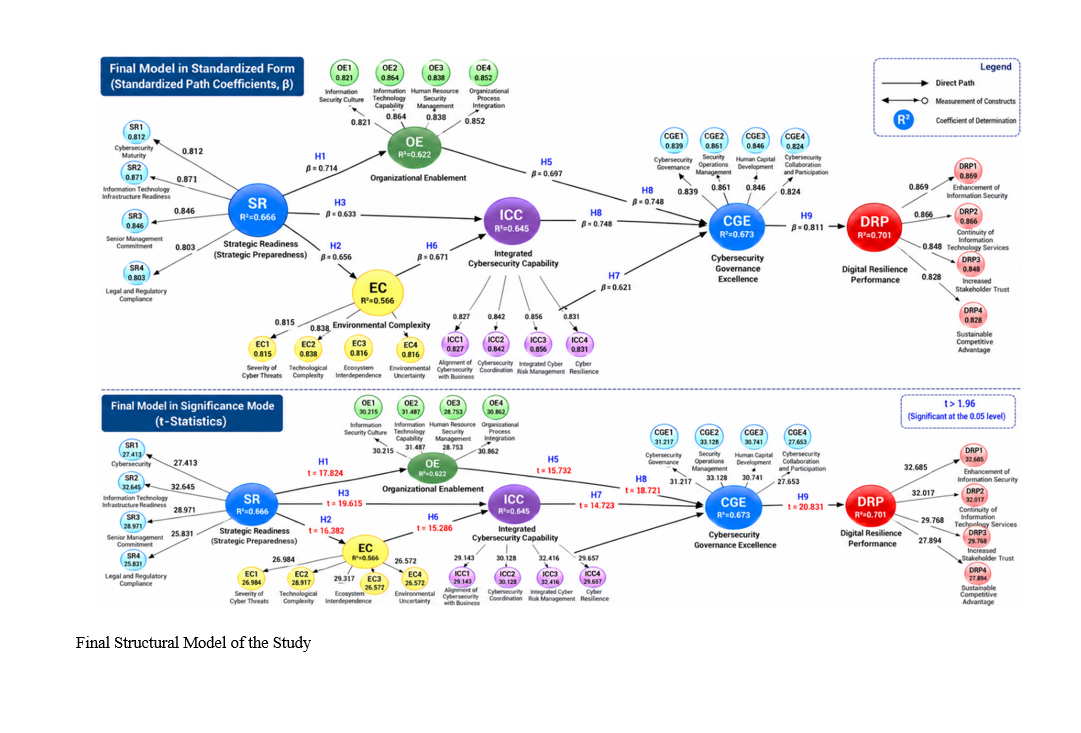
The present study aimed to evaluate cybersecurity strategies for improving information technology services through the design and quantitative testing of an integrated model. Given organizations’ increasing dependence on information technology services and the growing complexity of cyber threats in cloud environments, there is a clear need for a comprehensive model that simultaneously incorporates strategic and organizational dimensions as well as technical and environmental dimensions. In terms of purpose, this study is applied-developmental, and in terms of methodology, it adopts a mixed (quantitative) approach. In the quantitative phase, data were collected through a questionnaire administered to organizations providing information technology services and were analyzed using partial least squares structural equation modeling (PLS-SEM). The results indicated that strategic readiness has positive and significant effects on organizational enablement, environmental complexity, and integrated cybersecurity capability. Organizational enablement and environmental complexity also influence integrated cybersecurity capability and cybersecurity governance excellence. Furthermore, integrated cybersecurity capability has a significant effect on cybersecurity governance excellence, while cybersecurity governance excellence was ultimately identified as the most influential factor affecting digital resilience performance. Cybersecurity strategies are effective when they are designed and implemented within an integrated, multilayered model encompassing governance, risk management, and socio-technical dimensions. Cybersecurity governance constitutes the final linkage connecting security capabilities to digital resilience performance; without effective governance, investment in technology alone cannot ensure sustainable resilience. The findings are consistent with the existing theoretical literature on information security governance, risk management, and socio-technical systems, and the proposed model can be employed as a context-specific framework for assessing cybersecurity maturity in organizations providing information technology services.
References
[1] R. Von Solms and S. H. Von Solms, "Cybersecurity and Information Security - What Goes Where?," Information & Computer Security, vol. 26, no. 1, pp. 2-9, 2018, doi: 10.1108/ICS-04-2017-0025.
[2] N. Türegün, "Digital Transformation and Cybersecurity Risks," International Journal of Accounting Information Systems, 2024, doi: 10.1016/j.accinf.2025.100749.
[3] R. Von Solms and S. H. Von Solms, "Information Security Governance: A Model Based on the Direct-Control Cycle," Computers & Security, vol. 25, no. 6, pp. 408-412, 2006, doi: 10.1016/j.cose.2006.07.005.
[4] A. Chidukwani, S. Zander, and P. Koutsakis, "Cybersecurity Preparedness of Small-to-Medium Businesses: A Western Australia Study with Broader Implications," Computers & Security, vol. 145, p. 104026, 2024, doi: 10.1016/j.cose.2024.104026.
[5] P. H. Nguyen, T. V. Pham, L. A. T. Nguyen, H. A. T. Pham, T. H. T. Nguyen, and T. G. Vu, "Assessing Cybersecurity Risks and Prioritizing Top Strategies in Vietnam's Finance and Banking System Using Strategic Decision-Making Models-Based Neutrosophic Sets and Z Number," Heliyon, vol. 10, no. 19, p. e37893, 2024, doi: 10.1016/j.heliyon.2024.e37893.
[6] M. Omrani, "An Analysis of Organizational Information and Data Protection and Cybersecurity Using Emerging Information and Communication Technologies (ICT) in Municipalities," (in Persian), Quarterly Journal of New Research in Management and Accounting, vol. 6, no. 12, 2025.
[7] M. Hossein Gholipour, "Information Security Management Strategies for Countering Cyberattacks in Computer Networks," presented at the 24th National Conference on Applied Research in Electrical, Computer, and Biomedical Engineering Sciences, 2025.
[8] G. Baxter and I. Sommerville, "Socio-Technical Systems: From Design Methods to Systems Engineering," Interacting with Computers, vol. 23, no. 1, pp. 4-17, 2011, doi: 10.1016/j.intcom.2010.07.003.
[9] A. Capaccioli, L. Urciuoli, F. Di Ciommo, G. Rondinella, S. Giorgi, and R. Hueting, "Including the Excluded: How Can Design of Digital Delivery Service Address Cybersecurity Concerns of Vulnerable Users?," Transportation Research Procedia, vol. 72, pp. 2604-2611, 2023, doi: 10.1016/j.trpro.2023.11.791.
[10] J. Huang and U. Murthy, "The Impact of Cybersecurity Risk Management Strategy Disclosure on Investors' Judgments and Decisions," International Journal of Accounting Information Systems, vol. 54, p. 100696, 2024, doi: 10.1016/j.accinf.2024.100696.
Downloads
Publication Timeline
- Submitted
- Revised
- Accepted
Issue
Section
License
Copyright (c) 2026 Amin Moghimi (Author); Ahmad Reza Kasraee (Corresponding author); Sina Abuei Mehrizi , Hedeyeh Divsalar (Author)

This work is licensed under a Creative Commons Attribution-NonCommercial 4.0 International License.