Identification and Classification of Factors Affecting the Implementation of Artificial Intelligence in Organizations: A Meta-Synthesis Approach
Keywords:
Artificial Intelligence, Organizational Implementation, Meta, Synthesis, Influencing FactorsAbstract
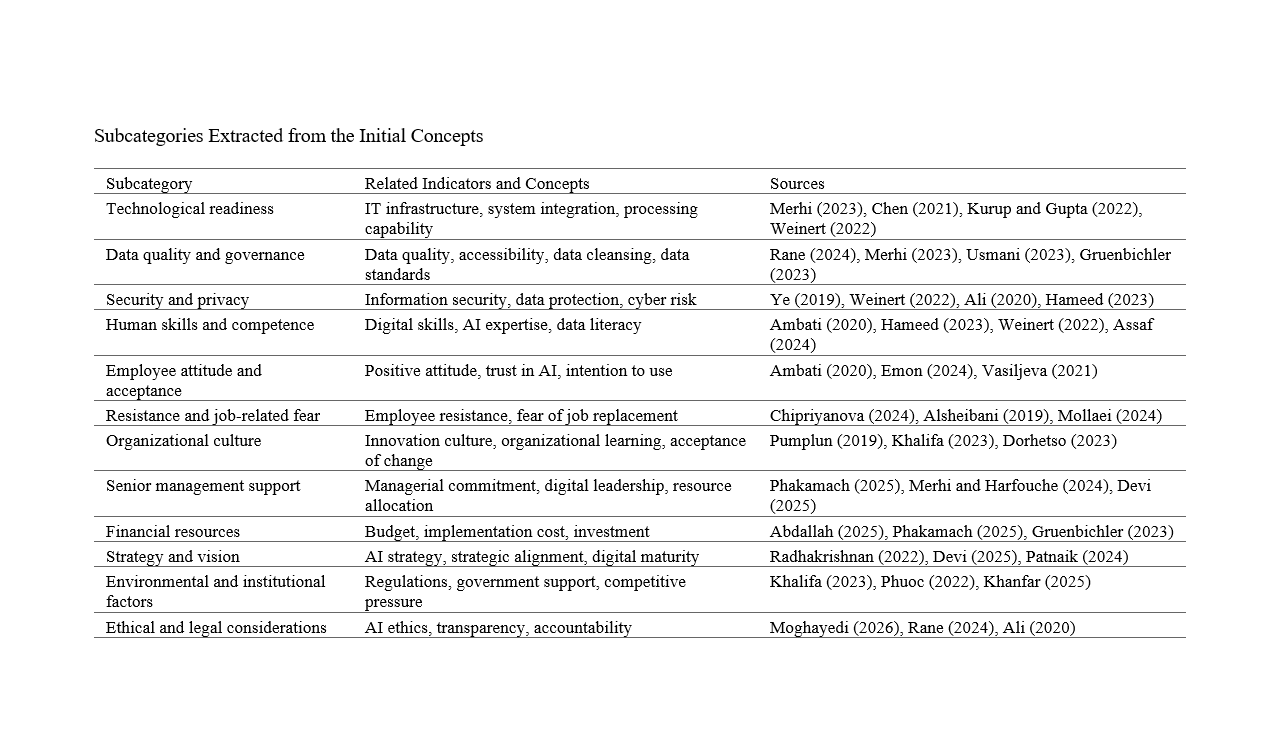
In recent years, artificial intelligence (AI), as one of the most significant transformative technologies, has attracted extensive attention from organizations, and its adoption has become an influential factor in improving efficiency, enhancing decision-making quality, innovating services, and creating competitive advantage. However, the successful implementation of AI in organizations is not limited merely to access to technology; rather, it is influenced by a set of intra-organizational and extra-organizational factors. Accordingly, the present study aimed to identify and classify the factors affecting the implementation of AI in organizations using a meta-synthesis approach. In terms of purpose, this study is applied research, and in terms of methodology, it is a qualitative study based on meta-synthesis. The research population consisted of domestic and international studies related to the subject, which were collected from valid scientific databases within a specified time frame. After conducting the stages of searching, screening, quality assessment, and eliminating irrelevant or duplicate studies, 44 articles were selected for final analysis. Subsequently, qualitative data were extracted through coding, analysis, and synthesis of concepts, and similar indicators were categorized into subcategories and main categories. The findings indicated that the factors affecting the implementation of AI in organizations can be classified into six main dimensions: technological dimension, human dimension, organizational dimension, strategic dimension, environmental dimension, and ethical-social dimension. The results demonstrate that success in AI deployment requires simultaneous attention to technical infrastructures, human skills and acceptance, managerial support, strategic alignment, environmental conditions, and ethical considerations. These findings can provide a theoretical and practical foundation for managers, policymakers, and researchers in the development and effective implementation of AI in organizations.
References
[1] M. F. Rahman, "The Impact of Artificial Intelligence Implementation on Organizational Performance Efficiency in the Digital Transformation Era," Techno-Science and Engineering Dimension Journal, vol. 1, no. 1, pp. 23-33, 2026.
[2] C. C. Iwuanyanwu, "Determinants and Impact of Artificial Intelligence on Organizational Competitiveness: A Study of Listed American Companies," Journal of Service and Science Management, 2021, doi: 10.4236/jssm.2021.145032.
[3] L. Mollaei, S. M. A. K. Firoozabadi, K. F. Hafshejani, and M. Rabiei, "Analyzing the Factors Influencing the Implementation of Artificial Intelligence in the Iranian Banking Industry: Findings from a Qualitative Study," Digital Transformation and Administration Innovation, vol. 2, no. 2, pp. 59-69, 2024, doi: 10.61838/dtai.2.2.7.
[4] A. Khanijahani, S. Iezadi, S. Dudley, M. Goettler, P. Kroetsch, and J. Wise, "Organizational, Professional, and Patient Characteristics Associated with Artificial Intelligence Adoption in Healthcare: A Systematic Review," Health Policy and Technology, vol. 11, no. 1, p. 100602, 2022, doi: 10.1016/j.hlpt.2022.100602.
[5] H. Chen, L. Li, and Y. Chen, "Explore Success Factors That Impact Artificial Intelligence Adoption on Telecom Industry in China," Journal of Management Analytics, vol. 8, no. 1, pp. 36-68, 2021, doi: 10.1080/23270012.2020.1852895.
[6] A. Usmani, M. Sharma, P. Bung, R. Kumar, F. Ahmad, and A. Gupta, "Key Variables Influencing Artificial Intelligence (AI) Implementation in Supply Chain Management (SCM): An Empirical Analysis on SMEs," Migration Letters, vol. 20, no. S11, pp. 1284-1307, 2023, doi: 10.59670/ml.v20iS11.9083.
[7] A. Infante-Moro, J. C. Infante-Moro, and J. Gallardo-Pérez, "Key Factors in the Process of Acceptance and Implementation of Artificial Intelligence in the Hotel Sector," in Handbook of Research on Applied Data Science and Artificial Intelligence in Business and Industry: IGI Global, 2021, pp. 304-322.
[8] P. Phakamach, A. Ratchavieng, S. Onsampant, and P. Santaveesuk, "Organizational Strategic Factors Affecting the Success of AI Technology Implementation for Higher Education Institution Management in Bangkok," RICE Journal of Creative Entrepreneurship and Management, vol. 6, no. 2, pp. 74-92, 2025, doi: 10.60027/jelr.2025.1831.
[9] M. H. Ronaghi, "The Influence of Artificial Intelligence Adoption on Circular Economy Practices in Manufacturing Industries," Environment, Development and Sustainability, vol. 25, no. 12, pp. 14355-14380, 2023, doi: 10.1007/s10668-022-02670-3.
[10] M. I. Merhi, "An Evaluation of the Critical Success Factors Impacting Artificial Intelligence Implementation," International Journal of Information Management, vol. 69, p. 102545, 2023, doi: 10.1016/j.ijinfomgt.2022.102545.
[11] A. A. Khanfar, R. Kiani Mavi, M. Iranmanesh, and D. Gengatharen, "Factors Influencing the Adoption of Artificial Intelligence Systems: A Systematic Literature Review," Management Decision, vol. 63, no. 10, pp. 3727-3755, 2025, doi: 10.1108/MD-05-2023-0838.
[12] P. Hamm and M. Klesel, "Success Factors for the Adoption of Artificial Intelligence in Organizations: A Literature Review," presented at the 27th Americas Conference on Information Systems, AMCIS 2021: Digital Innovation and Entrepreneurship, 2021.
[13] N. Rane, S. P. Choudhary, and J. Rane, "Acceptance of Artificial Intelligence: Key Factors, Challenges, and Implementation Strategies," Journal of Applied Artificial Intelligence, vol. 5, no. 2, pp. 50-70, 2024, doi: 10.48185/jaai.v5i2.1017.
[14] S. Kurup and V. Gupta, "Factors Influencing the AI Adoption in Organizations," Metamorphosis, vol. 21, no. 2, pp. 129-139, 2022, doi: 10.1177/09726225221124035.
[15] T. Le Tan, N. H. K. Nguyen, N. H. T. T. Vi, H. T. Nha, T. T. Thuy, and T. T. Danh, "Critical Factors Impact Artificial Intelligence Implementation in Supply Chain Management: Case Study Danang SMEs," Journal of Interdisciplinary Socio-Economic and Community Study, vol. 2, no. 1, pp. 27-33, 2022, doi: 10.21776/jiscos.02.01.04.
[16] M. I. Merhi and A. Harfouche, "Enablers of Artificial Intelligence Adoption and Implementation in Production Systems," International Journal of Production Research, vol. 62, no. 15, pp. 5457-5471, 2024, doi: 10.1080/00207543.2023.2167014.
[17] S. Badghish and Y. A. Soomro, "Artificial Intelligence Adoption by SMEs to Achieve Sustainable Business Performance: Application of Technology-Organization-Environment Framework," Sustainability, vol. 16, no. 5, p. 1864, 2024, doi: 10.3390/su16051864.
[18] H. Chen, "Success Factors Impacting Artificial Intelligence Adoption: Perspective from the Telecom Industry in China," Old Dominion University, 2019.
[19] S. A. Alsheibani, D. Y. Cheung, and D. C. Messom, "Factors Inhibiting the Adoption of Artificial Intelligence at Organizational-Level: A Preliminary Investigation," ed, 2019.
[20] L. Weinert, J. Müller, L. Svensson, and O. Heinze, "Perspective of Information Technology Decision Makers on Factors Influencing Adoption and Implementation of Artificial Intelligence Technologies in 40 German Hospitals: Descriptive Analysis," JMIR Medical Informatics, vol. 10, no. 6, p. e34678, 2022, doi: 10.2196/34678.
[21] L. S. Ambati, K. Narukonda, G. R. Bojja, and D. Bishop, "Factors Influencing the Adoption of Artificial Intelligence in Organizations from an Employee's Perspective," ed, 2020.
[22] L. Sai Ambati, K. Narukonda, G. R. Bojja, and D. Bishop, "Factors Influencing the Adoption of Artificial Intelligence in Organizations from an Employee's Perspective," ed, 2020.
[23] G. Chipriyanova, M. Chipriyanov, and K. Luchkov, "Investigation and Analysis of Attitudes Towards the Implementation of Artificial Intelligence in Internal Business Processes," presented at the Environment. Technology. Resources. Proceedings of the International Scientific and Practical Conference, 2024. [Online]. Available: https://doi.org/10.17770/etr2024vol2.8032.
[24] M. M. H. Emon, T. Khan, M. A. Rahman, and S. A. J. Siam, "Factors Influencing the Usage of Artificial Intelligence among Bangladeshi Professionals: Mediating Role of Attitude towards the Technology," presented at the 2024 IEEE International Conference on Computing, Applications and Systems (COMPAS), 2024. [Online]. Available: https://doi.org/10.1109/COMPAS60761.2024.10796110.
[25] B. Z. Hameed et al., "Breaking Barriers: Unveiling Factors Influencing the Adoption of Artificial Intelligence by Healthcare Providers," Big Data and Cognitive Computing, vol. 7, no. 2, p. 105, 2023, doi: 10.3390/bdcc7020105.
[26] T. Ye et al., "Psychosocial Factors Affecting Artificial Intelligence Adoption in Health Care in China: Cross-Sectional Study," Journal of Medical Internet Research, vol. 21, no. 10, p. e14316, 2019, doi: 10.2196/14316.
[27] T. Vasiljeva, I. Kreituss, and I. Lulle, "Artificial Intelligence: The Attitude of the Public and Representatives of Various Industries," Journal of Risk and Financial Management, vol. 14, no. 8, p. 339, 2021, doi: 10.3390/jrfm14080339.
[28] L. Pumplun, C. Tauchert, and M. Heidt, "A New Organizational Chassis for Artificial Intelligence: Exploring Organizational Readiness Factors," ed, 2019.
[29] I. Rudko, A. Bashirpour Bonab, and F. Bellini, "Organizational Structure and Artificial Intelligence: Modeling the Intraorganizational Response to the AI Contingency," Journal of Theoretical and Applied Electronic Commerce Research, vol. 16, no. 6, pp. 2341-2364, 2021, doi: 10.3390/jtaer16060129.
[30] W. Abdallah, A. Harraf, and H. Al Wael, "Factors Influencing Artificial Intelligence Implementation in the Accounting Industry: A Comparative Study among Private and Public Sectors," Journal of Financial Reporting and Accounting, vol. 23, no. 4, pp. 1509-1530, 2025, doi: 10.1108/JFRA-04-2024-0230.
[31] R. S. Devi and M. Suresh, "Factors Influencing an AI Implementation Strategy in Business," ed, 2025.
[32] S. N. Dorhetso and B. D. Quarshie, "Ratings of Driving Factors for the Adoption and Implementation of Artificial Intelligence in the Public Sector," Open Access Library Journal, vol. 10, no. 5, pp. 1-20, 2023, doi: 10.4236/oalib.1109982.
[33] R. Assaf, M. Omar, Y. Saleh, H. Attar, N. T. Alaqra, and M. Kanan, "Assessing the Acceptance for Implementing Artificial Intelligence Technologies in the Governmental Sector: An Empirical Study," Engineering, Technology & Applied Science Research, vol. 14, no. 6, pp. 18160-18170, 2024, doi: 10.48084/etasr.8711.
[34] C. Schaefer, K. Lemmer, K. Samy Kret, M. Ylinen, P. Mikalef, and B. Niehaves, "Truth or Dare? How Can We Influence the Adoption of Artificial Intelligence in Municipalities?," 2021. [Online]. Available: https://doi.org/10.24251/HICSS.2021.286.
[35] J. Radhakrishnan, S. Gupta, and S. Prashar, "Understanding Organizations' Artificial Intelligence Journey: A Qualitative Approach," Pacific Asia Journal of the Association for Information Systems, vol. 14, no. 6, p. 2, 2022, doi: 10.17705/1pais.14602.
[36] P. Patnaik and M. Bakkar, "Exploring Determinants Influencing Artificial Intelligence Adoption, Reference to Diffusion of Innovation Theory," Technology in Society, vol. 79, p. 102750, 2024, doi: 10.1016/j.techsoc.2024.102750.
[37] K. Khalifa, M. Al-Hashimi, and A. Hamdan, "The Factors Affecting the Adoption of Artificial Intelligence Technologies in Organizations," in Technological Sustainability and Business Competitive Advantage. Cham: Springer International Publishing, 2023, pp. 237-265.
[38] N. V. Phuoc, "The Critical Factors Impacting Artificial Intelligence Applications Adoption in Vietnam: A Structural Equation Modeling Analysis," Economies, vol. 10, no. 6, p. 129, 2022, doi: 10.3390/economies10060129.
[39] M. H. Ali, A. Hamdan, and B. Alareeni, "The Implementation of Artificial Intelligence in Organizations' Systems: Opportunities and Challenges," presented at the International Conference on Business and Technology, Cham, 2020. [Online]. Available: https://doi.org/10.1007/978-3-030-69221-6_12.
[40] A. Moghayedi, K. Michell, and B. O. Awuzie, "Analysis of the Drivers and Barriers Influencing Artificial Intelligence for Tackling Climate Change Challenges," Smart and Sustainable Built Environment, vol. 15, no. 3, pp. 1277-1312, 2026, doi: 10.1108/SASBE-05-2024-0148.
[41] A. Tursunbayeva and H. C. B. Gal, "Adoption of Artificial Intelligence: A TOP Framework-Based Checklist for Digital Leaders," Business Horizons, vol. 67, no. 4, pp. 357-368, 2024, doi: 10.1016/j.bushor.2024.04.006.
[42] R. Gruenbichler, "Implementation Barriers of Artificial Intelligence in Companies," presented at the Proceedings of FEB Zagreb International Odyssey Conference on Economics and Business, 2023.
[43] J. I. M. S. Ismail and M. N. Muhammad, "Artificial Intelligence Innovation Related Factors Affecting Organizational Performance," International Journal of Sustainable Construction Engineering and Technology, vol. 13, no. 2, pp. 203-212, 2022, doi: 10.30880/ijscet.2022.13.02.018.
[44] S. Asghari, S. Targholi, A. Kazemi, S. Shahriyari, and L. Rajabion, "A New Conceptual Framework for Identifying the Factors Influencing the Effectiveness of Competitive Intelligence," Competitiveness Review: An International Business Journal, vol. 30, no. 5, pp. 555-576, 2020, doi: 10.1108/CR-05-2019-0054.
Downloads
Publication Timeline
- Submitted
- Revised
- Accepted
Issue
Section
License
Copyright (c) 2025 Faezeh Mohammadzaheri (Author)

This work is licensed under a Creative Commons Attribution-NonCommercial 4.0 International License.