Multi-Level Governance and Science and Technology Policy in Steering Digital Transformation in Higher Education A Qualitative Study
Abstract
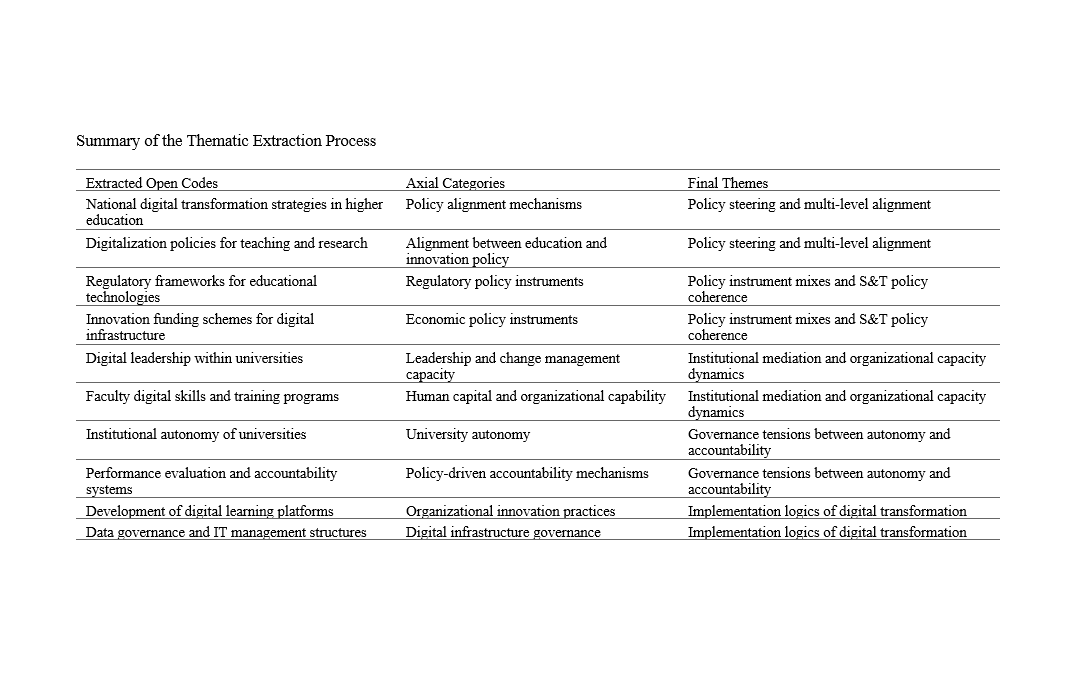
Digital transformation in higher education is often perceived as a technological change; however, in practice it represents a multidimensional and governance‑driven process that emerges through the interaction of public policies, institutional arrangements, and the organizational capacities of universities. The purpose of this study is to explain the role of multi‑level governance and science and technology policy in guiding and shaping digital transformation in higher education. This study adopted a qualitative approach using an interpretive meta‑synthesis method. Research data were collected through the analysis of relevant scholarly documents and examined using thematic analysis. The analytical process included familiarization with the data, open coding, axial coding, and selective coding, which ultimately led to the identification of major conceptual categories and themes. To enhance the trustworthiness of the study, the criteria of credibility, transferability, dependability, and confirmability were applied. The findings indicate that digital transformation in higher education is influenced by a set of governance and institutional factors that can be explained through five main themes: policy steering and multi‑level alignment; coherent policy instrument mixes and alignment of science and technology policies; institutional mediation and organizational capacity of universities; tensions between institutional autonomy and accountability mechanisms; and iterative and adaptive implementation logics. The results show that universities are not merely passive recipients of macro‑level policies; rather, they act as active mediators that interpret and implement policies within their institutional contexts. Accordingly, the success of digital transformation in higher education requires coordination across different levels of governance, coherence in policy instruments, strengthening institutional capacity within universities, and maintaining a balance between autonomy and accountability. By providing a governance‑oriented explanation of digital transformation, this study contributes to a more comprehensive theoretical understanding of this phenomenon in higher education.
References
[1] N. Aedi, B. A. Luxfiati, N. Amaliyah, and L. B. Wei, "Digital Leadership and System-Level Transformation in Indonesian Higher Education: A Mixed-Methods Study of Institutional Change and Governance," ed, 2026.
[2] H. Al-Dmour, R. Al-Dmour, Y. Al-Dmour, and A. Al-Dmour, "Redefining Job Satisfaction in the Digital Era: Herzberg's Two-Factor Theory and the Mediating Role of Digital Transformation in Higher Education," Education and Information Technologies, pp. 1-28, 2026, doi: 10.1007/s10639-025-13884-z.
[3] R. Kalra, K. Vazirani, R. Anuradha, and P. V. Ahuja, "Navigating Digital Transformation in HEIs: The Role of Leadership and Key Drivers Using DEMATEL," in Digital Leadership: Productivity Press, 2026, pp. 80-100.
[4] W. Lei, M. H. Alharbi, Z. Yu, M. M. Ariffin, and M. Shutaywi, "Governing Laboratory Education in the Post-Pandemic Era: A Multi-Level Governance Framework," European Journal of Education, vol. 61, no. 1, p. e70430, 2026, doi: 10.1111/ejed.70430.
[5] H. L. Nguyen and Y. Hong, "National Policy Analysis of Digital Transformation in Vietnamese Higher Education: Conceptualising a Three-Layer Model for Implementation," Policy Futures in Education, vol. 24, no. 1, pp. 35-58, 2026, doi: 10.1177/14782103251348089.
[6] I. O. Ukeje et al., "From Policies to Strategic Actions: Digitally Transforming Higher Education in Nigeria Through a Stakeholder-Driven Co-Governance Model," Innovative Higher Education, vol. 51, no. 1, pp. 121-151, 2026, doi: 10.1007/s10755-025-09861-6.
[7] J. Li and J. Zhang, "Digital Transformation Policy Combination and Government Governance Performance Improvement: Evidence from China," International Journal of Public Administration, vol. 49, no. 7, pp. 472-490, 2026, doi: 10.1080/01900692.2025.2499693.
[8] S. Rajabi Bazl, A. Khorasani, H. Yazdani, and F. Alami, "Designing a Policy Framework for Digital Transformation in Higher Education: A Meta-Ethnographic Synthesis of Public Policy Models," Iranian Journal of Public Policy, vol. 12, no. 1, pp. 209-224, 2026.
[9] D. Padma and N. Sumathi, "Digital Micro-Credentials and Generative AI in Higher Education: Global Policy, Pedagogical Innovation, and Quality Assurance Frameworks," Academic Research Journal of Science and Technology, vol. 5, no. 01, pp. 14-25, 2026.
[10] J. Yang and M. Valcke, "Flipped Classroom Design as a Driver of Digital Transformation and Sustainable Education in Higher Education: A Systematic Review of Reviews," Sustainability, vol. 18, no. 7, p. 3582, 2026, doi: 10.3390/su18073582.
[11] B. N. Pasi and P. Dhamak, "Review of Industry 4.0 and Higher Education: A Paradigm Shift Toward Digital Transformation," Asian Education and Development Studies, pp. 1-36, 2025, doi: 10.1108/AEDS-01-2025-0018.
[12] M. A. Al-Qawasmi, "The Role of Agile Administrative Leadership in Enhancing the Effectiveness of Digital Transformation in Palestinian Higher Education Institutions," Arado Business Journal, pp. 71-96, 2026, doi: 10.64190/abj.1.1.2026.2.
[13] J. R. Batmetan, "Sustainable Digital Transformation in Indonesian Higher Education: The Role of Service Planning and Architecture Strategy Within an Agile IT Governance Approach," Tadbir: Jurnal Studi Manajemen Pendidikan, vol. 10, no. 1, pp. 29-66, 2026, doi: 10.29240/jsmp.v10i1.16289.
[14] N. J. Kamel and S. Abdelrahman Ali, "The Impact of Organizational Change on Supporting Digital Transformation in Egyptian Tourism and Hotel Faculties and Institutes: The Mediating Role of Organizational Culture," Journal of Association of Arab Universities for Tourism and Hospitality, vol. 30, no. 1, pp. 47-63, 2026, doi: 10.21608/jaauth.2026.448680.1736.
[15] S. Karimi, "Digital Transformation in the Higher Education: Challenges and Opportunities for Faculty Unions," International Journal of Higher Education, vol. 15, no. 3, 2026, doi: 10.5430/ijhe.v15n3p28.
[16] L. L. Klein, F. Naranjo, and D. P. Ribeiro, "Analyzing Drivers, Barriers and Lean Outcomes of Digital Transformation in Public Higher Education Institutions," International Journal of Productivity and Performance Management, pp. 1-23, 2026, doi: 10.1108/IJPPM-07-2025-0671.
[17] C. Vaz, S. Joaquim, B. Rute, P. Emanuel, and R. M. Jcs, "From Resistance to Resilience: Organizational Learning and Digital Transformation in Higher Education Under Crisis," Education Sciences, vol. 16, no. 5, p. 735, 2026, doi: 10.3390/educsci16050735.
[18] A. A. M. Al-Momani et al., "Educational Administration in the Digital Era: Governance and Policy Challenges in Higher Education Institutions," EDPACS, pp. 1-19, 2026, doi: 10.1080/07366981.2026.2645145.
[19] R. Eissa, "Exploring Artificial Intelligence Governance in Higher Education: Policy Design, Implementation and Adaptability in Egypt," ed, 2026.
[20] P. Jha, E. J. A. Palau, and S. Bag, "Governance and Innovation Through Generative AI: A Systematic Literature Review of Policy-Driven Practices in Higher Education Supply Chains," Advances in Consumer Research, vol. 3, no. 1, 2026.
[21] O. Gran, "Data Governance, Student Rights, and Inclusive Digital Universities: A Comparative Legal-Institutional Analysis of Higher Education Reform in France and South Korea," Allogio: Journal of Law, Education and Economic Development, vol. 1, no. 1, 2026.
[22] H. C. Nwaigwe et al., "Digital Transformation and Public Value Creation in Higher Education: A PRISMA-ScR Review and Evidence-Synthesized Framework of Digital Competencies, Institutional Readiness, and Governance Pathways," Sustainability, 2026, doi: 10.3390/su18105125.
[23] J. Castro-Gomez, N. Marulanda-Grisales, C. Zapata-Molina, and J. A. Sanchez-Torres, "University Governance and Institutional Management for Sustainability: Teachers' Perspectives on Policy Implementation in Higher Education," Frontiers in Education, vol. 11, p. 1731067, 2026, doi: 10.3389/feduc.2026.1731067.
[24] F. Aposika, "Digital Transformation in Higher Education in Ghana with Focus on ICT Access Utilization and Policy Challenges," Discover Education, 2026, doi: 10.1007/s44217-026-01306-2.
[25] S. Rindawati, D. G. Saputra, and S. Supriadi, "Education Policy Recommendations in Addressing Digital Transformation and Access Inequality in Indonesia: A Public Administration Perspective," IJOSPOL-International Journal of Social, Policy and Law, vol. 7, no. 3, pp. 213-217, 2026.
[26] B. Eisinger Balassa and L. Buics, "Sustainable Digital Transformation in Public Administration: A Framework for University Enrollment," Journal of Sustainable Development of Energy, Water and Environment Systems, vol. 14, no. 1, pp. 1-22, 2026, doi: 10.13044/j.sdewes.d13.0639.
[27] D. E. Saputra, "Digital Transformation in Higher Education Management: Analysis of Readiness and Implementation," Zabags International Journal of Education, vol. 4, no. 1, pp. 34-45, 2026, doi: 10.61233/zijed.v4i1.36.
[28] H. N. D. Saputra and W. Wasilah, "Evaluation of Information Technology Governance Maturity Level Using COBIT 2019 in the Academic Information System at Nahdlatul Ulama University of Lampung," Sistemasi: Jurnal Sistem Informasi, vol. 15, no. 2, pp. 455-462, 2026, doi: 10.32520/stmsi.v15i2.5817.
[29] A. Mujahidin, Z. Zuhad, and B. Irawanto, "Digital Transformation Model for Higher Education Governance: An Integration of Business Processes, Human Resources, and Technology," Priviet Social Sciences Journal, vol. 6, no. 4, pp. 151-163, 2026, doi: 10.55942/pssj.v6i4.1129.
[30] J. H. Westover, "The AI Implementation Gap in Higher Education: Navigating the Disconnect Between Technology Adoption, Policy Awareness, and Institutional Governance," ed, 2026.
[31] I. L. Nnaji et al., "Enhancing Governance and Performance in Nigerian Higher Education Through AI-Driven Digital Transformation: Insights from Stakeholder Perspectives," Social Sciences & Humanities Open, vol. 13, p. 102348, 2026, doi: 10.1016/j.ssaho.2025.102348.
Downloads
Publication Timeline
- Submitted
- Revised
- Accepted
Issue
Section
License
Copyright (c) 2025 Sajad Ghorbani (Corresponding author); Mohammad Mojtabazadeh, Mahdi Mobini, Hossein Rasouli (Author)

This work is licensed under a Creative Commons Attribution-NonCommercial 4.0 International License.