Investigating Integrated Risk Management and Safety Culture Strategies for Enhancing Occupational Health at Construction Sites
Keywords:
Integrated Risk Management, Safety Culture, Occupational Health, Construction SitesAbstract
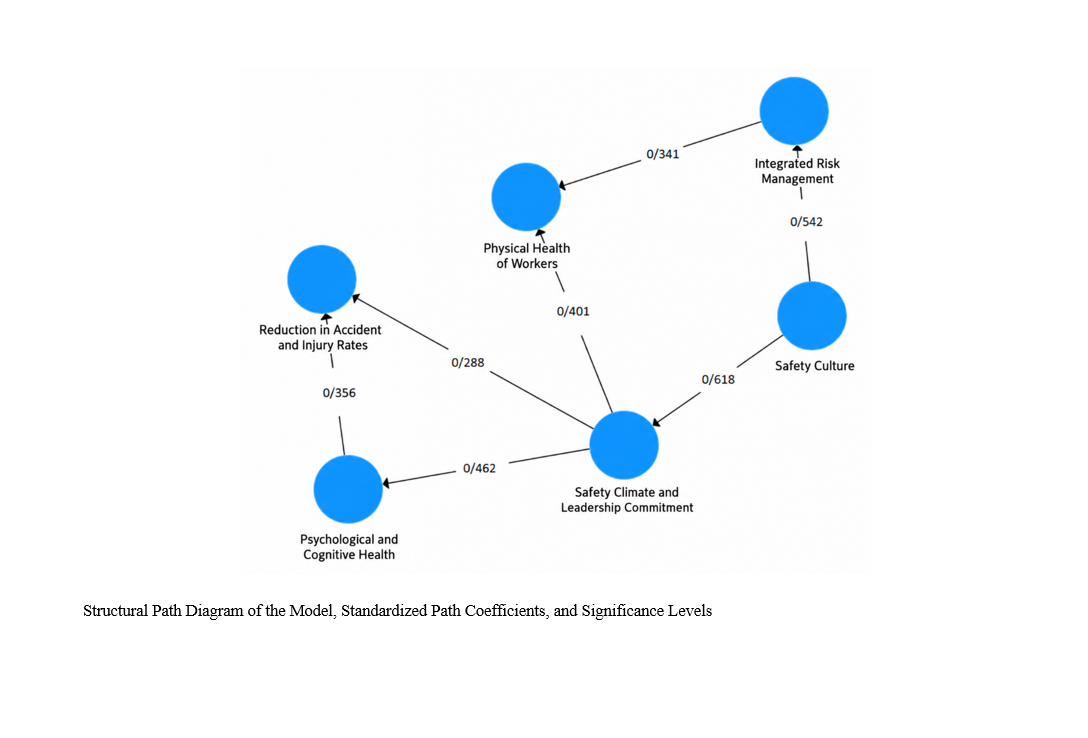
The construction industry has consistently been exposed to occupational hazards and work-related accidents due to its dynamic working environments and operational complexities. The present study aimed to investigate integrated risk management and safety culture strategies for enhancing occupational health at construction sites. This quantitative study employed a descriptive-correlational design and involved 382 project managers, engineers, and workers engaged in high-rise construction projects. Data were collected using standardized questionnaires assessing safety, general health, and ergonomics and were analyzed through structural equation modeling (SEM). The findings indicated that safety culture and leadership commitment are critical drivers of the effectiveness of risk management systems. The results demonstrated that integrated risk management, in the absence of a supportive cultural foundation, becomes ineffective due to its reactive and bureaucratic nature. Conversely, safety culture dimensions exerted significant direct effects on improvements in employees' physical and psychological health, with leadership commitment and safety climate playing mediating roles, while effectively reducing accident frequency rates. Within this framework, employees' psychological and cognitive health emerged as a key determinant of reducing human errors and preventing physical injuries. Finally, considering the structural, economic, and contractual barriers prevailing in the construction industry, policy recommendations were proposed regarding revisions to general contractual conditions, the allocation of dedicated and non-discretionary safety budgets, and the transition toward preventive approaches supported by emerging technologies. This study demonstrated that occupational health in construction environments is not merely a technical concern but rather the outcome of synergistic interactions between risk management and organizational culture, the realization of which requires a paradigm shift in overarching project management systems.
References
[1] I. Project Management, A Guide to the Project Management Body of Knowledge (PMBOK Guide). Project Management Institute (in English), 2021.
[2] A. Kazemzadeh and M. Enoch Yildiz, "An analytical-statistical study of occupational accidents at construction sites during the 2010s," (in Persian), Science and Engineering Elites, vol. 7, no. 5, pp. 54-62, 2022.
[3] A. Soltanzadeh and I. Mohammadfam, "Cause-consequence modeling of occupational accidents at construction sites: A retrospective study in Iran," (in Persian), Journal of Occupational Hygiene and Safety, vol. 12, no. 3, pp. 446-458, 2022.
[4] M. Balaji Kangarloo, M. Naebi Taheri, A. Dehdeshti, F. Fatemi, and A. Besharatzadeh, "Risk assessment of occupational safety and health hazards using job safety analysis: A case study of the steel industry," (in Persian), Preventive Medicine, vol. 8, no. 4, pp. 25-35, 2021.
[5] A. Khamooshi and M. Kiani, "A review of scheduling optimization techniques in construction projects," (in English), Journal of Civil Engineering and Management, vol. 27, no. 2, pp. 135-147, 2021.
[6] B. A. Almahameed and M. Bisharah, "Applying Machine Learning and Particle Swarm Optimization for Predictive Modeling and Cost Optimization in Construction Project Management," (in English), Asian Journal of Civil Engineering, vol. 25, pp. 1281-1294, 2024, doi: 10.1007/s42107-023-00843-7.
[7] M. Alzara, Y. A. Attia, S. Y. Mahfouz, A. M. Yosri, and A. Ehab, "Building a Genetic Algorithm-Based and BIM-Based 5D Time and Cost Optimization Model," (in English), IEEE Access, vol. 11, pp. 122502-122515, 2023, doi: 10.1109/ACCESS.2023.3317137.
[8] Z. Ye, M. F. Antwi-Afari, A. Tezel, and P. Manu, "Building Information Modeling (BIM) in Project Management: A Bibliometric and Science Mapping Review," (in English), Engineering, Construction and Architectural Management, vol. 32, pp. 3078-3103, 2024, doi: 10.1108/ECAM-04-2023-0355.
[9] A. Zabin, V. A. González, Y. Zou, and R. Amor, "Applications of machine learning to BIM: A systematic literature review," (in English), Advanced Engineering Informatics, vol. 51, p. 101474, 2022, doi: 10.1016/j.aei.2021.101474.
[10] A. Khosravi and A. Alavi, "Barriers to the adoption of new technologies in construction: A systematic review," (in English), Automation in Construction, vol. 124, p. 103588, 2021.
[11] D. Zohar, "Safety climate in industrial organizations: Theoretical and practical implications," (in English), Journal of Safety Research, vol. 73, pp. 1-10, 2020.
[12] S. Rezaei Ashtiani and J. Mahdinejad, "Training to improve worker safety and reduce occupational accidents at construction sites," (in Persian), Safety Promotion and Injury Prevention, vol. 7, no. 4, pp. 192-198, 2019.
[13] M. Mohammadian, F. Fatemi, M. Sadeghi, and M. Khazaei, "Ergonomic assessment of risk factors for musculoskeletal disorders among construction workers using WERA and the Cornell questionnaire," (in Persian), Toloo-e-Behdasht, vol. 18, no. 6, pp. 12-21, 2019.
[14] I. Mehmood et al., "Deep Learning-Based Construction Equipment Operators' Mental Fatigue Classification Using Wearable EEG Sensor Data," (in English), Advanced Engineering Informatics, vol. 56, p. 101978, 2023.
[15] R. Kanan, O. Elhassan, and R. Bensalem, "An IoT-Based Autonomous System for Workers' Safety in Construction Sites with Real-Time Alarming, Monitoring, and Positioning Strategies," (in English), Automation in Construction, vol. 88, pp. 73-86, 2018, doi: 10.1016/j.autcon.2017.12.033.
[16] Y. Huang, M. F. Antwi-Afari, B. Sun, and J. Liu, "Critical Success Factors for Implementing Self-Powered Wearable Internet of Things Sensors in Construction: A Systematic Literature Review and Conceptual Framework," (in English), Applied Energy, vol. 401, p. 126836, 2025, doi: 10.1016/j.apenergy.2025.126836.
[17] W. Fang, P. E. D. Love, L. Ding, S. Xu, T. Kong, and H. Li, "Computer Vision and Deep Learning to Manage Safety," (in English), Engineering Management, vol. 70, pp. 4120-4132, 2023, doi: 10.1109/TEM.2021.3093166.
[18] Q. Lin and X. Yang, "KSG-YOLO: Application of YOLO-Based Detection With Knowledge Distillation and Structured Pruning in Green Assembly Building Scenarios," (in English), IEEE Access, vol. 13, pp. 193462-193473, 2025, doi: 10.1109/ACCESS.2025.3632200.
[19] X. Luo, X. Li, X. Song, and Q. Liu, "Convolutional Neural Network Algorithm-Based Novel Automatic Text Classification Framework for Construction Accident Reports," (in English), Journal of Construction Engineering and Management, vol. 149, p. 04023128, 2023, doi: 10.1061/JCEMD4.COENG-13523.
[20] A. Deria, P. Ghannad, and Y. C. Lee, "Dynamic Real-Time Optimization of Modular Unit Allocation to Off-Site Facilities in Postdisaster Reconstruction Using Deep Reinforcement Learning," (in English), Journal of Management in Engineering, vol. 40, p. 04024021, 2024.
Downloads
Publication Timeline
- Submitted
- Revised
- Accepted
Issue
Section
License
Copyright (c) 2025 Hadi Bodaghi (Author); Mehdi Mirza Goltabar Roshan (Corresponding author); Mohammad Ali Sayari Nejad (Author)

This work is licensed under a Creative Commons Attribution-NonCommercial 4.0 International License.