Designing an Intelligent Decision-Support Model to Enhance Strategic Decision-Making in Organizations Using Business Intelligence and Machine Learning: A Case Study of the Iranian Retail Industry
Keywords:
Business Intelligence, Machine Learning, Strategic Decision, Making, Intelligent Decision, Support System, Predictive Analytics, Organizational Intelligence, Retail IndustryAbstract
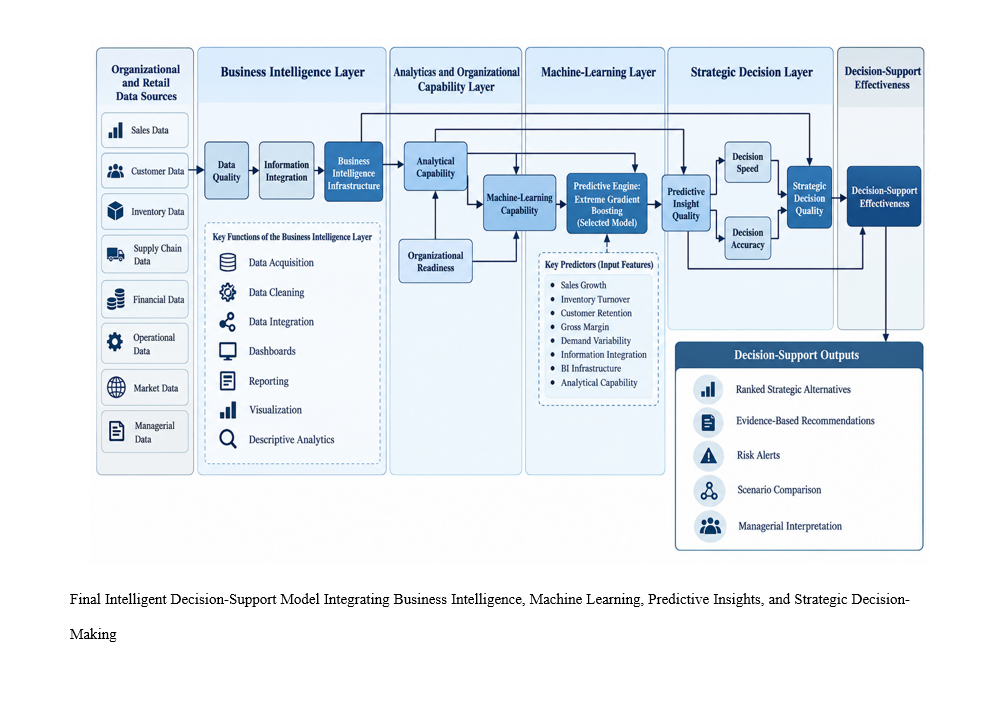
This study aimed to design and validate an intelligent decision-support model for enhancing strategic decision-making through the integrated use of business intelligence and machine learning in the Iranian retail industry. This applied, quantitative, cross-sectional study was conducted among 327 senior and middle managers, strategic planning specialists, business intelligence experts, information technology managers, data analysts, and other decision-related professionals working in retail organizations in Tehran, Iran. Data were collected using a researcher-developed questionnaire assessing data quality, information integration, business intelligence infrastructure, analytical capability, organizational readiness, machine-learning capability, predictive insight quality, decision speed, decision accuracy, strategic decision quality, and decision-support effectiveness, together with selected organizational and retail performance indicators. The measurement and structural models were analyzed using SPSS 29 and SmartPLS 4. Machine-learning models, including random forest, extreme gradient boosting, support vector machine, and multilayer perceptron neural network, were developed and evaluated in Python using training, validation, and test subsets. Information integration (β = .41, p < .001) and data quality (β = .29, p < .001) significantly predicted business intelligence infrastructure. Business intelligence infrastructure significantly predicted analytical capability (β = .46, p < .001), while analytical capability (β = .43, p < .001) and organizational readiness (β = .31, p < .001) predicted machine-learning capability. Machine-learning capability strongly predicted predictive insight quality (β = .48, p < .001), which subsequently predicted decision speed (β = .44, p < .001), decision accuracy (β = .51, p < .001), and strategic decision quality (β = .36, p < .001). Decision accuracy was a stronger predictor of strategic decision quality (β = .39, p < .001) than decision speed (β = .17, p < .001). The model explained 74.3% of the variance in strategic decision quality and 76.1% of the variance in decision-support effectiveness. Extreme gradient boosting achieved the best predictive performance with test R² = .87 and AUC = .94. The findings demonstrate that the integration of reliable business intelligence infrastructure with organizational readiness, analytical capability, and machine learning can substantially improve the quality, speed, accuracy, and overall effectiveness of strategic decision-making in retail organizations.
References
[1] M. M. Bodrick, H. M. Alqarni, M. I. Alsuhaim, and Y. S. Almuways, "Critical Appraisal of Definitions on Intelligence Within the Organizational Context," Journal of Learning and Development Studies, vol. 4, no. 2, pp. 12-20, 2024, doi: 10.32996/jlds.2024.4.2.2.
[2] C. Brătianu and R.-M. Stăneiu, "The Emergence of Neuroleadership in the Knowledge Economy," Encyclopedia, vol. 4, no. 3, pp. 1100-1116, 2024, doi: 10.3390/encyclopedia4030071.
[3] I. Hesselbarth, A. Alnoor, and V. Tiberius, "Behavioral Strategy: A Systematic Literature Review and Research Framework," Management Decision, vol. 61, no. 9, pp. 2740-2756, 2023, doi: 10.1108/md-09-2021-1274.
[4] V. Violant and E. D. d. Silva, "Emotions and Decision-Making in Boardrooms—a Systematic Review From Behavioral Strategy Perspective," Frontiers in Psychology, vol. 15, 2024, doi: 10.3389/fpsyg.2024.1473175.
[5] M. O. Obonyo and J. M. Kilika, "Competitive Intelligence and Corresponding Outcome in a Strategic Management Process: A Review of Literature," Journal of Economics and Business, vol. 3, no. 4, 2020, doi: 10.31014/aior.1992.03.04.313.
[6] F. Alfazzi, "A Knowledge Behavioral and Intelligence Management in Fostering Entrepreneurship for Modern Industries," International Journal for Applied Information Management, vol. 2, no. 4, pp. 95-105, 2022, doi: 10.47738/ijaim.v2i4.42.
[7] V. Biagi, "Data Model Design to Support Data-Driven IT Governance Implementation," Technologies, vol. 10, no. 5, p. 106, 2022, doi: 10.3390/technologies10050106.
[8] T. J. Andersen and P. C. Young, "Enhancing Public Sector Enterprise Risk Management Through Interactive Information Processing," Frontiers in Research Metrics and Analytics, vol. 8, 2023, doi: 10.3389/frma.2023.1239447.
[9] D.-J. v. Veen, R. S. Kudesia, and H. R. Heinimann, "An Agent-Based Model of Collective Decision-Making: How Information Sharing Strategies Scale With Information Overload," Ieee Transactions on Computational Social Systems, vol. 7, no. 3, pp. 751-767, 2020, doi: 10.1109/tcss.2020.2986161.
[10] F. Kitsios and M. I. Kamariotou, "Artificial Intelligence and Business Strategy Towards Digital Transformation: A Research Agenda," Sustainability, vol. 13, no. 4, p. 2025, 2021, doi: 10.3390/su13042025.
[11] N. Kumar and A. Shrivastava, "The Artificial Intelligence (AI) Revolution: Evolving Business Decision-Making in the Digital Age," Business Information Review, vol. 42, no. 3, pp. 183-196, 2025, doi: 10.1177/02663821251364069.
[12] I. C. L. Feio and V. Santos, "A Strategic Model and Framework for Intelligent Process Automation," pp. 1-6, 2022, doi: 10.23919/cisti54924.2022.9820099.
[13] C. Engel, P. Ebel, and J. M. Leimeister, "Cognitive Automation," Electronic Markets, vol. 32, no. 1, pp. 339-350, 2022, doi: 10.1007/s12525-021-00519-7.
[14] A. Fernández‐Miguel, S. Ortíz-Marcos, M. Jiménez, H. Alfonso Pedro Fernández del, F. E. García‐Muiña, and D. Settembre‐Blundo, "Toward the Theoretical Foundations of Industry 6.0: A Framework for AI-Driven Decentralized Manufacturing Control," Future Internet, vol. 17, no. 10, p. 455, 2025, doi: 10.3390/fi17100455.
[15] X. Zhang, T. Liu, H. Yang, Z. Hao, and L. Wang, "Principles of Autonomous Transportation System From the Perspective of Embodied Intelligence," Iop Conference Series Materials Science and Engineering, vol. 1343, no. 1, p. 012002, 2026, doi: 10.1088/1757-899x/1343/1/012002.
[16] X. Zhou, "Constructing Embodied Intelligent Spaces From an Architectural Perspective: Technical Frameworks, Integration Mechanisms, and Implementation Pathways," Buildings, vol. 16, no. 19, p. 3906, 2026, doi: 10.3390/buildings16193906.
[17] Z. Li, Q. Li, X. Li, Z. Wang, and X. Wu, "Dual-Brain Fusion: Bidirectional Empowerment Between Human Brain and Brain-Inspired Systems," Fundamental Research, vol. 6, no. 5, pp. 3529-3543, 2026, doi: 10.1016/j.fmre.2026.03.020.
[18] A. M. A. Nezhad, P. J. Amirkhizi, S. Pedrammehr, Z. H. Aghdam, and M. Soleimanzadeh, "Design Management in Industry 5.0: Synergy of AI, Humans, and Machines," Administrative Sciences, vol. 16, no. 7, p. 333, 2026, doi: 10.3390/admsci16070333.
[19] Á. Réa-Neto, "Clinical Reasoning, Pathophysiology, and Artificial Intelligence in Critical Care: A Conceptual Framework for Integrating Decision-Making," Journal of Clinical Medicine, vol. 15, no. 20, p. 7987, 2026, doi: 10.3390/jcm15207987.
[20] B. G. Awata, "AI-Augmented Nursing Care: Integrating Human Judgment, Mental Health, and Intelligent Technologies in Contemporary Clinical Practice," 2026, doi: 10.21203/rs.3.rs-10424558/v1.
[21] y. p. Huo, l. yu, and y. ji, "Cognitive Biases in Intelligence Analysis: Amplification Mechanisms and Intervention Strategies in the Digital-Intelligent Era," 2026, doi: 10.21203/rs.3.rs-8698493/v1.
[22] L. Theodorakopoulos, A. Theodoropoulou, and C. Halkiopoulos, "Cognitive Bias Mitigation in Executive Decision-Making: A Data-Driven Approach Integrating Big Data Analytics, AI, and Explainable Systems," Electronics, vol. 14, no. 19, p. 3930, 2025, doi: 10.3390/electronics14193930.
[23] D. J. Kritz, "Coming Together: Strengthening the Intelligence Community Through Cognitive Diversity," Security and Intelligence, vol. 7, no. 1, 2022, doi: 10.18278/gsis.7.1.3.
[24] R. Andrade, W. Fuertes, M. Cazares, I. Ortiz-Garcés, and G. Navas, "An Exploratory Study of Cognitive Sciences Applied to Cybersecurity," Electronics, vol. 11, no. 11, p. 1692, 2022, doi: 10.3390/electronics11111692.
[25] E. Ö. Alakaş and M. Polat, "Exploring the Nexus of Neuroscience and Management: A Bibliometric Analysis of Emerging Trends in Neuro‐Management, Neuro‐Leadership, and Neuro‐Strategy," Global Business and Organizational Excellence, vol. 45, no. 3, pp. 319-340, 2025, doi: 10.1002/joe.70023.
[26] A. Asriati, "Psychological Insights Into Human Resource Management Strategy: A Qualitative Exploration and Review of Literature," Golden Ratio of Human Resource Management, vol. 5, no. 1, pp. 198-212, 2025, doi: 10.52970/grhrm.v5i1.503.
[27] A. Kuzior and M. Sira, "Sustainable Digital Economy Transformation Through Intelligent Automation: A Multi-Environmental Framework for Strategic Decision-Making," Sustainability, vol. 17, no. 17, p. 7723, 2025, doi: 10.3390/su17177723.
[28] L. Espina-Romero, D. E. R. Parra, J. G. N. Sánchez, J. I. Olmedo, E. Diaz, and Y. J. Nieto, "Bridging the Microfoundations of Organizational Intelligence for Sustainability: A Systematic Review of Digital Transformation, Artificial Intelligence, and Capability-Based Mechanisms," Sustainability, vol. 18, no. 12, p. 6020, 2026, doi: 10.3390/su18126020.
[29] M. Sharma, S. Luthra, and A. K. V, "Implementing Challenges of Artificial Intelligence: Evidence From Public Manufacturing Sector of an Emerging Economy," Government Information Quarterly, vol. 39, no. 4, p. 101624, 2022, doi: 10.1016/j.giq.2021.101624.
[30] H. A. Mustafa, K. M. Ebabekir, and G. A. Ismael, "Attitudes of Bank Managers Towards the Effect of Cultural Intelligence on Organizational Climate and the Process of Strategy Activation: With Special Reference to Commercial Banks in Erbil, Kurdistan Region," World Journal of Business and Management, vol. 6, no. 2, p. 15, 2020, doi: 10.5296/wjbm.v6i2.17371.
[31] Y. Zhou, Y. X. Zhou, L. Zhang, X. Zhao, and W. Chen, "Effects of Top Management Team Characteristics on Patent Strategic Change and Firm Performance," Frontiers in Psychology, vol. 12, 2022, doi: 10.3389/fpsyg.2021.762499.
[32] S. A. Elandaloussi and P. Zaraté, "Strategic Support Systems for Crisis Management: A Literature Review," Foundations and Trends® in Information Systems, vol. 8, no. 1, pp. 1-65, 2024, doi: 10.1561/2900000025.
[33] L. Sikora, N. K. Lysa, Y. Tsikalo, and O. Y. Fedevych, "System-Information and Cognitive Technologies of Man-Made Infrastructure Cyber Security," Journal of Cyber Security and Mobility, 2023, doi: 10.13052/jcsm2245-1439.123.7.
[34] X. Baraza and J. Torrent‐Sellens, "Artificial Intelligence and Emerging Risks in Occupational Safety and Health," Encyclopedia, vol. 6, no. 1, p. 25, 2026, doi: 10.3390/encyclopedia6010025.
[35] A. Ünal and İ. KilinÇ, "The Feasibility of Artificial Intelligence Performing as CEO: The Vizier-Shah Theory," Foresight, vol. 23, no. 6, pp. 698-723, 2021, doi: 10.1108/fs-02-2021-0048.
[36] A. Choori and S. Kazemi, "Strategic Management in the Digital Age: A Review of Decision-Making Frameworks," Ijimob, vol. 3, no. 2, pp. 21-32, 2023, doi: 10.61838/kman.ijimob.3.2.4.
Downloads
Publication Timeline
- Submitted
- Revised
- Accepted
Issue
Section
License
Copyright (c) 2025 Esmaeil Khoobi (Author); Mohammadreza Sanaei (Corresponding author); Reza Ehtesham Rasi (Author)

This work is licensed under a Creative Commons Attribution-NonCommercial 4.0 International License.