The Role of Social Capital in Promoting Administrative Health and Transparency in Iranian Governmental Organizations: A Case Study of the General Directorate of Education of Tehran City
Keywords:
Social Capital, Administrative Health, financial transparency, Organizational Health, Education SystemAbstract
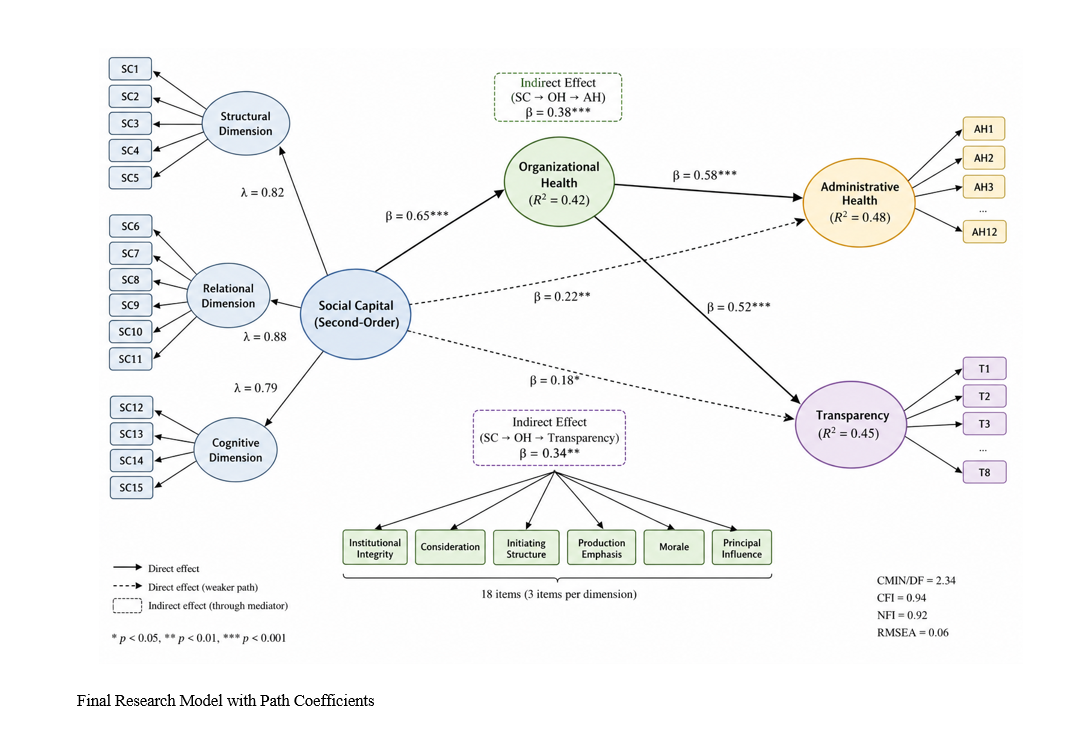
The present study aimed to investigate the role of social capital in promoting administrative health and transparency, considering the mediating role of organizational health in the General Directorate of Education of Tehran City. In terms of purpose, this research was applied, and regarding the method of data collection, it was a descriptive-survey study of a correlational nature. The statistical population consisted of all employees and managers of the General Directorate in 2025, from whom 400 participants were selected through stratified random sampling. The research instrument was a standardized questionnaire comprising the dimensions of social capital (structural, relational, and cognitive), organizational health, administrative health, and transparency, whose validity and reliability were confirmed. Data were analyzed using Structural Equation Modeling (SEM) and SmartPLS software. The findings indicated that all research hypotheses were supported. Social capital had a strong and positive effect on organizational health (β = 0.65). Furthermore, organizational health exerted a significant direct effect on administrative health (β = 0.58) and transparency (β = 0.52). The results of the mediation analysis using the bootstrap method revealed that organizational health functioned as a full mediating variable, such that a substantial portion of the effect of social capital on administrative health (indirect effect = 0.38) and transparency (indirect effect = 0.34) was transmitted through this pathway. The direct effects of social capital on these two variables were weaker but remained statistically significant. Among the dimensions of social capital, the relational dimension (trust and norms) emerged as the strongest predictor of organizational health. Therefore, it can be argued that a fundamental strategy for enhancing administrative health and transparency in governmental organizations is the deliberate strengthening of social capital, particularly through trust-building and the development of collaborative networks. By improving overall organizational health, such investment provides the necessary foundation for the spontaneous and sustainable emergence of healthy and transparent administrative behaviors. The findings of this study underscore the necessity of shifting from purely control-oriented approaches toward a paradigm of capacity-building and internal trust in Iran’s public administration.
References
[1] M. Tanjung and Y. Shimada, "Modelling the Impact of Governance and Economic Growth: Insights From ASEAN and Developed Countries," Journal of Public Affairs, vol. 25, no. 2, 2025, doi: 10.1002/pa.70048.
[2] Z. Chen and M. Hu, "Does National Auditing Improve Local Fiscal Transparency? Evidence From China," International Studies of Economics, vol. 20, no. 2, pp. 153-161, 2025, doi: 10.1002/ise3.70007.
[3] H. K. Chavula, "Public Finance Management and Economic Growth: The Case of Public Procurement Systems and Practices in Africa," Public Finance and Management, vol. 24, no. 3-4, pp. 130-147, 2025, doi: 10.1177/15239721251357511.
[4] S. Ashraf, F. Jamshaid, and R. Batool, "Public Financial Management and Growth Interaction: Evidence From the Two-Stage Least Square Approach," International Journal of Business and Economic Affairs, vol. 6, no. 4, 2021, doi: 10.24088/ijbea-2021-64004.
[5] K. S. Ikechi, O. H. Kenedunium, and A. H. Chinedum, "Impact of Public Sector Financial Management on the Economic Growth of Nigeria," The International Journal of Management Science and Business Administration, vol. 7, no. 4, pp. 45-59, 2021, doi: 10.18775/ijmsba.1849-5664-5419.2014.74.1006.
[6] N. A. Akpotunimibofa, F. F. Sapele, and A. D. Raphael, "An Assessment of Good Governance and Development in Nigeria: A Study of Bayelsa State 2012-2019," JSS, vol. 8, no. 1, pp. 16-27, 2023, doi: 10.31578/jss.v8i1.127.
[7] U. K. De and C. P. Shafuda, "Performance and Efficiency of Public Sector in Independent Namibia," South Asian Journal of Macroeconomics and Public Finance, vol. 12, no. 2, pp. 160-185, 2023, doi: 10.1177/22779787231204698.
[8] M. Suvedi, "The Level of Corruption in Democratic Republic of Nepal: An in-Depth Analysis of Root Causes, Governance Impact, and Potential Solutions," Contemporary Research an Interdisciplinary Academic Journal, vol. 7, no. 1, pp. 39-58, 2024, doi: 10.3126/craiaj.v7i1.67252.
[9] N. T. T. Hoa and N. N. Thanh, "Factors Affecting Corruption Control in Public Administration: Evidence From Vietnam," Journal of Law and Sustainable Development, vol. 11, no. 12, p. e1636, 2023, doi: 10.55908/sdgs.v11i12.1636.
[10] I. Kubbe, F. Kırşanlı, and W. S. Nugroho, "Corruption and Informal Practices in the Middle East and North Africa: A Pooled Cross-Sectional Analysis," Journal of Institutional Economics, vol. 21, 2025, doi: 10.1017/s1744137425100118.
[11] S. Ataribanam, "The Factors Accounting for the Weak Commitment to Implement Good Corporate Governance Practices in Public Institutions in Upper East Region Ghana," African Journal of Empirical Research, vol. 5, no. 4, pp. 1161-1178, 2024, doi: 10.51867/ajernet.5.4.95.
[12] C. Alawattage and J. D. Azure, "Behind the World Bank’s Ringing Declarations of “Social Accountability”: Ghana’s Public Financial Management Reform," Critical Perspectives on Accounting, vol. 78, p. 102075, 2021, doi: 10.1016/j.cpa.2019.02.002.
[13] Q. Wang, "Strengthening Democracy and Market Economies Through Social Capital Building in Developing Countries," SHS Web of Conferences, vol. 183, p. 02021, 2024, doi: 10.1051/shsconf/202418302021.
[14] P. Wiratama, D. G. Suharto, and I. D. A. Nurhaeni, "Realizing Social Capital Gain Through Civic Engagement: Lessons for Indonesia’s Decentralization," 2022, doi: 10.2991/assehr.k.220108.055.
[15] T. Zaiats, H. Kraievska, and O. Diakonenko, "Social Capital of Rural Territorial Communities in Ukraine: Problems of Strengthening and Directions of Their Solution," Agricultural and Resource Economics International Scientific E-Journal, vol. 8, no. 2, pp. 158-178, 2022, doi: 10.51599/are.2022.08.02.09.
[16] G. Albanese, E. Galli, I. Rizzo, and C. Scaglioni, "Transparency, Civic Capital and Political Accountability: A Virtuous Relation?," Kyklos, vol. 74, no. 2, pp. 155-169, 2021, doi: 10.1111/kykl.12260.
[17] R. Krah and G. Mertens, "Transparency in Local Governments: Patterns and Practices of Twenty-First Century," State and Local Government Review, vol. 52, no. 3, pp. 200-213, 2020, doi: 10.1177/0160323x20970245.
[18] J. M. C. Silva, D. Ribeiro, L. F. M. Ramos, and V. Fonte, "Towards Open Data Impact Evaluation Framework – an Empirical Analysis of the Demand-Side Response," 2023, doi: 10.24251/hicss.2023.237.
[19] M. E. De’Nyok and M. Adea, "The Roles of Service Leadership in South Sudan Transitional Governance and Institutional Performances," International Journal of Science and Business, vol. 33, no. 1, pp. 139-154, 2024, doi: 10.58970/ijsb.2320.
[20] L. Yang, L. Hu, and Y. Li, "Institutional Environment, Institutional Arrangements, and Risk Identification and Allocation in Public–Private Partnerships: A Multilevel Model Analysis Based on Data From 31 Provinces in China," Sustainability, vol. 16, no. 15, p. 6674, 2024, doi: 10.3390/su16156674.
[21] M. Ç. AkbaŞ and C. T. Kaya, "An Analytical Hierarchy Process Based Integrated Performance Evaluation Index Model Proposal for Municipalities in Turkey," Muhasebe Bilim Dünyası Dergisi, vol. 25, no. 2, pp. 361-398, 2023, doi: 10.31460/mbdd.1239927.
[22] F. P. Charão and O. V. d. Oliveira, "Overview of Brics Countries' Initiatives on Best Corporate Governance Practices," 2023, doi: 10.56238/devopinterscie-028.
[23] N. C. Phuong, T. D. K. Nguyen, and P. V. Ha, "Politics and Institution of Corporate Governance in Vietnamese State-Owned Enterprises," Managerial Auditing Journal, vol. 35, no. 5, pp. 667-684, 2020, doi: 10.1108/maj-02-2018-1810.
[24] S. Lillejord, "From "Unintelligent" to Intelligent Accountability," Journal of Educational Change, vol. 21, no. 1, pp. 1-18, 2020, doi: 10.1007/s10833-020-09379-y.
[25] S. I. Bergh, "6. Thinking and Working Politically? The Role of External Actors in Decentralization Reforms in Morocco and Tunisia," pp. 151-198, 2021, doi: 10.5771/9783748920731-151.
[26] P. C. Patel, "Recentralization and Self‐employment: A Quasi‐natural Experiment in Switzerland," Managerial and Decision Economics, vol. 43, no. 5, pp. 1379-1402, 2021, doi: 10.1002/mde.3461.
[27] K. Kasemets and R. Nugin, "Everyday Materialities, Territorial Bordering, and Place-Identity Defined by Recent Administrative Reform: Reactions From Estonian Dispersed Ruralities," Fennia - International Journal of Geography, vol. 200, no. 2, 2023, doi: 10.11143/fennia.116490.
[28] A. Hajdari, A. Hajdini, and S. Hadzimustafa, "Legal Determinants That Impact Economic Growth: Panel Data Evidence," 2023, doi: 10.21203/rs.3.rs-3266668/v1.
[29] J. K. Kim, M.-H. Park, and M. Lee, "Developing Modernization Indicators for the People’s Republic of China: Key Considerations and a Proposed Framework," SSRN Electronic Journal, 2020, doi: 10.2139/ssrn.3845793.
[30] I. M. Bobukh and О. ГЕРАСІМОВА, "Розвиток Інфраструктури Як Структурна Реформа В Україні: Інвестиційні Аспекти, Міжнародний Досвід Та Аудит," Economy of Ukraine, vol. 63, no. 8 (705), pp. 24-39, 2024, doi: 10.15407/economyukr.2020.08.024.
[31] M. S. d. Vries, J. Nemec, D. Špaček, and T. Genro, "The Diffusion of Participatory Budgeting: An Introduction to This Volume—With an Intermezzo by Tarso Genro, the Mayor of Porto Alegre Between 1992 and 1996," pp. 1-26, 2021, doi: 10.1007/978-3-030-79930-4_1.
[32] Y. Yi, D. Xu, W. Tao, and Y. Lee, "We Are Sidekicks! Concretizing the Antecedents and Outcomes of Communal Coping in the COVID‐19 Crisis Renewal," Journal of Contingencies and Crisis Management, vol. 32, no. 1, 2024, doi: 10.1111/1468-5973.12557.
[33] H. Wang and B. Ran, "How Business-Related Governance Strategies Impact Paths Towards the Formation of Global Cities? An Institutional Embeddedness Perspective," Land Use Policy, vol. 118, p. 106139, 2022, doi: 10.1016/j.landusepol.2022.106139.
[34] N. M. Cường, "Vietnam's Model of Market Socialism: Development Model in Crisis?," Social Evolution & History, vol. 23, no. 1, pp. 133-155, 2024, doi: 10.30884/seh/2024.01.06.
[35] A. A. Louyeh, A. Takian, B. Ahmadi, M. Arab, and A. D. Kiakalayeh, "Patterns of the Social Approach to Health in Selected Countries and Iran: A Comparative Study," Medical Journal of the Islamic Republic of Iran, 2021, doi: 10.47176/mjiri.35.171.
[36] J. Westerink, C. J. A. M. Termeer, and A. Manhoudt, "Identity Conflict? Agri-Environmental Collectives as Self-Governing Groups of Farmers or as Boundary Organisations," International Journal of the Commons, vol. 14, no. 1, pp. 388-403, 2020, doi: 10.5334/ijc.997.
[37] A. B. Chukwunweike and C. C. Egolum, "Issues in the Practice of Land Taxation in Delta State, Nigeria," Jefms, vol. 07, no. 07, 2024, doi: 10.47191/jefms/v7-i7-86.
Downloads
Publication Timeline
- Submitted
- Revised
- Accepted
Issue
Section
License
Copyright (c) 2025 Majid Parsa (Author); Hossein Modami (Corresponding author); Mehri Alaei Noor (Author)

This work is licensed under a Creative Commons Attribution-NonCommercial 4.0 International License.