Hybrid Fuzzy-NSGA-II Decision-Support Framework for Multi-Objective Risk Assessment of Construction
DOI:
https://doi.org/10.61838/msesj.304Keywords:
Contractor risk assessment, Fuzzy Logic Controller, NSGA-II, Multi-objective optimization, Construction projectsAbstract
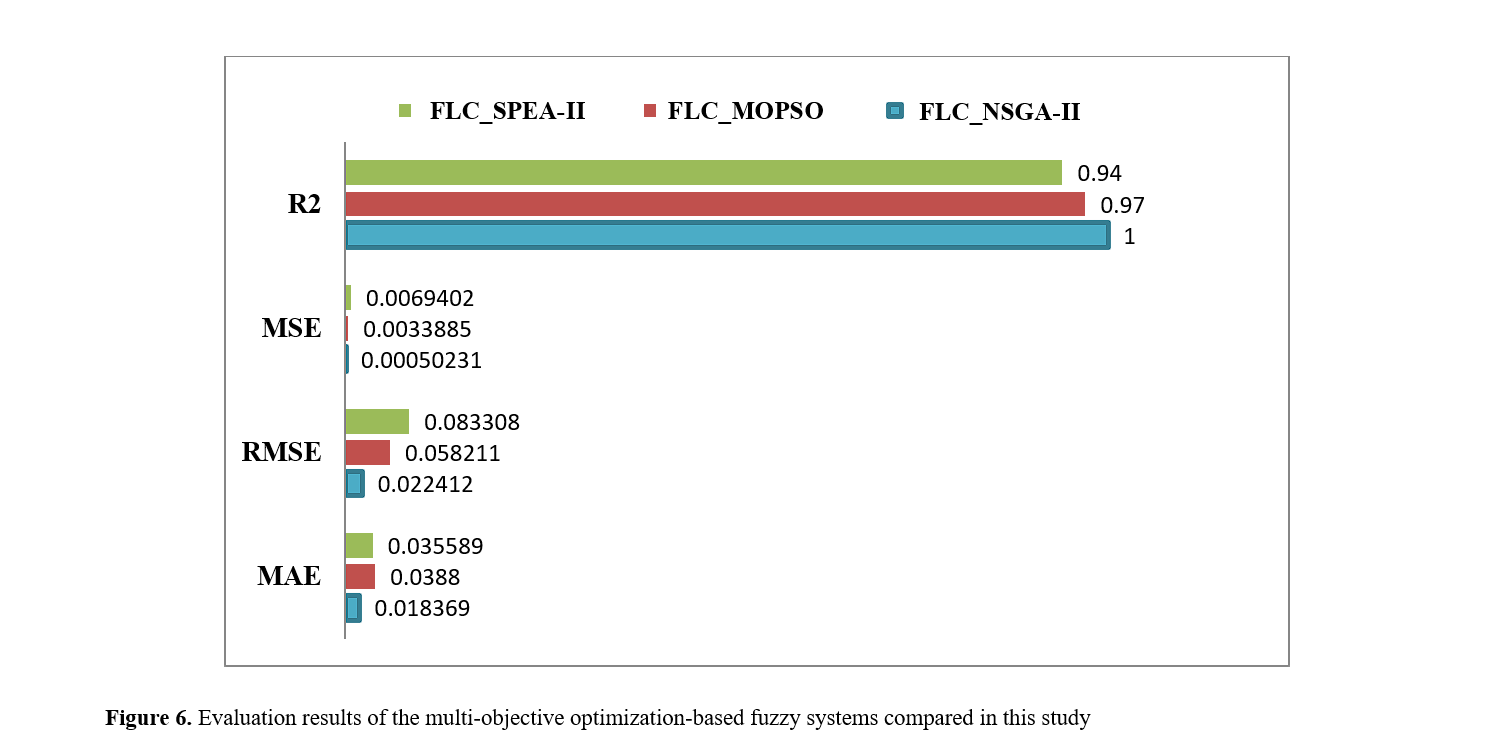
Credit risk assessment of construction contractors is a process that predicts the likelihood of project default by analyzing contractors’ past performance. Existing methods are mostly single-objective and often neglect key project dimensions such as time, quality, and cost, limiting their accuracy and effectiveness. This study proposes a multi-objective approach for contractor credit risk assessment, simultaneously optimizing two conflicting goals: enhancing contractor quality and minimizing the financial–temporal burden of projects. A Fuzzy Logic Controller (FLC) is employed for its interpretability and alignment with human decision-making processes. The design of the knowledge base and membership functions is optimized using a Genetic Algorithm integrated with the Non-dominated Sorting Genetic Algorithm II (NSGA-II). The proposed model is evaluated on a dataset of 540 real construction contractor records. Experimental results demonstrate that the FLC-NSGA-II framework outperforms comparative methods including group regression, non-group regression, MOPSO, and SPEA-II in terms of predictive accuracy, achieving performance indices of R² = 0.1000, MSE = 0.0005, RMSE = 0.0224, and MAE = 0.0183. This high accuracy improves credit risk prediction, prevents project defaults, and reduces financial losses for construction firms. The proposed framework provides a novel, precise, and generalizable tool for credit risk assessment and supports decision-making in complex construction projects.
References
[1] Y. Lee, "Study on the Plan for Reduction of Credit Risk of Medium-size Construction Companies Preparing for Restructuring," Korean Journal of Construction Engineering and Management, vol. 21, no. 5, pp. 64-73, 2020.
[2] A. Khodabakhshian, "Machine learning for risk management in construction projects," ed, 2023.
[3] S. Jain, S. K. Jauhar, and Piyush, "A machine-learning-based framework for contractor selection and order allocation in public construction projects considering sustainability, risk, and safety," Annals of Operations Research, vol. 338, no. 1, pp. 225-267, 2024, doi: 10.1007/s10479-024-05898-6.
[4] V. Trivedi, P. Varshney, and M. J. S. I. Ramteke, "A simplified multi-objective particle swarm optimization algorithm," vol. 14, no. 2, pp. 83-116, 2020, doi: 10.1007/s11721-019-00170-1.
[5] Y. Shvimer and A. Herbon, "Application of Machine Learning Models in Credit Risk Assessment of Infrastructure Bonds," in The Routledge Handbook of Infrastructure Finance: Routledge, 2025, pp. 623-641.
[6] D. Bani Hani, I. Al-Nsour, and H. Al-Shamayleh, "Enhancing Risk Management in Construction Projects: Integrating Machine Learning Techniques in the Jordanian Industry," 2025, doi: 10.2139/ssrn.5336395.
[7] E. Zitzler, M. Laumanns, and L. Thiele, "SPEA2: Improving the strength Pareto evolutionary algorithm," IEEE Transactions on Evolutionary Computation, vol. 103, 2001.
[8] S. Mahmoudinazlou and C. J. Kwon, "A hybrid genetic algorithm for the min-max Multiple Traveling Salesman Problem," Computers & Operations Research, vol. 162, p. 106455, 2024, doi: 10.1016/j.cor.2023.106455.
[9] S. Clark, X. Zhu, Z. Wang, R. Mehta, J. Blake, and X. Wei, "Construction of a Supply Chain Credit Risk Evaluation Model for Manufacturing Enterprises Using XGBoost," International Journal of Management Science Research, vol. 8, no. 5, pp. 1-8, 2025.
[10] L. Abualigah, "Particle Swarm Optimization: Advances, Applications, and Experimental Insights," Computers, Materials & Continua, vol. 82, no. 2, 2025, doi: 10.32604/cmc.2025.060765.
[11] P. Kanimalar and R. Balakumar, "The Art of Fuzzy: Crafting Defuzzification with Centroid of Maxima and Minima," International Journal of Fuzzy Systems, pp. 1-17, 2025, doi: 10.1007/s40815-025-01996-0.
[12] A. J. Nebro, J. Galeano-Brajones, F. Luna, and C. A. Coello Coello, "Is NSGA-II ready for large-scale multi-objective optimization?," Mathematical and Computational Applications, vol. 27, no. 6, p. 103, 2022, doi: 10.3390/mca27060103.
[13] H. P. Piepho, "A coefficient of determination (R2) for generalized linear mixed models," Biometrical Journal, vol. 61, no. 4, pp. 860-872, 2019, doi: 10.1002/bimj.201800270.
[14] M. D. Schluchter, "Mean square error," ed, 2005.
[15] A. De Myttenaere, B. Golden, B. Le Grand, and F. Rossi, "Mean absolute percentage error for regression models," Neurocomputing, vol. 192, pp. 38-48, 2016, doi: 10.1016/j.neucom.2015.12.114.
[16] D. S. K. Karunasingha, "Root mean square error or mean absolute error? Use their ratio as well," Information Sciences, vol. 585, pp. 609-629, 2022, doi: 10.1016/j.ins.2021.11.036.
[17] G. A. Flores-Fernandez, M. Jiménez-Carrión, F. Gutierrez, and R. A. Sanchez-Ancajima, "Genetic Algorithm and LSTM Artificial Neural Network for Investment Portfolio Optimization," Journal of Wireless Mobile Networks, Ubiquitous Computing, and Dependable Applications, vol. 15, no. 2, pp. 27-46, 2024, doi: 10.58346/JOWUA.2024.I2.003.
[18] Y. Yi, Z. Wang, Y. Shi, Z. Song, and B. Zhao, "Convergence-Driven Adaptive Many-Objective Particle Swarm Optimization," IEEE Access, 2025, doi: 10.1109/ACCESS.2025.3525850.
[19] K. Shankar and A. S. Baviskar, "Improved hybrid strength pareto evolutionary algorithms for multi-objective optimization," International Journal of Intelligent Computing and Cybernetics, vol. 11, no. 1, pp. 20-46, 2018, doi: 10.1108/IJICC-12-2016-0063.
[20] Z. Wang, E. Bridgeford, S. Wang, J. T. Vogelstein, and B. Caffo, "Statistical analysis of data repeatability measures," International Statistical Review, 2024, doi: 10.1111/insr.12591.
[21] B. K. Das, D. N. Jha, S. K. Sahu, A. K. Yadav, R. K. Raman, and M. Kartikeyan, "Chi-square test of significance," in Concept building in fisheries data analysis: Springer, 2022, pp. 81-94.
Downloads
Publication Timeline
- Submitted
- Revised
- Accepted
Issue
Section
License
Copyright (c) 2025 Nazanin Rahmani (Author); Mehdi Golsorkhtabaramiri (Corresponding author); Amir Sahafi (Author)

This work is licensed under a Creative Commons Attribution-NonCommercial 4.0 International License.