Presentation and Validation of a Model of Social Minority Entrepreneurship (Case Study: Socially Harmed Women Entrepreneurs)
DOI:
https://doi.org/10.61838/msesj.341Keywords:
Social minority entrepreneurship, healing-oriented entrepreneurship, social empowerment, socially harmed women entrepreneursAbstract
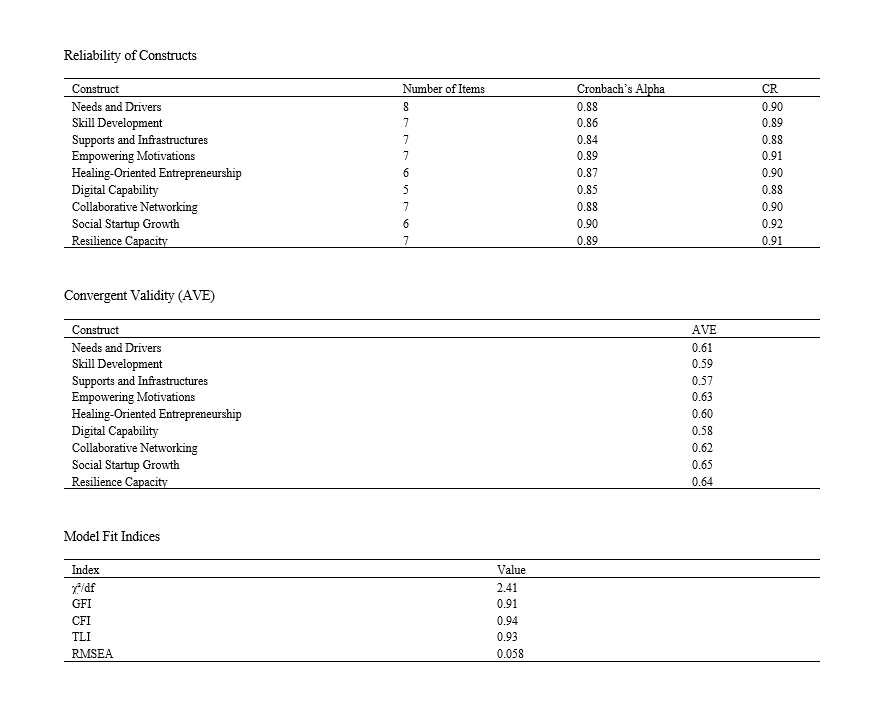
Social minority entrepreneurship, particularly among socially harmed women entrepreneurs, has attracted increasing scholarly attention as an effective strategy for individual empowerment, psychological reconstruction, and the promotion of social development. However, the lack of indigenous and empirically validated models capable of explaining the multidimensional nature of this phenomenon remains a major gap in the existing literature. The present study aimed to develop and validate a model of social minority entrepreneurship with a specific focus on socially harmed women entrepreneurs. From a methodological perspective, this research employed a quantitative mixed-methods approach. Based on the results of the qualitative phase, a 70-item questionnaire was developed, and data were collected from a sample of socially harmed women entrepreneurs. Data analysis was conducted using structural equation modeling with AMOS software. The results of confirmatory factor analysis indicated that all model constructs demonstrated satisfactory reliability as well as convergent and discriminant validity. Model fit indices (CFI, TLI, RMSEA, and χ²/df) confirmed an adequate fit between the proposed model and the empirical data. The findings revealed that empowering motivations and attitudes, supports and infrastructures, digital capability, and collaborative networking exert significant effects on healing-oriented entrepreneurship, which in turn directly leads to the growth of social startups and an increase in resilience capacity. Overall, the results indicate that entrepreneurship for socially harmed women is not merely an economic activity but a multidimensional process of psychological healing, social identity reconstruction, and enhancement of social participation. The proposed model can serve as a practical framework for policymakers, support institutions, and social development planners.
References
[1] H. Ahl, "Why research on women entrepreneurs needs new directions," Entrepreneurship Theory and Practice, vol. 30, no. 5, pp. 595-621, 2006, doi: 10.1111/j.1540-6520.2006.00138.x.
[2] L. H. Koch and A. Kuckertz, "Unleashing the potential: a bibliometric analysis of growth-oriented women entrepreneurship," International Journal of Gender and Entrepreneurship, vol. 16, no. 4, pp. 536-563, 2024. [Online]. Available: http://dx.doi.org/10.1108/IJGE-10-2023-0257.
[3] B. S. Saripalli, V. Chawan, and S. Gunta, "Empowering Subsistence Women Entrepreneurs in India," Society and Business Review, vol. 14, no. 1, pp. 71-92, 2019, doi: 10.1108/sbr-05-2018-0042.
[4] F. Rahmani, M. Hosseini, and N. Karimi, "Investigating the barriers to women's entrepreneurship in Iran," Journal of Entrepreneurship Research, vol. 9, no. 2, pp. 115-136, 2020.
[5] J. Mair and I. Martí, "Social entrepreneurship research," Journal of World Business, vol. 41, no. 1, pp. 36-44, 2006, doi: 10.1016/j.jwb.2005.09.002.
[6] D. Bornstein and S. Davis, Social entrepreneurship: What everyone needs to know. Oxford University Press, 2010.
[7] M. Yunus, Creating a world without poverty. PublicAffairs, 2008.
[8] S. A. Zahra, "Entrepreneurship in social contexts," Academy of Management Perspectives, vol. 31, no. 2, pp. 182-196, 2017.
[9] P. Y. Ng, B. P. Wood, and B. L. Bastian, "Reformulating the Empowerment Process Through Women Entrepreneurship in a Collective Context," International Journal of Entrepreneurial Behaviour & Research, vol. 28, no. 9, pp. 154-176, 2022, doi: 10.1108/ijebr-06-2021-0479.
[10] A. Hosseini, M. Rezaei, and L. Sadeghi, "Factors affecting the empowerment of female entrepreneurs," Journal of Women and Society, vol. 12, no. 1, pp. 55-78, 2022.
[11] I. Love, B. Nikolaev, and C. Dhakal, "The well-being of women entrepreneurs: the role of gender inequality and gender roles," Small Business Economics, vol. 62, no. 1, pp. 325–352, 2024, doi: 10.1007/s11187-023-00769-z.
[12] P. Singh and P. Malhotra, "Literature Review of “Emotional Intelligence and Women Entrepreneurial Orientation”," Dmejm, vol. 3, no. 01, pp. 40-49, 2023, doi: 10.53361/dmejm.v3i01.07.
[13] B. L. Bastian, B. P. Wood, and P. Y. Ng, "The Role of Strong Ties in Empowering Women Entrepreneurs in Collectivist Contexts," International Journal of Gender and Entrepreneurship, 2023, doi: 10.1108/ijge-10-2021-0171.
[14] M. Zare, S. Mohammadi, and H. Akbari, "The role of social capital in the development of women's entrepreneurship," Iranian Journal of Social Studies, vol. 14, no. 3, pp. 87-106, 2021.
[15] A. Bullough, M. Renko, and T. Myatt, "Danger zone entrepreneurs," Entrepreneurship Theory and Practice, vol. 38, no. 3, pp. 473-504, 2014, doi: 10.1111/etap.12006.
[16] D. A. Shepherd, "COVID-19 and entrepreneurship," Journal of Management Studies, vol. 57, no. 8, pp. 1753-1768, 2020, doi: 10.1111/joms.12633.
[17] L. Keya, E. Jemutai, and A. Makori, "Financial Availability and Its Influence on Women’s Economic Empowerment in Kakamega County, Kenya," International Journal of Research and Scientific Innovation, vol. 12, no. 8, pp. 672-688, 2025, doi: 10.51244/ijrsi.2025.120800054.
[18] K. Bel Hadj Miled, "Microfinance and women entrepreneurship development: evidence from Tunisia," SN Business & Economics, vol. 3, no. 1, pp. 1-16, 2023, doi: 10.1007/s43546-022-00381-5.
[19] A. Sarawagi and M. S. Singh, "Mechanisms and Impact of Self-Help Groups on the Socio-Economic Empowerment of Tribal Women in Uttar Pradesh," pp. 30-42, 2025, doi: 10.58532/nbennursech4.
[20] A. V. Desai, Transforming Freedom into Women's Empowerment Through Logotherapy: An Overview Empowering Indian Women Through Resilience: Recent Developments and Future Perspective. 2025, pp. 45-68.
[21] S. Estrin, T. Mickiewicz, and U. Stephan, "Human capital in social and commercial entrepreneurship," Journal of Business Venturing, vol. 31, no. 4, pp. 449-467, 2016, doi: 10.1016/j.jbusvent.2016.05.003.
[22] M. Mari, S. Poggesi, G. Abatecola, and C. Essers, "Women entrepreneurs and innovation: Retrospect and prospect," Journal of Innovation & Knowledge, vol. 9, no. 3, p. 100519, 2024, doi: 10.1016/j.jik.2024.100519.
[23] J. Jumriaty, S. Suhandiah, C. Candraningrat, and J. Wibowo, "Navigating Innovation in Women Entrepreneurship: The Integral Roles of Psychological Capital, Digital Literacy, and Work-Family Conflict," Jem17 Jurnal Ekonomi Manajemen, vol. 9, no. 1, 2024, doi: 10.30996/jem17.v9i1.10940.
[24] S. Majumder, Women Entrepreneurship in Industrial Revolution 4.0: Opportunities and Challenges (Constraint Decision-Making Systems in Engineering). 2023, pp. 177-203.
[25] M. Mweha, "Digital Transformation and Strategic Resilience: A Framework for Sustainable Women Entrepreneurship in Zimbabwe’s Post-Covid Economy," International Journal of Research and Innovation in Social Science, vol. IX, no. XIV, pp. 1269-1281, 2025, doi: 10.47772/ijriss.2025.914mg0096.
[26] N. V. Feranita, A. Dwimahendrawan, and N. A. Mayasiana, "Identification of Dynamic Capability Elements for Women Entrepreneurs Performance Development to Achieve Gender Equality of SDG’s," JLSDGR, vol. 5, no. 3, p. e05448, 2025, doi: 10.47172/2965-730x.sdgsreview.v5.n03.pe05448.
[27] S. A. Zahra, E. Gedajlovic, D. O. Neubaum, and J. Shulman, "A typology of social entrepreneurs," Journal of Business Venturing, vol. 24, no. 5, pp. 519-532, 2009, doi: 10.1016/j.jbusvent.2008.04.007.
[28] E. Jeong and H. Yoo, "Women in social entrepreneurship," Service Business, vol. 16, no. 4, pp. 935-970, 2022, doi: 10.1007/s11628-022-00512-w.
[29] N. Sharifi, "Social entrepreneurship and sustainable development," Journal of Social Development, vol. 10, no. 4, pp. 23-45, 2019.
[30] A. Rafiaie, "Identifying the Sources of Work-Family Conflict Among Women Entrepreneurs in Iran: A Comparison Between Opportunity- And Necessity-Driven Women Entrepreneurs," Jwee, no. 1-2, pp. 110-130, 2023, doi: 10.28934/jwee23.12.pp110-130.
Downloads
Publication Timeline
- Submitted
- Revised
- Accepted
Issue
Section
License
Copyright (c) 2026 Fatemeh Shahnazipour, Mohammad Reza Dalvi Isfahan, Zahra Dashtlaali (Author)

This work is licensed under a Creative Commons Attribution-NonCommercial 4.0 International License.