Identification and Prioritization of Barriers to the Development of Green Buildings in Existing Buildings Using the DEMATEL-Based Analytic Network Process
Keywords:
green building, energy conservation, DEMATEL, Analytic Network Process, multi-criteria decision-makingAbstract
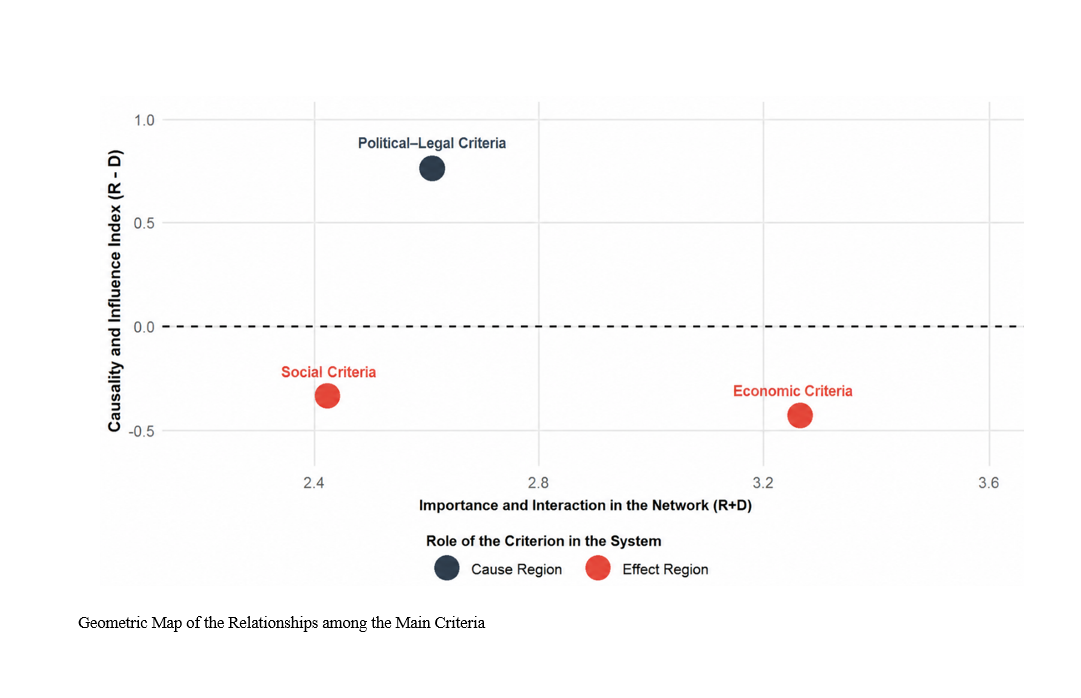
The development of green buildings is considered one of the most effective strategies for reducing energy consumption and greenhouse gas emissions in the building sector. However, the implementation of this approach in developing countries faces multiple barriers across economic, social, and politico-legal dimensions. The aim of this study was to identify, structurally analyze, and prioritize the barriers to the development of green construction in existing buildings, with a focus on energy conservation. To this end, eighteen key barriers were extracted based on a review of previous studies and classified into three main criteria: economic, social, and politico-legal. Subsequently, using the hybrid DEMATEL-based Analytic Network Process (DANP) approach, the causal relationships among the barriers and their final weights were determined. The required data were collected through questionnaires and the opinions of experts in the fields of building engineering and energy, and the analyses were performed using RStudio software. The results of the DEMATEL technique showed that the politico-legal criterion, with a positive causality index (+0.759), was identified as the root and principal influential factor in the system, whereas the economic and social criteria were classified as affected factors. Based on the DANP results, the most important barriers to the development of green buildings were the absence of comprehensive and locally adapted green building standards (19.31%), the lack of binding laws and regulations (14.41%), ineffective supervision of the implementation of building regulations (10.02%), the lack of public acceptance of energy consumption standards (8.51%), and non-specialized implementation and the use of traditional construction methods (8.41%). The findings indicate that economic barriers, including high initial costs, are not the primary causes but are rather consequences of weaknesses in legal frameworks, standards, and supportive policies. Accordingly, reforming regulations and legal requirements, strengthening the construction supervision system, establishing financial incentives, and enhancing public awareness are proposed as the most important policy strategies.
References
[1] L. W. Park, K. Cho, and M.-i. Choi, "A Sustainability Evaluation of Buildings: A Review on Sustainability Factors to Move Towards a Greener City Environment," Buildings, vol. 14, no. 2, p. 446, 2024, doi: 10.3390/buildings14020446.
[2] F. Bai and J. Xing, "Application of Renewable Energy in Green Buildings and Energy Consumption Optimization," EAI Endorsed Transactions on Energy Web, 2024, doi: 10.4108/ew.5830.
[3] M. Reyes, G. Pérez, and J. Coma, "The Role of Building-Integrated Greenery Systems in Building Sustainability Rating Systems," Land, vol. 13, no. 8, p. 1114, 2024, doi: 10.3390/land13081114.
[4] C. Şirin, J. Goggins, and M. Hajdukiewicz, "A review on building-integrated photovoltaic/thermal systems for green buildings," Applied Thermal Engineering, vol. 229, p. 120607, 2023, doi: 10.1016/j.applthermaleng.2023.120607.
[5] S. E. Bibri, "AI and AI-powered Digital Twins for Smart, Green, and Zero-Energy Buildings: A Systematic Review of Leading-Edge Solutions for Advancing Environmental Sustainability Goals," Environmental Science and Ecotechnology, vol. 28, p. 100628, 2025, doi: 10.1016/j.ese.2025.100628.
[6] P. Lotfinejad, A. Tarkashvand, and H. Sanaieian, "A computational approach for integration of greenhouse and “Shanashir” to enhance thermal comfort of occupants, utilizing NSGA-II algorithm," (in English), BUILDING AND ENVIRONMENT, vol. 273, 2025, doi: 10.1016/j.buildenv.2025.112717.
[7] W. B. Santana, L. M. Pereira, F. G. M. Freires, and L. M. F. Maués, "Analysis of the barriers to the adoption of green buildings labels in Brazil by the validated Interpretative Structural Modeling (VISM) technique," Journal of Cleaner Production, vol. 137642, 2023, doi: 10.1016/j.jclepro.2023.137642.
[8] C. T. M. Kowet and A. Ozumba, "Green Building Practitioners’ Understanding of the Concept of Sustainability: South African Perspective," Iop Conference Series Earth and Environmental Science, vol. 1101, no. 6, p. 062027, 2022, doi: 10.1088/1755-1315/1101/6/062027.
[9] M. L. Tseng, S. X. Li, C. W. R. Lin, and A. S. Chiu, "Validating green building social sustainability indicators in China using the fuzzy delphi method," Journal of Industrial and Production Engineering, vol. 40, no. 1, pp. 35-53, 2023, doi: 10.1080/21681015.2022.2070934.
[10] A. Jorge-Ortiz, M. Braulio-Gonzalo, and M. D. Bovea, "Exploring how waste management is being approached in green building rating systems: A case study," Waste Management & Research, vol. 41, no. 6, pp. 1121-1133, 2023. [Online]. Available: https://journals.sagepub.com/doi/abs/10.1177/0734242X221143952.
[11] N. Karami and S. Heydari, "Evaluation of Green Building Indicators within the Circular Economy Framework to Reduce Environmental Impacts," (in English), Applied Research in Civil Engineering, vol. 6, no. 1, pp. 105-120, 2022.
[12] M. Mokhber Takmeh Dash, F. Syadati, S. Safari, M. R. Podratchi Asl, M. Yari, and N. Zareh Aqdaraq, "Analyzing the performance of green buildings in the construction industry and environmentally compatible materials," 2023. [Online]. Available: https://civilica.com/doc/1944888/.
[13] K. Keita and S. Kourouma, "Assessment of Policy and Legal Frameworks of Urban Green Infrastructure Development: Republic of Guinea," Buildings, vol. 13, no. 8, p. 1945, 2023, doi: 10.3390/buildings13081945.
[14] M. El Mokadem and M. Khalaf, "Building sustainable performance through green supply chain management," International Journal of Productivity and Performance Management, vol. 74, no. 1, pp. 203-223, 2025, doi: 10.1108/IJPPM-02-2024-0113.
[15] Y. Jiang, Y. Zhang, A. J. Yeganeh, and D. Zhao, "Resilience of Green Building Supply Chain: Capabilities, Risks and Influence Mechanism," Journal of Green Building, vol. 19, no. 3, pp. 41-69, 2024, doi: 10.3992/jgb.19.3.41.
[16] C. Hou, J. H. Lai, and H. Wu, "Project-Based Learning and Pedagogies for Virtual Reality-Aided Green Building Education: Case Study on a University Course," International Journal of Sustainability in Higher Education, vol. 24, no. 6, pp. 1308-1327, 2023, doi: 10.1108/ijshe-06-2022-0197.
[17] L. Greenwood, J. Schneider, D. Hess, and Y. Abraham, "Capacity Building for Organizational Resilience: Integrating Standards on Risk, Disruption and Business Continuity in the Curriculum," in Proceedings of IConSES 2022--International Conference on Social and Education Sciences, 2022, pp. 157-163. [Online]. Available: https://www.nist.gov/document/greenwood-et-al-capacity-building-org-resilience.
[18] K. M. McGoey, A. Aberson, B. Green, and S. Bandi Stewart, "Building foundations for friendship: Preventing bullying behavior in preschool," Perspectives on Early Childhood Psychology and Education, vol. 7, no. 1, p. 9, 2023, doi: 10.58948/2834-8257.1038.
[19] O. Alharasees, U. Kale, J. Rohács, D. Rohács, M. A. Éva, and A. Boros, "Green Building Energy: Patents Analysis and Analytical Hierarchy Process Evaluation," Heliyon, vol. 10, no. 8, p. e29442, 2024, doi: 10.1016/j.heliyon.2024.e29442.
[20] R. Aslanoğlu et al., "Ten questions concerning the role of urban greenery in shaping the future of urban areas," Building and Environment, vol. 267, p. 112154, 2025, doi: 10.1016/j.buildenv.2024.112154.
[21] V. T. Dang and J. Wang, "Building competitive advantage for hospitality companies: The roles of green innovation strategic orientation and green intellectual capital," International Journal of Hospitality Management, vol. 102, p. 103161, 2022, doi: 10.1016/j.ijhm.2022.103161.
[22] A. Shah, S. A. Siddiqui, S. Ilyas, A. Usman, and A. Mahmood, "Green Marketing Meets Green HRM: Building a Sustainable Brand Through Workforce Engagement," Ijss, vol. 4, no. 3, pp. 200-214, 2025, doi: 10.63544/ijss.v4i3.158.
[23] Salarian, Abbasi, and Rangriz, "Proposing an Institutional Capacity-Building Model for Citizen Participation Policy in the Environmental Sector: A Green Human Resource Management Approach," Human Resource Excellence, vol. 2, no. 5, 2024. [Online]. Available: https://ensani.ir/fa/article/author/277616.
[24] S. Yuliani and W. Setyaningsih, "Green Architecture in Tourism Sustainable Development: A Case Study at Laweyan, Indonesia," Journal of Asian Architecture and Building Engineering, vol. 24, no. 1, pp. 27-38, 2023.
Downloads
Publication Timeline
- Submitted
- Revised
- Accepted
Issue
Section
License
Copyright (c) 2025 Seyed Esmaeil Sadeghi (Author); Atieh Asgari Toorzani (Corresponding author)

This work is licensed under a Creative Commons Attribution-NonCommercial 4.0 International License.