Gender Classification from Facial Images under Illumination and Head-Pose Variations Using AlexNet Features and a Grasshopper-Optimized Multilayer Perceptron
Keywords:
face analysis, gender-label classification, AlexNet, transfer learning, multilayer perceptron, Grasshopper Optimization Algorithm, GENDER-FERET, low-data learningAbstract
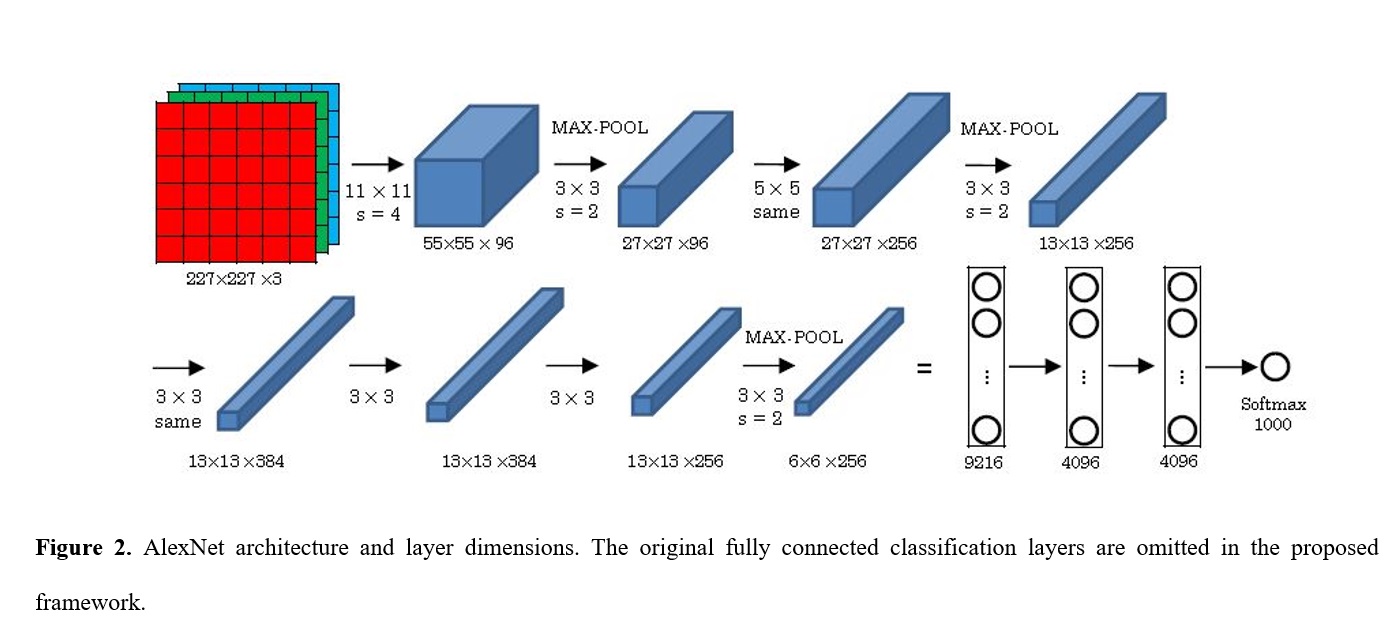
Automatic binary gender-label classification from facial images is a well-established face-analysis task. Although current systems perform well under controlled conditions, their accuracy can deteriorate in the presence of illumination changes, head-pose variation, age differences, facial expression, and partial occlusion. This study addresses the design of a framework that can extract stable facial representations from a limited training set and learn the classifier decision boundary without relying exclusively on gradient-based optimization. The proposed method comprises three components: the frozen convolutional part of an ImageNet-pretrained AlexNet used as a feature extractor, a multilayer perceptron with one hidden layer of 128 neurons used as the classifier, and the Grasshopper Optimization Algorithm (GOA) used to search for the classifier weights and biases. After resizing, illumination normalization, and limited data augmentation, input images are passed through the convolutional backbone, and the Pool5 output is flattened into a 9,216-dimensional feature vector. The features are normalized using parameters estimated exclusively from the training set and are then supplied to the MLP. The main evaluation uses the official identity-disjoint split of GENDER-FERET, comprising 474 training images and 472 test images. The reported results indicate a test accuracy of 98.94%. For the male class, precision, recall, and F1-score are 99.15%, 98.73%, and 98.94%, respectively; for the female class, the corresponding values are 98.73%, 99.15%, and 98.94%. The small difference between class-specific results indicates balanced errors on this split. Nevertheless, the limited dataset size, controlled image acquisition, absence of cross-dataset testing, and the substantial computational cost of directly optimizing more than one million parameters constrain the external validity of the results. From the perspective of reusing deep representations while separating feature extraction from classifier optimization, the proposed framework is a viable approach for further investigation in low-data settings.
References
[1] E. Makinen and R. Raisamo, "Evaluation of gender classification methods with automatically detected and aligned faces," Pattern Recognition Letters, vol. 29, no. 10, pp. 1544-1556, 2008, doi: 10.1016/j.patrec.2008.03.016.
[2] C. W. Ng, Y. H. Tay, and B. M. Goi, "Recognizing human gender in computer vision: a survey," Pattern Analysis and Applications, vol. 18, pp. 739-755, 2015, doi: 10.1007/s10044-015-0499-6.
[3] J. Deng, W. Dong, R. Socher, L. J. Li, K. Li, and L. Fei-Fei, "ImageNet: A large-scale hierarchical image database," in 2009 IEEE Conference on Computer Vision and Pattern Recognition, 2009, pp. 248-255, doi: 10.1109/CVPR.2009.5206848.
[4] A. Krizhevsky, I. Sutskever, and G. E. Hinton, "ImageNet classification with deep convolutional neural networks," in Advances in Neural Information Processing Systems 25, 2012, pp. 1097-1105. [Online]. Available: https://proceedings.neurips.cc/paper/2012/hash/c399862d3b9d6b76c8436e924a68c45b-Abstract.html.
[5] S. J. Pan and Q. Yang, "A survey on transfer learning," IEEE Transactions on Knowledge and Data Engineering, vol. 22, no. 10, pp. 1345-1359, 2010, doi: 10.1109/TKDE.2009.191.
[6] F. Zhuang and et al., "A comprehensive survey on transfer learning," Proceedings of the IEEE, vol. 109, no. 1, pp. 43-76, 2021, doi: 10.1109/JPROC.2020.3004555.
[7] D. E. Rumelhart, G. E. Hinton, and R. J. Williams, "Learning representations by back-propagating errors," Nature, vol. 323, pp. 533-536, 1986, doi: 10.1038/323533a0.
[8] S. Saremi, S. Mirjalili, and A. Lewis, "Grasshopper optimisation algorithm: Theory and application," Advances in Engineering Software, vol. 105, pp. 30-47, 2017, doi: 10.1016/j.advengsoft.2017.01.004.
[9] G. Azzopardi, A. Greco, A. Saggese, and M. Vento, "Fusion of domain-specific and trainable features for gender recognition from face images," IEEE Access, vol. 6, pp. 24171-24183, 2018, doi: 10.1109/ACCESS.2018.2823378.
[10] G. Azzopardi, A. Greco, and M. Vento, "Gender recognition from face images with trainable COSFIRE filters," in 2016 13th IEEE International Conference on Advanced Video and Signal Based Surveillance (AVSS), 2016, pp. 235-241, doi: 10.1109/AVSS.2016.7738073.
[11] P. J. Phillips, H. Moon, S. A. Rizvi, and P. J. Rauss, "The FERET evaluation methodology for face-recognition algorithms," IEEE Transactions on Pattern Analysis and Machine Intelligence, vol. 22, no. 10, pp. 1090-1104, 2000, doi: 10.1109/34.879790.
[12] A. S. Georghiades, P. N. Belhumeur, and D. J. Kriegman, "From few to many: Illumination cone models for face recognition under variable lighting and pose," IEEE Transactions on Pattern Analysis and Machine Intelligence, vol. 23, no. 6, pp. 643-660, 2001, doi: 10.1109/34.927464.
[13] X. Tan and B. Triggs, "Enhanced local texture feature sets for face recognition under difficult lighting conditions," IEEE Transactions on Image Processing, vol. 19, no. 6, pp. 1635-1650, 2010, doi: 10.1109/TIP.2010.2042645.
[14] C. Ding and D. Tao, "A comprehensive survey on pose-invariant face recognition," ACM Computing Surveys, vol. 49, no. 2, p. 37, 2016, doi: 10.1145/2845089.
[15] T. Hassner, S. Harel, E. Paz, and R. Enbar, "Effective face frontalization in unconstrained images," in 2015 IEEE Conference on Computer Vision and Pattern Recognition, 2015, pp. 4295-4304, doi: 10.1109/CVPR.2015.7299058.
[16] T. Ojala, M. Pietikainen, and T. Maenpaa, "Multiresolution gray-scale and rotation invariant texture classification with local binary patterns," IEEE Transactions on Pattern Analysis and Machine Intelligence, vol. 24, no. 7, pp. 971-987, 2002, doi: 10.1109/TPAMI.2002.1017623.
[17] N. Dalal and B. Triggs, "Histograms of oriented gradients for human detection," in 2005 IEEE Computer Society Conference on Computer Vision and Pattern Recognition, 2005, pp. 886-893, doi: 10.1109/CVPR.2005.177.
[18] D. G. Lowe, "Distinctive image features from scale-invariant keypoints," International Journal of Computer Vision, vol. 60, pp. 91-110, 2004, doi: 10.1023/B:VISI.0000029664.99615.94.
[19] K. Simonyan and A. Zisserman, "Very deep convolutional networks for large-scale image recognition," in International Conference on Learning Representations, 2015. [Online]. Available: https://arxiv.org/abs/1409.1556.
[20] C. Szegedy and et al., "Going deeper with convolutions," in 2015 IEEE Conference on Computer Vision and Pattern Recognition, 2015, pp. 1-9, doi: 10.1109/CVPR.2015.7298594.
[21] K. Zhang, Z. Zhang, Z. Li, and Y. Qiao, "Joint face detection and alignment using multitask cascaded convolutional networks," IEEE Signal Processing Letters, vol. 23, no. 10, pp. 1499-1503, 2016, doi: 10.1109/LSP.2016.2603342.
[22] M. Tan and Q. V. Le, "EfficientNet: Rethinking model scaling for convolutional neural networks," in Proceedings of Machine Learning Research, 2019, vol. 97, pp. 6105-6114. [Online]. Available: https://proceedings.mlr.press/v97/tan19a.html?ref=ji.
[23] M. Sandler, A. Howard, M. Zhu, A. Zhmoginov, and L. C. Chen, "MobileNetV2: Inverted residuals and linear bottlenecks," in 2018 IEEE Conference on Computer Vision and Pattern Recognition, 2018, pp. 4510-4520, doi: 10.1109/CVPR.2018.00474.
[24] G. Levi and T. Hassner, "Age and gender classification using convolutional neural networks," in 2015 IEEE Conference on Computer Vision and Pattern Recognition Workshops, 2015, pp. 34-42, doi: 10.1109/CVPRW.2015.7301352.
[25] V. Carletti, A. Greco, G. Percannella, and M. Vento, "Age and gender recognition by smart cameras," Journal of Ambient Intelligence and Humanized Computing, vol. 11, pp. 1203-1215, 2020, doi: 10.1007/s12652-019-01267-5.
[26] A. Greco, A. Saggese, M. Vento, and V. Vigilante, "A robustness evaluation of facial gender classification methods against image degradations," Journal of Ambient Intelligence and Humanized Computing, vol. 13, pp. 2779-2795, 2022, doi: 10.1007/s12652-021-02985-x.
[27] C. M. Bishop, Pattern Recognition and Machine Learning. Springer, 2006.
[28] S. Ioffe and C. Szegedy, "Batch normalization: Accelerating deep network training by reducing internal covariate shift," in Proceedings of Machine Learning Research, 2015, vol. 37, pp. 448-456. [Online]. Available: http://proceedings.mlr.press/v37/ioffe15.html.
[29] N. Srivastava and et al., "Dropout: A simple way to prevent neural networks from overfitting," Journal of Machine Learning Research, vol. 15, pp. 1929-1958, 2014.
[30] V. Kazemi and J. Sullivan, "One millisecond face alignment with an ensemble of regression trees," in 2014 IEEE Conference on Computer Vision and Pattern Recognition, 2014, pp. 1867-1874, doi: 10.1109/CVPR.2014.241.

Downloads
Published
Submitted
Revised
Accepted
Issue
Section
License
Copyright (c) 2025 Mohammed Raad Yaseen Asabr (Author); Farhad Navabifar (Corresponding author); Hiba AbdulJaleel Kzar Al-Asady, Keyvan Mohebbi (Author)

This work is licensed under a Creative Commons Attribution-NonCommercial 4.0 International License.