Development of a Strategic Decision-Making Framework for Transitioning to a Circular Economy in Mining: A Hybrid SWOT–Fuzzy VIKOR Approach
Keywords:
Circular Economy, SWOT Analysis, Fuzzy-VIKOR Model, Strategic Decision-Making, Sustainable Management, Copper MineAbstract
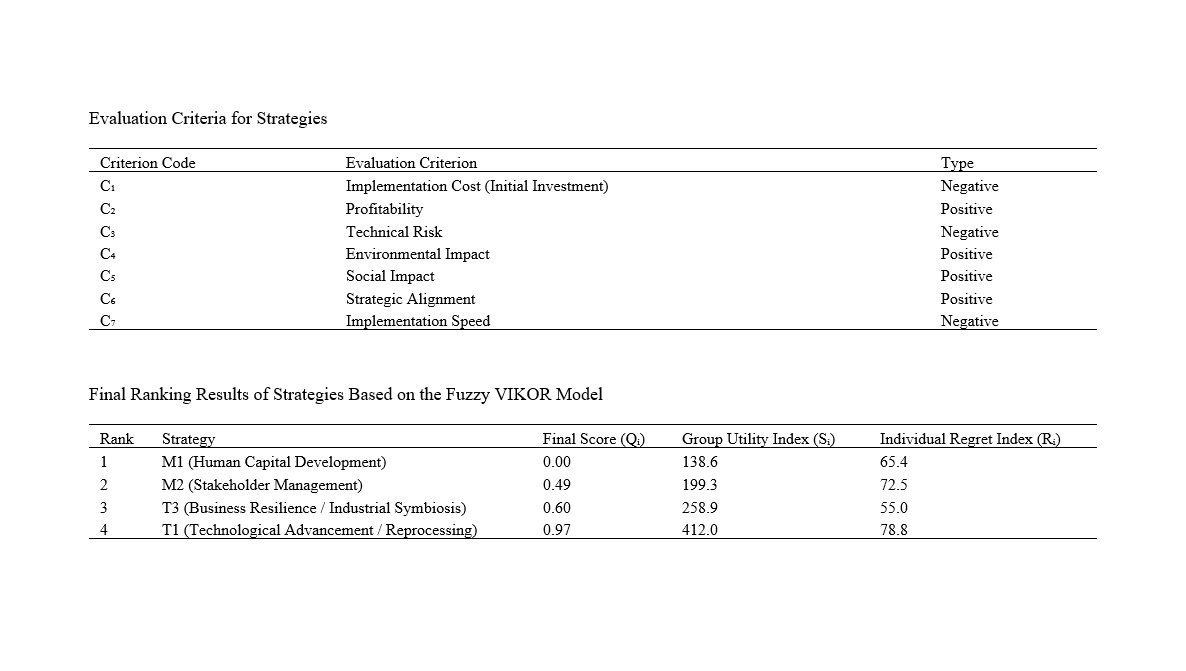
The transition to a circular economy (CE) in the mining industry constitutes a complex decision-making challenge that confronts managers with conflicting objectives (economic, environmental, and social) and data uncertainty. This study aims to bridge the gap between theory and practice by proposing an innovative hybrid framework (SWOT–Fuzzy VIKOR) for prioritizing CE strategies. The proposed framework integrates qualitative expert analysis through SWOT analysis and the formulation of TOWS strategies with the quantitative evaluation of a fuzzy multi-criteria decision-making model (Fuzzy VIKOR). The research was conducted as a case study in a copper mining complex located in the northwest of the country. The results indicate that strategies based on human capital development (M1), with a score of Q = 0.00, and stakeholder management (M2), with a score of Q = 0.49, are identified as the primary priorities. These findings suggest that, prior to making large-scale technical investments, managers should focus on strengthening human and social infrastructures as essential prerequisites for a successful transition toward sustainability. This framework provides a practical and robust tool for strategic decision-making in heavy industries.
References
[1] P. Ghisellini, C. Cialani, and S. Ulgiati, "A Review on Circular Economy: The Expected Transition to a Balanced Interplay of Environmental and Economic Systems," Journal of Cleaner Production, vol. 114, pp. 11-32, 2016, doi: 10.1016/j.jclepro.2015.09.007.
[2] S. Islam, S. Hassan, S. Hossain, T. Ahmed, C. L. Karmaker, and A. M. Bari, "Exploring the influence of circular economy on big data analytics and supply chain resilience nexus: A structural equation modeling approach," Green Technologies and Sustainability, pp. 100219-100219, 2025 2025, doi: 10.1016/j.grets.2025.100219.
[3] T. S. Gaur, V. Yadav, S. Prakash, and A. Panwar, "Integration of industry 4.0 and circular economy for sustainable E-waste management," Management of Environmental Quality: An International Journal, vol. 36, no. 5, pp. 1304-1325, 2025, doi: 10.1108/MEQ-07-2024-0277.
[4] M. M. Mamun, "Circular Economy and Digital Supply Chain: The role of emerging technologies for facilitating sustainability," School of Innovation & technology, University of VAASA, 2025. [Online]. Available: https://osuva.uwasa.fi/items/59acbf49-8c3b-4826-ab9f-e973b2c73e76
[5] S. Sharifian Jazi, A. Mohammadi, A. Abbasi, and M. Alimohammadlou, "Identifying Challenges Affecting the Implementation of Circular Economy and Industry 4.0 in Supply Chain Management," Management Research in Iran, vol. 28, no. 2, pp. 146-183, 2025 2025. [Online]. Available: https://mri.modares.ac.ir/article_661_en.html?lang=fa.
[6] A. Kumar et al., "A Review of Multi Criteria Decision Making (MCDM) Towards Sustainable Renewable Energy Development," Renewable and Sustainable Energy Reviews, vol. 69, pp. 596-609, 2017, doi: 10.1016/j.rser.2016.11.191.
[7] S. Opricovic and G. H. Tzeng, "Compromise Solution by MCDM Methods: A Comparative Analysis of VIKOR and TOPSIS," European Journal of Operational Research, vol. 156, no. 2, pp. 445-455, 2004, doi: 10.1016/S0377-2217(03)00020-1.
[8] A. Shemshadi, H. Shirazi, M. Toreihi, and M. J. Tarokh, "A Fuzzy VIKOR Method for Supplier Selection Based on Entropy Measure for Objective Weighting," Expert Systems with Applications, vol. 38, no. 10, pp. 12160-12167, 2011, doi: 10.1016/j.eswa.2011.03.027.
[9] M. Yazdani, P. Chatterjee, E. K. Zavadskas, and S. H. Zolfani, "Integrated QFD-MCDM Framework for Green Supplier Selection," Journal of Cleaner Production, vol. 142, pp. 3728-3740, 2017, doi: 10.1016/j.jclepro.2016.10.095.
[10] M. Kurttila, M. Pesonen, J. Kangas, and M. Kajanus, "Utilizing the Analytic Hierarchy Process (AHP) in SWOT Analysis: A Hybrid Method and Its Application to a Forest-Certification Case," Forest Policy and Economics, vol. 1, no. 1, pp. 41-52, 2000, doi: 10.1016/S1389-9341(99)00004-0.
[11] R. Singh, S. Rani, and V. Kandpal, "Driving Environmental Resilience: Integrating Industry 4.0 for Circular Economy," in Green Futures: Navigating the Path to Environmental Resilience. Singapore: Springer Nature Singapore, 2025, pp. 23-40.
[12] S. Rani, "Synergizing Artificial Intelligence and HRM for Circular Economy Transition: A Conceptual Framework," The International Journal of Education Management and Sociology, vol. 4, no. 4, pp. 124-137, 2025 2025, doi: 10.58818/ijems.v4i3.205.
[13] E. Mugoni, B. Shumbanhete, and B. Nyagadza, "The Nexus Between Circular Economy (CE) and Sustainable Supply Chain Management (SSCM): A Systematic Literature Review and Mapping of Future Research Agenda," Circular Economy and Sustainability, pp. 1-38, 2025, doi: 10.1007/s43615-025-00663-8.
[14] V. P. Tathavadekar, "Sustainable and Resilient Supply Chain Practices through Digital Transformation and Circular Economy Strategies," 2025 2025. [Online]. Available: https://www.google.com/url?sa=t&source=web&rct=j&opi=89978449&url=https://zenodo.org/records/15605978/files/V13i601.pdf%3Fdownload%3D1&ved=2ahUKEwieoc2ai9eSAxUIXKQEHa4GApsQFnoECBsQAQ&usg=AOvVaw0S-paBPhl3RbMbSdYMcOWv.
[15] H. Taghizadeh and A. Shokri, "Relationship Among the Dimensions of Knowledge Management from the Viewpoint of Social Capital Based on Interpretive Structural Modelling: A Case Study," Journal of Information & Knowledge Management, vol. 14, no. 03, p. 1550024, 2015, doi: 10.1142/S0219649215500240.
[16] K. N. Alfina, R. C. Ratnayake, D. Wibisono, M. H. Basri, and N. B. Mulyono, "Prioritizing Performance Indicators for the Circular Economy Transition in Healthcare Supply Chains," Circular Economy and Sustainability, vol. 5, no. 1, pp. 231-276, 2025 2025, doi: 10.1007/s43615-024-00436-9.
[17] Μ. Αντωνιάδου, "Integrating Lean Management and Circular Economy for Sustainable Dentistry," 2024, doi: 10.20944/preprints202410.0248.v1.
[18] P. Kumar and J. Singh, "Harnessing Bioproducts for a Sustainable Circular Economy," in Value Addition and Utilization of Lignocellulosic Biomass: Through Novel Technological Interventions, G. Mukherjee and S. Dhiman Eds. Singapore: Springer Nature Singapore, 2025, pp. 263-293.
[19] R. Singh, A. Joshi, A. Singh, K. Raghuveer, and V. Kumar, "Synergising HR practices and social performance for adoption of digital circular economy: a case of developing country perspective," Strategy & Leadership, vol. 53, no. 4, pp. 434-456, 2025 2025, doi: 10.1108/SL-12-2024-0146.

Downloads
Published
Submitted
Revised
Accepted
Issue
Section
License
Copyright (c) 2025 Amirreza Bardideh (Author); Aynur Naseri (Corresponding author); Rashed Poormirzaee, Rahim Taghizadeh (Author)

This work is licensed under a Creative Commons Attribution-NonCommercial 4.0 International License.