Design of a Fuzzy Multi-Objective Mathematical Model for Short-Term Preventive Maintenance Scheduling Using a Total Productive Maintenance Approach
Keywords:
Fuzzy mathematical model, multi-objective optimization, preventive maintenance, short-term scheduling, Total Productive Maintenance, NSGA-IIAbstract
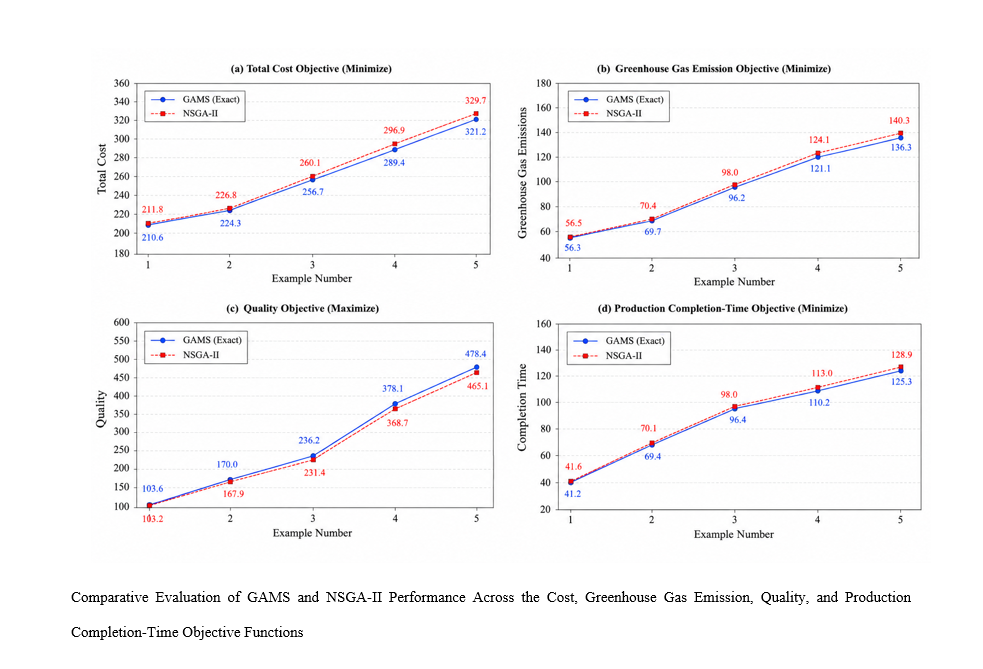
This study aimed to design a fuzzy multi-objective mathematical model for short-term preventive maintenance scheduling based on the Total Productive Maintenance approach to optimize production completion time, total cost, greenhouse gas emissions, and product quality under uncertainty. This applied quantitative study was conducted using mathematical modeling and computational optimization. The proposed model integrated production scheduling and preventive maintenance decisions within a short-term planning horizon and formulated four objective functions: minimization of completion time, total cost, and greenhouse gas emissions, and maximization of product quality. Uncertain parameters were modeled using a fuzzy approach to increase the realism of the scheduling environment. Five small-scale numerical instances with increasing complexity were generated and solved using GAMS as an exact optimization benchmark. The NSGA-II metaheuristic algorithm was implemented in MATLAB to solve the same instances and evaluate the model’s computational efficiency, accuracy, and stability. The inferential comparison between GAMS and NSGA-II indicated that the proposed algorithm generated near-optimal solutions across all objective functions. For the quality objective, deviations ranged from 0.39% to 2.78%, and for completion time, deviations ranged from 0.97% to 2.87%. For the cost objective, deviations ranged from 0.57% to 2.65%, while greenhouse gas emission deviations ranged from 0.36% to 2.93%. Repeated executions of the algorithm showed low dispersion between best, worst, and mean solutions, confirming acceptable convergence and stability. The best–worst deviation for the cost objective reached 3.02% only in the largest instance, while the quality objective remained below 1% across all instances. The proposed fuzzy multi-objective model provides an effective decision-support framework for short-term preventive maintenance scheduling in TPM-based production systems. The results confirm that NSGA-II can generate accurate, stable, and computationally efficient solutions close to exact optimization results while balancing economic, environmental, operational, and quality-related objectives.
References
[1] D. Fanourakis, "Climate Change Impacts on Greenhouse Horticulture in the Mediterranean Basin: Challenges and Adaptation Strategies," Plants, vol. 14, no. 21, p. 3390, 2025, doi: 10.3390/plants14213390.
[2] K. Shahanaghi, M. Jafarian, M. Beikverdi, and Z. Nejad Biglari, "Optimization of the Threshold of Preventive Maintenance Actions in a Condition-Based Maintenance Program (CPM) Using a Dynamic Programming Approach," (in English), Industrial Engineering and Management, vol. 26, no. 2, pp. 115-119, 2010. [Online]. Available: https://sjie.journals.sharif.edu/article_5185_232f7856250e37cfef4de502d40ed76d.pdf.
[3] N. Molaverdi, F. Mousavizadegan, and B. Mehdinia, "A Method for Optimizing Preventive Maintenance," (in English), Research in Production and Operations Management, vol. 11, no. 3, pp. 117-137, 2020, doi: 10.22108/jpom.2021.127885.1354.
[4] A. Moazzam Jozi, R. Tavakkoli-Moghaddam, and H. Abdollahzadeh Sangroodi, "A Mathematical Programming Model for Dynamic Grouping of Maintenance Activities Considering Intermittent Operation of a Multi-Component System," (in English), Industrial Engineering and Management, vol. 39, no. 1, pp. 3-21, 2023, doi: 10.24200/j65.2022.56610.2163.
[5] M. Qamhan, A. Qamhan, I. Al-Harkan, and Y. Alotaibi, "Mathematical Modeling and Discrete Firefly Algorithm to Optimize Scheduling Problem with Release Date, Sequence-Dependent Setup Time, and Periodic Maintenance," (in English), Mathematical Problems in Engineering, vol. 2019, pp. 1-16, 2019, doi: 10.1155/2019/8028759.
[6] M. Sharifzadegan, T. Sohrabi, and A. Jafarnejad Chaghoushi, "A Bi-Objective Hybrid Production Scheduling Model with Resource Constraints Using a Preventive Maintenance Approach," (in English), Decision Making and Operations Research, vol. 6, no. Special Issue, pp. 1-17, 2022, doi: 10.22105/dmor.2021.278207.1343.
[7] Z. Sun and L. Li, "Opportunity Estimation for Real-Time Energy Control of Sustainable Manufacturing Systems," (in English), IEEE Transactions on Automation Science and Engineering, vol. 10, no. 1, pp. 38-44, 2013/01 2013, doi: 10.1109/TASE.2012.2216876.
[8] J. Cheng, F. Chu, C. Chu, and W. Xia, "Bi-Objective Optimization of Single-Machine Batch Scheduling under Time-of-Use Electricity Prices," (in English), RAIRO - Operations Research, vol. 50, 2015, doi: 10.1051/ro/2015063.
[9] C. Lu, L. Gao, X. Li, Q. Pan, and Q. Wang, "Energy-Efficient Permutation Flow Shop Scheduling Problem Using a Hybrid Multi-Objective Backtracking Search Algorithm," (in English), Journal of Cleaner Production, vol. 144, pp. 228-238, 2017, doi: 10.1016/j.jclepro.2017.01.011.
[10] J. Duan, M. Feng, and Q. Zhang, "Energy-Efficient Collaborative Scheduling of Heterogeneous Multi-Stage Hybrid Flowshop for Large Metallic Component Manufacturing," (in English), Journal of Cleaner Production, vol. 375, p. 134148, 2022, doi: 10.1016/j.jclepro.2022.134148.
[11] M. Foumani and K. Smith-Miles, "The Impact of Various Carbon Reduction Policies on Green Flowshop Scheduling," (in English), Applied Energy, vol. 249, pp. 300-315, 2019, doi: 10.1016/j.apenergy.2019.04.155.
[12] H. Piroozfard, K. Y. Wong, and W. P. Wong, "Minimizing Total Carbon Footprint and Total Late Work Criterion in Flexible Job Shop Scheduling by Using an Improved Multi-Objective Genetic Algorithm," (in English), Resources, Conservation and Recycling, vol. 128, pp. 267-283, 2017, doi: 10.1016/j.resconrec.2016.12.001.
[13] T. Ning and Y. Huang, "Low Carbon Emission Management for Flexible Job Shop Scheduling: A Study Case in China," (in English), Journal of Ambient Intelligence and Humanized Computing, vol. 14, 2021, doi: 10.1007/s12652-021-03330-6.
[14] T. Ning, Z. Wang, P. Zhang, and T. Gou, "Integrated Optimization of Disruption Management and Scheduling for Reducing Carbon Emission in Manufacturing," (in English), Journal of Cleaner Production, vol. 263, p. 121449, 2020, doi: 10.1016/j.jclepro.2020.121449.
[15] Y. Bok, N. K. Lee, S. Jo, S. Lee, S. J. Kweon, and H. S. Na, "The Production Scheduling Problem Employing Non-Identical Parallel Machines with Due Dates Considering Carbon Emissions and Multiple Types of Energy Sources," (in English), Expert Systems with Applications, vol. 238, p. 121990, 2024, doi: 10.1016/j.eswa.2023.121990.
[16] S. M. A. D. M. T. S. Raeisi, "Simultaneous Planning of Maintenance and Spare Parts Inventory Control: A Case Study of the Paint Pre-Treatment Shuttle Robot in an Automotive Company," (in English), Strategic Management in Industrial Systems, vol. 14, no. 49, pp. 19-33, 2019/11 2019.
[17] M. D. F. A. S. M. Sajjadi, "A Simulation-Optimization Model for Networked Failure-Prone Production Systems with a Reliability-Based Maintenance Approach and Revenue Sharing," (in English), Journal of Industrial Management Perspective, vol. 12, no. 4, pp. 131-158, 2022, doi: 10.52547/jimp.12.4.131.
[18] R. Nouri, A. Sadeghieh, and M. Lotfi, "A Mathematical Model for Simultaneous Planning of Inspections and Preventive Maintenance under Markovian Machine Deterioration and Demand Uncertainty," (in English), Industrial Engineering and Management, vol. 35.1, no. 2.2, pp. 151-163, 2020, doi: 10.24200/j65.2019.50720.1866.
[19] R. N. A. S. M. M. Lotfi, "Simultaneous Demand-Based Inspection and Preventive Maintenance Planning under Markovian Machine Deterioration for Application in Wind Turbines," (in English), Journal of Mechanical Engineering, vol. 18, no. 61, pp. 63-84, 2020/07 2020, doi: 10.22075/jme.2020.19265.1820.
[20] J. Asadkhani, A. Fallahi, and H. Mokhtari, "A Sustainable Supply Chain under VMI-CS Agreement with Withdrawal Policies for Imperfect Items," (in English), Journal of Cleaner Production, vol. 376, p. 134098, 2022, doi: 10.1016/j.jclepro.2022.134098.
[21] L. Zhang, J. Wang, and J. You, "Consumer Environmental Awareness and Channel Coordination with Two Substitutable Products," (in English), European Journal of Operational Research, vol. 241, no. 1, pp. 63-73, 2015, doi: 10.1016/j.ejor.2014.07.043.
[22] J. Wang, S. Yao, J. Sheng, and H. Yang, "Minimizing Total Carbon Emissions in an Integrated Machine Scheduling and Vehicle Routing Problem," (in English), Journal of Cleaner Production, vol. 229, pp. 1004-1017, 2019, doi: 10.1016/j.jclepro.2019.04.344.
[23] R. Eshtehadi, M. Fathian, and E. Demir, "Robust Solutions to the Pollution-Routing Problem with Demand and Travel Time Uncertainty," (in English), Transportation Research Part D: Transport and Environment, vol. 51, pp. 351-363, 2017, doi: 10.1016/j.trd.2017.01.003.
[24] Y. V. Fan, S. Perry, J. J. Klemeš, and C. T. Lee, "A Review on Air Emissions Assessment: Transportation," (in English), Journal of Cleaner Production, vol. 194, pp. 673-684, 2018, doi: 10.1016/j.jclepro.2018.05.151.
[25] S. Moons, K. Ramaekers, A. Caris, and Y. Arda, "Integrating Production Scheduling and Vehicle Routing Decisions at the Operational Decision Level: A Review and Discussion," (in English), Computers & Industrial Engineering, vol. 104, pp. 224-245, 2017, doi: 10.1016/j.cie.2016.12.010.
[26] X. Zou, L. Liu, K. Li, and W. Li, "A Coordinated Algorithm for Integrated Production Scheduling and Vehicle Routing Problem," (in English), International Journal of Production Research, vol. 56, no. 15, pp. 5005-5024, 2018, doi: 10.1080/00207543.2017.1378955.
[27] M. Azimian, M. Karbassian, and K. Atashgar, "Selecting the Best Preventive Maintenance Period for Single-Purpose Equipment: A New Fuzzy Decision-Making Approach," (in English), Research in Production and Operations Management, vol. 12, no. 4, pp. 21-39, 2021, doi: 10.22108/jpom.2021.130857.1401.
[28] Y. Damchi and J. Saebi, "A Risk-Based Preventive Maintenance Planning Model Considering Intangible Risk Indicators," (in English), Tabriz Journal of Electrical Engineering, vol. 53, no. 3, pp. 171-182, 2023, doi: 10.22034/tjee.2023.53875.4540.
[29] A. A. Hasani, "A Hybrid Multi-Objective Metaheuristic Algorithm for the Distributed Re-Entrant Permutation Flow Shop Scheduling Problem Considering Preventive Maintenance under Uncertainty," (in English), Research in Production and Operations Management, vol. 9, no. 2, pp. 1-22, 2018, doi: 10.22108/jpom.2018.92504.0.
[30] P. Lotfinejad, A. Tarkashvand, and H. Sanaieian, "A computational approach for integration of greenhouse and “Shanashir” to enhance thermal comfort of occupants, utilizing NSGA-II algorithm," (in English), BUILDING AND ENVIRONMENT, vol. 273, 2025, doi: 10.1016/j.buildenv.2025.112717.

Downloads
Published
Submitted
Revised
Accepted
Issue
Section
License
Copyright (c) 2025 Foroud Rajabpour (Author); Masoomeh Zeinalnezhad (Corresponding author); Vahid Hajipour (Author)

This work is licensed under a Creative Commons Attribution-NonCommercial 4.0 International License.