Economic Assessment of Gas Supply to Petrochemical Industries under Natural Gas Imbalance Conditions through LNG Imports Using a Virtual Pipeline and On-Site Regasification Approach
Keywords:
petrochemical industry, gas imbalance, virtual pipeline, FSU facility, Ambient Air Vaporizer (AAV), financial opportunity costAbstract
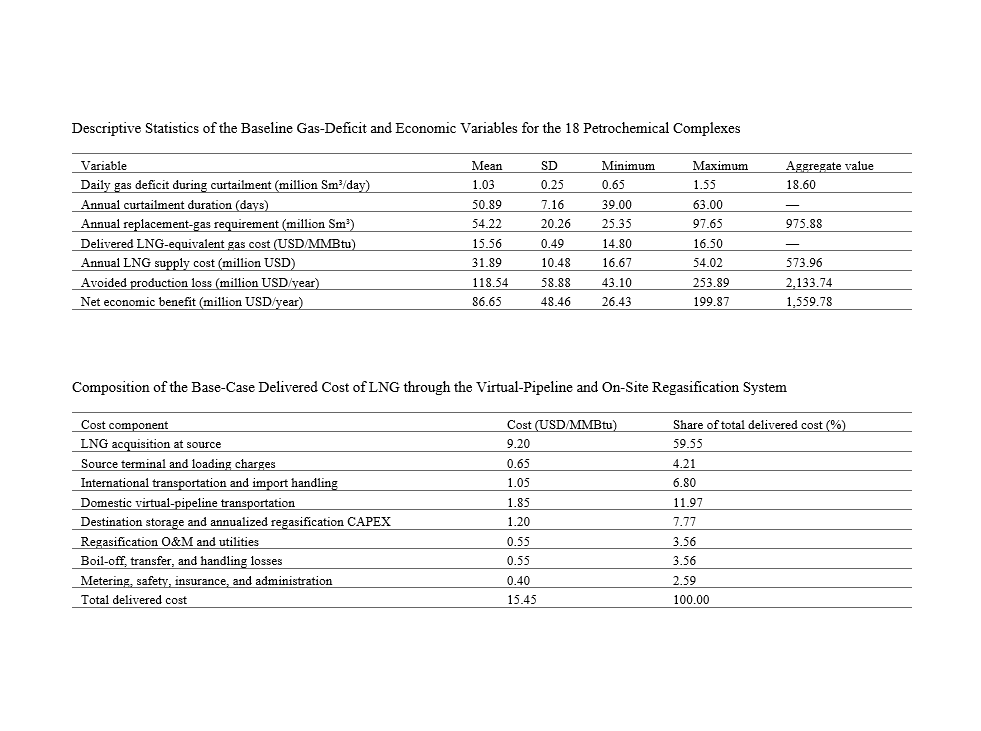
This study aimed to assess the economic feasibility of supplying natural gas to Iranian petrochemical industries during periods of gas imbalance through imported liquefied natural gas (LNG), virtual-pipeline transportation, and on-site regasification. This applied quantitative techno-economic study examined 18 gas-dependent petrochemical complexes located in the principal petrochemical production regions of Iran. A facility-level analytical model was developed to estimate replacement-gas requirements, delivered LNG costs, transportation and handling expenditures, storage and regasification costs, avoided production losses, net economic benefits, benefit-cost ratios, break-even LNG prices, and investment payback periods. The analysis incorporated LNG procurement, international and domestic logistics, cryogenic transportation, storage, regasification, boil-off and handling losses, and petrochemical contribution margins. One-way sensitivity analyses and favorable, base-case, and unfavorable scenarios were used to evaluate economic robustness under changes in LNG price, transportation cost, curtailment duration, infrastructure expenditure, production margins, and other key operational parameters. Under the base-case scenario, the aggregate annual replacement-gas requirement was 975.88 million Sm³, with an estimated LNG supply cost of USD 573.96 million. Avoided petrochemical production losses reached USD 2,133.74 million, producing an annual net economic benefit of USD 1,559.78 million. Facility-level benefit-cost ratios ranged from 2.59 to 4.70, and all 18 complexes remained economically feasible. Break-even LNG purchase prices ranged from USD 38.74 to 67.18/MMBtu. Sensitivity analysis showed that LNG purchase price and petrochemical contribution margin had the strongest effects on economic performance. Even under the unfavorable scenario, the strategy generated a positive net benefit of USD 937.48 million and a benefit-cost ratio of 2.60. Imported LNG delivered through a virtual pipeline and regasified on site can provide an economically viable and flexible response to seasonal gas imbalance in Iran, particularly when supplies are prioritized toward petrochemical complexes with high avoided production losses and favorable logistics.
References
[1] S. Piya, A. Shamsuzzoha, and M. Khadem, "Analysis of supply chain resilience drivers in oil and gas industries during the COVID-19 pandemic using an integrated approach," Applied Soft Computing, vol. 121, p. 108756, 2022, doi: 10.1016/j.asoc.2022.108756.
[2] J. Soheili, "Designing a Supply Chain Resilience Model in the South Pars Gas Complex," Scientific Journal of New Research Approaches in Management and Accounting, vol. 5, no. 18, pp. 32-48, 2021. [Online]. Available: https://majournal.ir/index.php/ma/article/view/1000.
[3] S. A. S. A. Jaradi and D. N. Ayadi, "Improving Logistics and Supply Chain Efficiency in the Oil and Gas Sector: A Literature Review," IJRDO - Journal of Business Management, 2025, doi: 10.53555/bm.v11i1.6323.
[4] C. A. Ogbaini, "Supply Chain Management Strategies on Oil and Gas Companies Performance in Nigeria," INCOME: Innovation of Economics and Management, 2025, doi: 10.32764/income.v4i3.5668.
[5] E. Mehri Babadi, S. Iranzadeh, and K. Fathi Hafshjani, "Providing a Model for Performance Evaluation of Large-Scale Supply Chain in the Oil and Gas Industry (Case Study: National Iranian South Oil Company)," Iranian Management Sciences Association Quarterly Journal, vol. 17, no. 65, pp. 83-121, 2022. [Online]. Available: https://journal.iams.ir/article_369.html.
[6] M. Behi Far, M. Razavi, and P. Jafari, "Dynamic capability of the upstream oil and gas supply chain for achieving competitive advantage," Supply Chain Management, vol. 27, no. 89, pp. 1-26, 2025, doi: 10.47176/scmj.2026.1620.
[7] D. Pentyala, "Enhancing Supply Chain Management in the Oil and Gas Industry Through Digital Transformation of ERP Systems," Research and Analysis Journal, 2022, doi: 10.18535/raj.v5i1.278.
[8] S. K. C. Tulli, "Enhancing Supply Chain Efficiency in the Oil and Gas Industry: The Role of Digital Transformation in ERP Systems for Real-Time Analytics and Decision-Making," Research and Analysis Journal, 2024, doi: 10.18535/raj.v7i03.394.
[9] A. Jusoh, "Digital Supply Chain and Business Performance: The Case of the Oil and Gas Industry," Information Management and Business Review, 2024, doi: 10.22610/imbr.v16i3(i)s.3998.
[10] A. C. Odimarha, S. A. Ayodeji, and E. A. Abaku, "Machine learning's influence on supply chain and logistics optimization in the oil and gas sector: a comprehensive analysis," Computer Science & IT Research Journal, vol. 5, no. 3, pp. 725-740, 2024, doi: 10.51594/csitrj.v5i3.976.
[11] A. V. Orajaka and C. V. Orajaka, "The Role of Artificial Intelligence in Enhancing Supply Chain Performance within Nigeria’s Oil and Gas Sector," International Journal of Research and Innovation in Applied Science, 2025, doi: 10.51584/ijrias.2025.1005000110.
[12] A. Etemadi and A. Kasraei, "Leaning the Supply Chain in the Oil and Gas Industry: A Case Study of Iran Marine Industrial Company," Industrial Management Journal, no. 30, pp. 36-44, 2024.
[13] A. Hosseinzadeh, M. E. Mohammadpourzarandi, and M. A. Afshar Kazemi, "Evaluating Competitive Strategies of LARG Supply Chain Management with a Sustainability Approach: A Case Study of an Oil and Gas Operating Company," Strategic Studies in the Oil and Energy Industry, vol. 14, no. 55, 2022.
[14] A. Keyghobadi, "Presenting a Model for Evaluating Supply Chain Sustainability in the Oil and Gas Industries Based on Structural Equation Modeling," Quarterly Journal of Human Capital Empowerment, vol. 4, no. 2, pp. 129-146, 2021.
[15] A. K. Ghazifard and K. Rasouli, "Study of Influential Variables on Reverse Logistics and Closed-Loop Supply Chain in the Oil and Gas Industry of Gachsaran Using Hierarchical Methods," in Seventh International Conference on Management and Accounting Sciences, 2021. [Online]. Available: https://civilica.com/doc/1257747/.
[16] A. K. Qazi Far and K. Rasouli, "Study of influential variables on reverse logistics and closed-loop supply chain in the oil and gas industry of Gachsaran using hierarchical methods," in Seventh International Conference on Management and Accounting Sciences, Tehran, 2021. [Online]. Available: https://civilica.com/doc/1257747/.
[17] A. Kumar, "Challenges and Opportunities to Conduct a Smart Supply Chain Management in Oil and Gas Industry With a Sustainable Strategies," 2023, doi: 10.52783/jier.v3i2.171.
[18] V. Roshan, "Enhancing Operational Efficiency and Cash Flow through Supply Chain Optimization in the Oil and Gas Sector," International Journal of Business and Management, 2024, doi: 10.5539/ijbm.v19n3p91.
[19] J. B. Alves, M. H. P. Rodrigues, F. A. Duarte, E. B. Furlong, and A. Christ-Ribeiro, "Rice Bran and Its Potential To Complement the Nutritional Needs of Children and Elderly," Plant Foods for Human Nutrition, vol. 78, no. 1, pp. 86-92, 2023/03/01 2023, doi: 10.1007/s11130-022-01014-w.
Downloads
Publication Timeline
- Submitted
- Revised
- Accepted
Issue
Section
License
Copyright (c) 2025 Touraj Dehghani (Corresponding author)

This work is licensed under a Creative Commons Attribution-NonCommercial 4.0 International License.