Engineering Management of CNN-LSTM-Based Mineral Exploration Decisions: A Multi-Objective Framework for Drilling Portfolio Prioritization
Keywords:
artificial intelligence, drilling portfolio, engineering management, mineral exploration, multi-objective decision support, Pareto analysisAbstract
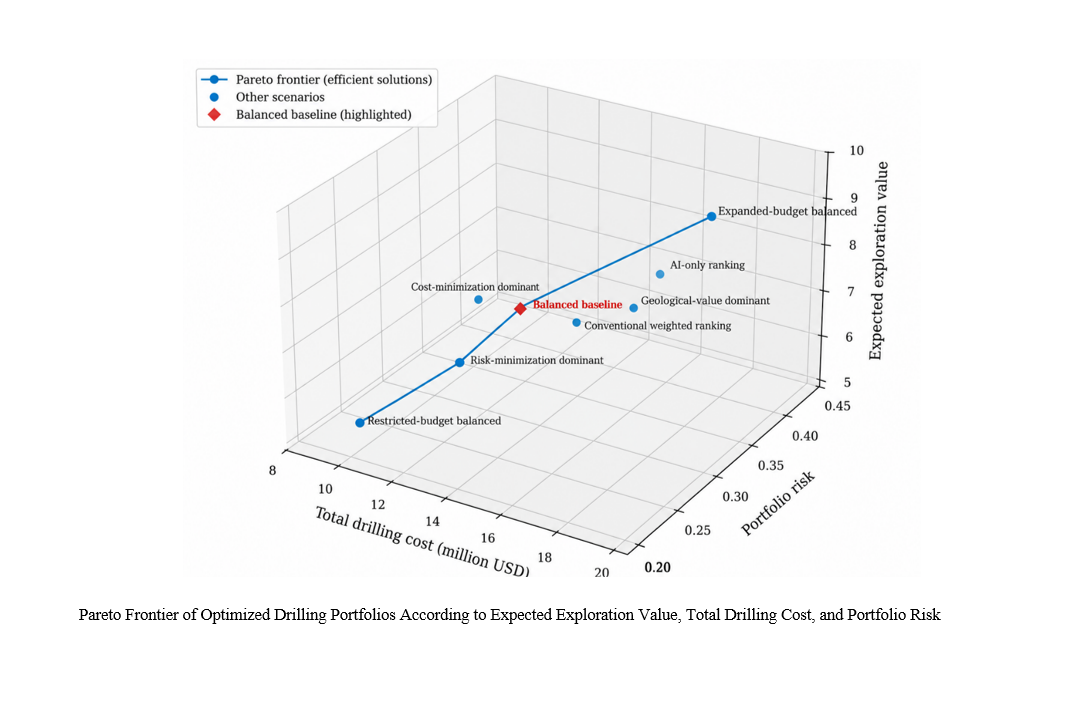
This study aimed to develop and evaluate an integrated engineering-management framework that combines CNN-LSTM-based mineral prospectivity prediction with multi-objective optimization for prioritizing drilling targets under geological, economic, operational, strategic, and risk-related constraints. This applied quantitative study was conducted with 218 mineral exploration and engineering professionals in Tehran, Iran, of whom 206 complete expert records were retained for analysis. Geological, geochemical, geophysical, remote-sensing, topographic, and historical drilling data were integrated and processed using a hybrid convolutional neural network–long short-term memory model. The CNN-LSTM output was incorporated into a multi-criteria drilling decision framework including expected mineralization value, drilling cost, geological confidence, accessibility, technical resources, implementation time, uncertainty, operational risk, environmental sensitivity, safety, and strategic compatibility. Multi-objective portfolio optimization was then performed under alternative budget and management scenarios, followed by sensitivity analysis. The CNN-LSTM model demonstrated strong predictive performance on the independent test set, with accuracy of 0.898, precision of 0.883, recall of 0.909, F1-score of 0.896, ROC-AUC of 0.944, specificity of 0.886, and binary cross-entropy loss of 0.249. The balanced baseline portfolio achieved the highest efficiency score of 0.901, selecting nine targets with mean prospectivity of 0.857, expected portfolio value of 7.56, mean risk of 0.26, and total cost of USD 13.97 million. The AI-only ranking showed higher mean prospectivity (0.906) but lower efficiency (0.806) and higher risk (0.41). Sensitivity analysis showed strong ranking stability, with Spearman correlations ranging from 0.81 to 0.94. Integrating CNN-LSTM prospectivity prediction with multi-objective portfolio optimization produced more balanced and resource-efficient drilling decisions than either AI-only or conventional weighted ranking, demonstrating the value of combining predictive intelligence with engineering-management constraints.
References
[1] G. F. Bonham-Carter, Geographic information systems for geoscientists: Modelling with GIS. Pergamon, 1994.
[2] J. M. A. Hronsky and O. P. Kreuzer, "Applying spatial prospectivity mapping to exploration targeting: Fundamental practical issues and suggested solutions for the future," Ore Geology Reviews, vol. 107, pp. 647-653, 2019, doi: 10.1016/j.oregeorev.2019.03.016.
[3] M. Yousefi, E. J. M. Carranza, O. P. Kreuzer, V. Nykänen, J. M. A. Hronsky, and M. J. Mihalasky, "Data analysis methods for prospectivity modelling as applied to mineral exploration targeting: State-of-the-art and outlook," Journal of Geochemical Exploration, vol. 229, p. 106839, 2021, doi: 10.1016/j.gexplo.2021.106839.
[4] Y. Xiong, R. Zuo, and E. J. M. Carranza, "Mapping mineral prospectivity through big data analytics and a deep learning algorithm," Ore Geology Reviews, vol. 102, pp. 811-817, 2018, doi: 10.1016/j.oregeorev.2018.10.006.
[5] R. Zuo and E. J. M. Carranza, "Machine learning-based mapping for mineral exploration," Mathematical Geosciences, vol. 55, pp. 891-895, 2023, doi: 10.1007/s11004-023-10097-3.
[6] F. Azhari, C. C. Sennersten, C. A. Lindley, and E. Sellers, "Deep learning implementations in mining applications: A compact critical review," Artificial Intelligence Review, vol. 56, pp. 14367-14402, 2023, doi: 10.1007/s10462-023-10500-9.
[7] M. Yuan et al., "A systematic review of deep learning methods for mineral exploration using multisource geoscience data (2018-2025)," International Journal of Applied Earth Observation and Geoinformation, vol. 149, p. 105254, 2026, doi: 10.1016/j.jag.2026.105254.
[8] Z. Wang and R. Zuo, "Mineral prospectivity mapping using a joint singularity-based weighting method and long short-term memory network," Computers & Geosciences, vol. 158, p. 104974, 2022, doi: 10.1016/j.cageo.2021.104974.
[9] R. Zuo, O. P. Kreuzer, J. Wang, Y. Xiong, Z. Zhang, and Z. Wang, "Uncertainties in GIS-based mineral prospectivity mapping: Key types, potential impacts and possible solutions," Natural Resources Research, vol. 30, pp. 3059-3079, 2021, doi: 10.1007/s11053-021-09871-z.
[10] S. E. Zhang, C. J. M. Lawley, J. E. Bourdeau, G. T. Nwaila, and Y. Ghorbani, "Workflow-induced uncertainty in data-driven mineral prospectivity mapping," Natural Resources Research, vol. 33, pp. 995-1023, 2024, doi: 10.1007/s11053-024-10322-8.
[11] G. A. Partington, K. J. Peters, T. A. Czertowicz, P. A. Greville, P. L. Blevin, and E. A. Bahiru, "Ranking mineral exploration targets in support of commercial decision making: A key component for inclusion in an exploration information system," Applied Geochemistry, vol. 168, p. 106010, 2024, doi: 10.1016/j.apgeochem.2024.106010.
[12] A. Ebrahimi, "Optimization techniques for resource allocation in large-scale engineering projects: A review of current approaches," Management Strategies and Engineering Sciences, vol. 1, no. 1, pp. 11-25, 2019.
[13] S. Omidi, "Project portfolio management in engineering: Strategies for resource optimization and risk balancing," Management Strategies and Engineering Sciences, vol. 2, no. 1, pp. 21-30, 2020. [Online]. Available: https://msesj.com/index.php/mses/article/view/13.
[14] K. Miettinen, Nonlinear multiobjective optimization. Kluwer Academic Publishers, 1999.
[15] K. F. Doerner, W. J. Gutjahr, R. F. Hartl, C. Strauss, and C. Stummer, "Pareto ant colony optimization with ILP preprocessing in multiobjective project portfolio selection," European Journal of Operational Research, vol. 171, no. 3, pp. 830-841, 2006, doi: 10.1016/j.ejor.2004.09.009.
[16] A. F. Carazo, T. Gómez, J. Molina, A. G. Hernández-Díaz, F. M. Guerrero, and R. Caballero, "Solving a comprehensive model for multiobjective project portfolio selection," Computers & Operations Research, vol. 37, no. 4, pp. 630-639, 2010, doi: 10.1016/j.cor.2009.06.012.
[17] Ö. Şahin Zorluoğlu and Ö. Kabak, "An interactive multi-objective programming approach for project portfolio selection and scheduling," Computers & Industrial Engineering, vol. 169, p. 108191, 2022, doi: 10.1016/j.cie.2022.108191.
[18] A. R. Hoseini, S. F. Ghannadpour, and M. Hemmati, "A comprehensive mathematical model for resource-constrained multi-objective project portfolio selection and scheduling considering sustainability and projects splitting," Journal of Cleaner Production, vol. 269, p. 122073, 2020, doi: 10.1016/j.jclepro.2020.122073.
[19] M. G. C. Resende, R. Martí, M. Gallego, and A. Duarte, "GRASP and path relinking for the max-min diversity problem," Computers & Operations Research, vol. 37, no. 3, pp. 498-508, 2010, doi: 10.1016/j.cor.2008.05.011.
Downloads
Publication Timeline
- Submitted
- Revised
- Accepted
Issue
Section
License
Copyright (c) 2025 Shahou Rezaei (Author); Farnusch Hajizadeh (Corresponding author)

This work is licensed under a Creative Commons Attribution-NonCommercial 4.0 International License.