Exploring the Trajectory from Causes to Outcomes of Totalitarian Corporate Governance in the Context of Iran’s Capital Market
Keywords:
Totalitarian Corporate Governance, Grounded Theory, Structural Utility FittingAbstract
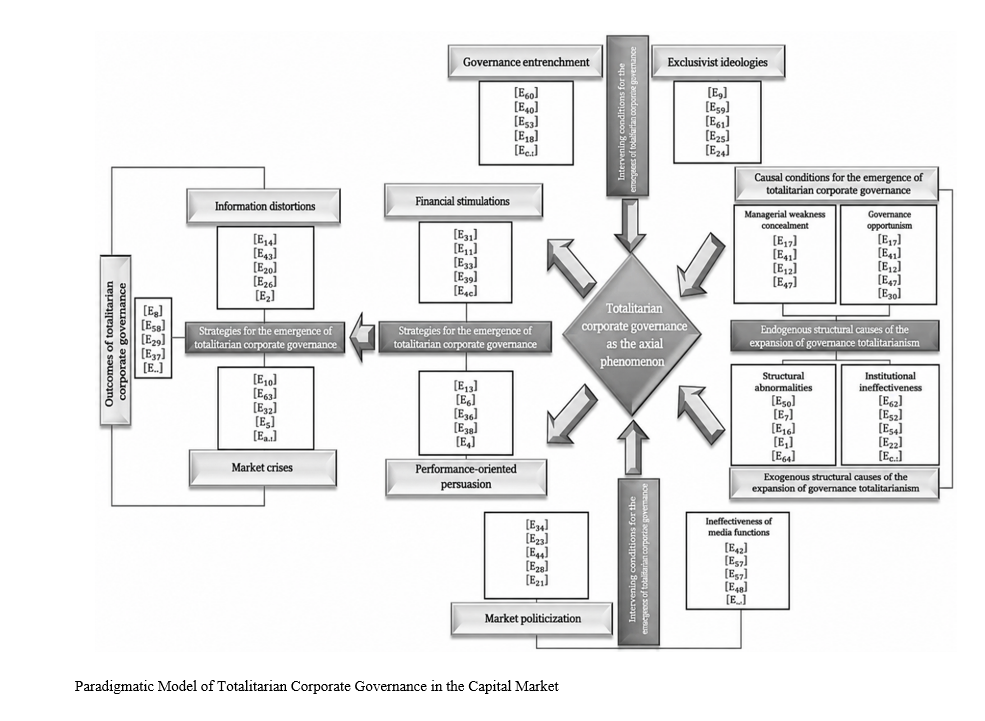
The purpose of this study is to present a framework for understanding the trajectory from causes to outcomes of totalitarian corporate governance within the context of Iran’s capital market. From a methodological perspective, this study is considered a mixed-method investigation and, through the implementation of the grounded theory process based on the approach of Anselm Strauss and Juliet Corbin (1998), seeks to provide a paradigmatic framework for a deeper understanding of corporate governance mechanisms in Iran’s capital market. Through expert interviews and the execution of three stages of coding, the study attempted to identify five dimensions—including causal conditions, contextual conditions, intervening conditions, strategies, and consequences—within a theoretical framework. Subsequently, using a simple random sampling method, financial managers and heads of accounting departments of capital market companies, on the one hand, and technical experts of the capital market, on the other hand, were selected as the target population of the quantitative section of the study. The developed checklists, based on the convergence of core components with the identified conceptual themes, were distributed among these participants in order to establish paradigmatic dimensions through rotated matrix combinations and exploratory/confirmatory factor analysis coefficients. The research findings, following interviews and the three-stage coding process conducted to present the identified dimensions within a paradigmatic framework, utilized two criteria—Content Validity Index (CVI) and test–retest reliability coefficient—to confirm the identification of 65 conceptual themes derived from 401 open codes generated during the interviews, organized into 13 core components and 6 structural categories within the paradigmatic model. Furthermore, after conducting exploratory and confirmatory factor analyses indicating satisfactory structural model fit, the convergence among core components in relation to the identified conceptual themes was also confirmed through orthogonal and oblique rotation processes in factor analysis and through the integration of matrix scales with a five-point Likert scale. These findings demonstrate that the proposed paradigmatic model possesses generalizability within the study context. The results obtained from the final paradigmatic model indicate that the development and expansion of totalitarian corporate governance within the capital market may be the outcome of endogenous and exogenous functions that create the conditions for the growth and expansion of authoritarian corporations. Such corporations prioritize the preservation of the interests of founders and power structures emerging at the apex of capital market companies, while disregarding the interests of minority shareholders and investors.
References
[1] J. Park and S. Lee, "Governance Centralization and the Risk of Corporate Misconduct," Business Ethics Quarterly, vol. 35, no. 1, pp. 88-112, 2025, doi: 10.1017/beq.2024.27.
[2] C. Lin and T. Yang, "Corporate Governance Rigidity and Monitoring Failure: A Multi-Stakeholder Analysis," International Review of Financial Analysis, vol. 92, no. 1, p. 103145, 2025, doi: 10.1016/j.irfa.2024.103035.
[3] A. Zaitoul and R. B. Adams, "Corporate Governance, Board Power, and Stakeholder Welfare," Journal of Corporate Finance, vol. 80, no. 2, p. 102144, 2023, doi: 10.1016/j.jcorpfin.2023.102350.
[4] A. Gramsci, Modern Prince and Other Writings (The Prison Notebooks (Quaderni del carcere)). Lawrence and Wishart, International Publishers Company, 1996.
[5] J. O. Ogbor, "Critical Theory and the Hegemony of Corporate Culture," Journal of Organizational Change Management, vol. 14, no. 6, pp. 590-608, 2001, doi: 10.1108/09534810110408015.
[6] H. M. Trebing and P. N. Goldstene, "Corporate Hegemony," Journal of Economic Issues, vol. 24, no. 4, pp. 1147-1155, 1990, doi: 10.1080/00213624.1990.11505109.
[7] I. Harymawan and J. Nowland, "Board Independence and the Mitigation of Managerial Dominance," Accounting & Finance, vol. 64, no. 1, pp. 211-233, 2024, doi: 10.1111/acfi.13127.
[8] M. A. Khan and C. Mallin, "Concentration of Control and Corporate Transparency: Implications for Minority Shareholders," Corporate Governance: An International Review, vol. 31, no. 4, pp. 745-762, 2023, doi: 10.1111/corg.12456.
[9] Y. Zhu and P. Wang, "Governance Failures and Information Opacity: How Managerial Entrenchment Affects Market Integrity," Journal of Business Research, vol. 169, no. 1, p. 114134, 2024, doi: 10.1016/j.jbusres.2023.114234.
[10] V. Kitiwong and A. A. Sarhan, "Ownership Concentration and the Erosion of Stakeholder Rights: Evidence from Emerging Markets," Finance Research Letters, vol. 58, no. 3, p. 104160, 2024, doi: 10.1016/j.frl.2024.104460.
[11] A. Charoenrook and C. M. Lewis, "Information, Selective Disclosure, and Analyst Behavior," Financial Management, vol. 38, no. 1, pp. 39-57, 2009, doi: 10.1111/j.1755-053X.2009.01027.x.
[12] I. Dadashi, "Board Governance Mechanisms and Misclassification of Operating Revenues and Expenses: An Application of Quantile-on-Quantile Regression," Accounting Advances, vol. 17, no. 1, pp. 115-147, 2025.
[13] M. Marfou and S. M. Hassanzadeh Diva, "Earnings Management: Opportunistic Behaviors, Monitoring Mechanisms, and Financial Distress," Journal of Financial Accounting and Auditing Research, vol. 12, no. 48, pp. 43-81, 2020.
[14] L. Zamanianfar, H. Alidadi, D. Heydari, and A. Altafi, "Driving Contexts of Governance Possessiveness in Family Firms: Reflection of Caudillo Governance Theory," Empirical Studies in Financial Accounting, vol. 21, no. 84, pp. 279-316, 2024.
[15] M. H. Safarzadeh and S. Tavousi, "The Relationship between Corporate Governance and Related-Party Transactions," Quarterly Journal of Empirical Studies in Financial Accounting, vol. 13, no. 53, pp. 135-151, 2017.
[16] J. Shokrkhah, M. Amiri, G. Bolo, and H. Mozaffari, "Developing Corporate Governance Principles for the Iranian Capital Market," Financial Management Perspective, vol. 10, no. 31, pp. 29-52, 2021.
[17] Ž. Paić, "The Return of Totalitarianism," Springer Nature Link, vol. 2, no. 1, pp. 71-102, 2023.
[18] H. F. Zou, "Why Totalitarian Regimes Fall: A Unified Model of Power, Conformity, Dissent, and Entropy," Central University of Finance and Economics, 2025, vol. 2.
[19] G. Khedri and A. Khorram, "The Decline of Empathy in Totalitarian Systems from Hannah Arendt’s Perspective," Contemporary Political Essays, vol. 13, no. 3, pp. 53-75, 2022.
[20] J. Novak, "Understanding and Judging History: Hannah Arendt and Philosophical Hermeneutics," Meta: Research in Hermeneutics, Phenomenology, and Practical Philosophy, no. 2, 2010.
[21] Y. Cao, "Totalitarian Accounting and the Trumpian Risks," MSI Journal of Economics and Business Management, vol. 2, no. 3, pp. 13-16, 2025. [Online]. Available: https://mpra.ub.uni-muenchen.de/125456.
[22] M. E. Geis, A. Bosiacki, and C. Safferling, Dealing with Totalitarian Regimes and Human Rights: A Polish-German Dialogue (Interdisciplinary Studies in Human Rights). 2025, pp. 1-198.
[23] M. T. Sabzeei, "Civil Society against Totalitarian Regimes: A Sociological Analysis of Eastern European Approaches to Civil Society," Iranian Journal of Sociology, vol. 13, no. 1-2, pp. 109-129, 2012.
[24] S. P. Vallas, "Why Teamworking Fails: Obstacles to Workplace Change in Four Manufacturing Plants," American Sociological Review, vol. 68, no. 2, pp. 223-250, 2003, doi: 10.2307/1519767.
[25] A. Strauss and J. Corbin, Basics of Qualitative Research: Techniques and Procedures for Developing Grounded Theory. Thousand Oaks, CA: Sage Publications, 1998.
[26] M. J. Keane, Power System Stability and Control. McGraw-Hill, 2001.
[27] F. Sharaei, A. M. Kalabi, and S. H. Khodadad, "Designing a Corporate Sustainable Development Model: Explaining the Role of Corporate Social Responsibility, Corporate Governance, and Creating Shared Value," Social Capital Management, vol. 6, no. 3, pp. 305-325, 2019.
Downloads
Publication Timeline
- Submitted
- Revised
- Accepted
Issue
Section
License
Copyright (c) 2025 Behnam Khatibi Sharifie (Author); Mohammadreza Abdoli (Corresponding author); Hasan Valiyan, Maryam Shahri (Author)

This work is licensed under a Creative Commons Attribution-NonCommercial 4.0 International License.