Hybrid BWM–VIKOR Evaluation under PLTS Conditions for the Application of Industry 4.0 Technologies in Retail Management with Emphasis on Warehouse Systems
Keywords:
Industry 4, 0 technologies, retail management, warehousing, PLTS, BWM–VIKORAbstract
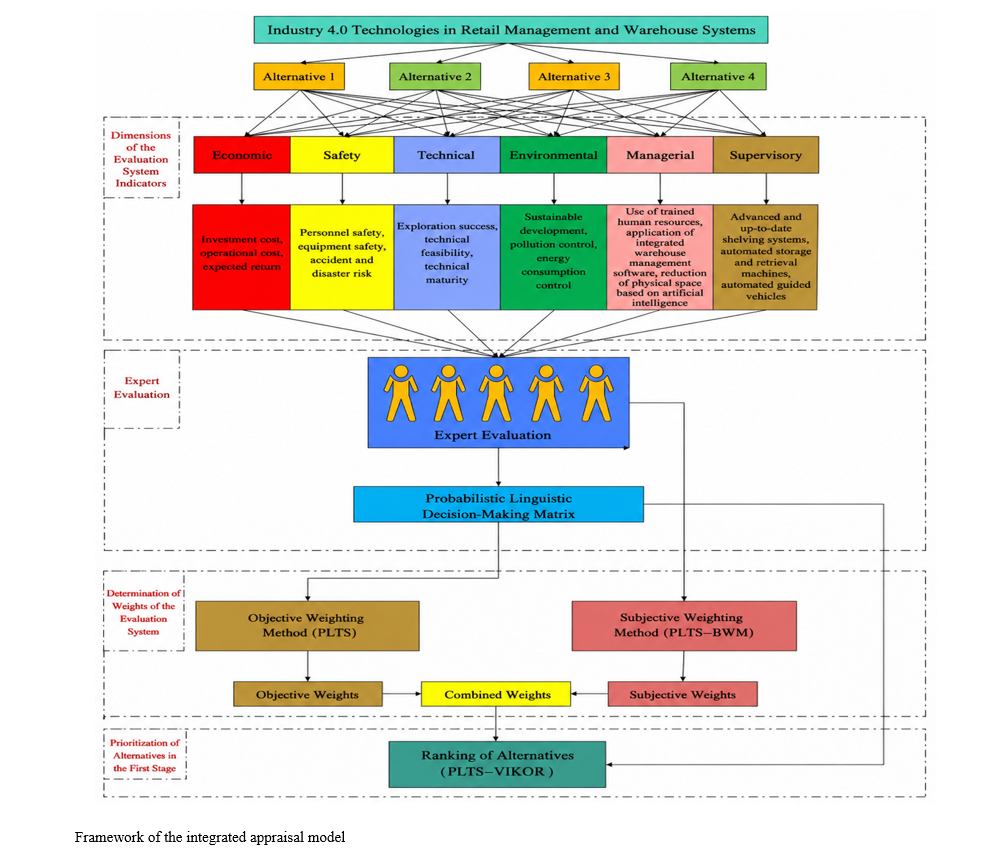
Traditional warehousing methods not only fail to meet current requirements but also lead to increased operational errors, product waste, and reduced productivity. In recent decades, the retail industry has undergone significant transformations in technology, consumer behavior, and supply chain structures. The emergence of the Fourth Industrial Revolution (Industry 4.0) has created unprecedented opportunities for optimizing operational processes. In this context, warehouse management within the complex and multi-branch structure of chain stores, as one of the critical pillars of the supply chain, plays a key role in achieving productivity, flexibility, and customer satisfaction. Therefore, the aim of this study is to evaluate a hybrid BWM–VIKOR approach under PLTS conditions for the application of Industry 4.0 technologies in retail management, with an emphasis on warehouse systems. This study is categorized as an analytical–survey research. Given the application of the VIKOR and BWM techniques, the statistical population and sample consist of 10 experts in retail management with extensive experience, as well as specialists in Industry 4.0 technologies, selected through a census approach. Purposeful sampling is employed in this research. Data collection methods include both library research (articles, journals, books, and theses) and field studies (pairwise comparison questionnaires). The findings indicate that this study introduces a hybrid model to enhance decision-making efficiency. The limitations associated with subjective absolutism in single subjective weighting methods are reduced by this model, and the logical consistency of evaluation results is improved. Furthermore, the use of PLTS ensures the accuracy of evaluation data. In the domain of warehouse management, this hybrid model represents an advanced approach to multi-criteria decision-making (MCDM) that balances subjective judgments with objective data, thereby increasing the robustness and validity of decision-making. By reducing biases and improving overall performance, this method supports more informed and balanced decision-making. The results demonstrate that the model for implementing Industry 4.0 technologies in warehouse management of chain stores, developed in this study using the BWM–VIKOR method, has practical value for future decision-making evaluations regarding Industry 4.0 technologies in warehouse management of chain stores. The integration of the BWM–VIKOR approach into Industry 4.0 implementation processes is recognized as an advanced analytical tool that can enhance strategic planning and operational efficiency. This model provides a comprehensive understanding of the indicators, enabling chain store managers to develop effective warehouse management strategies and ultimately ensuring readiness and resilience in modern and intelligent warehousing systems.
References
[1] S. Ghaznavi, "Technology and Information Technology in Optimizing Modern Warehousing," in Proceedings of the 8th International Conference on Knowledge and Technology of Electrical, Mechanical, and Computer Engineering, Tehran, Iran, 2022/03/18 2022, pp. 135-146. [Online]. Available: https://civilica.com/doc/1637776.
[2] M. Amiri and E. Mirzakhaniyan, "A Review of the Economic and Financial Performance of Demand-Driven Innovative Warehousing Systems," in Proceedings of the 8th International Conference on Logistics and Supply Chain: Transformative, Innovative, and Knowledge-Based Ecosystems, Tehran, Iran, 2022/02/01 2022, pp. 59-79. [Online]. Available: https://civilica.com/doc/1650851.
[3] A. Ahmad, P. K. Singh, and M. Alam, "Industrial Internet of Things (IIoT): Enabling Technologies, Challenges, and Future Directions," Journal of Industrial Information Integration, vol. 30, p. 100459, 2023, doi: 10.1016/j.jii.2022.100459.
[4] R. Kurniawan, "A Survey: Implementation of Internet of Things in Industry," Procedia Computer Science, vol. 167, pp. 736-745, 2020, doi: 10.1016/j.procs.2020.03.396.
[5] X. Li, Y. Zhang, and L. Zhao, "IoT and Machine Learning-Based Decision Support System in Industry 4.0: Enhancing Smart Warehouse Management," Computers & Industrial Engineering, vol. 153, p. 107060, 2021, doi: 10.1016/j.cie.2020.107060.
[6] P. Balakrishnan, R. Kumar, and V. Singh, "IoT, Autonomous Mobile Robots, and Blockchain for Smart Warehouse Transformation: A Unified Framework," Journal of Cleaner Production, vol. 414, p. 137591, 2023, doi: 10.1016/j.jclepro.2023.137591.
[7] M. Ghobakhloo, M. Iranmanesh, B. Foroughi, M. L. Tseng, D. Nikbin, and A. A. Khanfar, "Industry 4.0 digital transformation and opportunities for supply chain resilience: a comprehensive review and a strategic roadmap," Production planning & control, vol. 36, no. 1, pp. 61-91, 2025 2025, doi: 10.1080/09537287.2023.2252376.
[8] T. Khan and M. M. H. Emon, "Supply chain performance in the age of Industry 4.0: evidence from manufacturing sector," Brazilian Journal of Operations & Production Management, vol. 22, no. 1, pp. 2434-2434, 2025. [Online]. Available: https://doi.org/10.14488/BJOPM.2434.2025.
[9] D. Savushkin, "Warehouse Automation and Autonomous Robotics: Improving Logistics Performance in Amazon and Ocado," Procedia Manufacturing, vol. 68, pp. 355-366, 2024, doi: 10.1016/j.promfg.2024.02.031.
[10] M. Qi, D. Chen, and Y. Wu, "Enhancing Safety and Efficiency in AGV-Based Warehouse Logistics Using Real-Time Obstacle Detection," Robotics and Computer-Integrated Manufacturing, vol. 54, pp. 124-133, 2018, doi: 10.1016/j.rcim.2018.05.007.
[11] S. Sharifian Jazi, A. Mohammadi, A. Abbasi, and M. Alimohammadlou, "Identifying Challenges Affecting the Implementation of Circular Economy and Industry 4.0 in Supply Chain Management," Management Research in Iran, vol. 28, no. 2, pp. 146-183, 2025 2025. [Online]. Available: https://mri.modares.ac.ir/article_661_en.html?lang=fa.
[12] S. Shafiei, "Presenting a conceptual model for the deployment of Industry 4.0 technologies in the supply chain with a grounded theory approach," New Marketing Research, vol. 15, no. 3, pp. 133-160, 2025, doi: 10.22108/nmrj.2025.145929.3216.
[13] M. Peron, P. Barbosa, G. L. Tortorella, and F. S. Fogliatto, "Integration of Industry 4.0 Technologies and Just-in-Time Systems in Smart Warehousing: A Multi-Dimensional Framework," International Journal of Production Economics, vol. 240, p. 108232, 2021, doi: 10.1016/j.ijpe.2021.108232.
[14] R. Singh, "Digital Transformation of Indian Manufacturing Supply Chains: An Industry 4.0 Perspective," Interantional Journal of Scientific Research in Engineering and Management, vol. 09, no. 06, pp. 1-9, 2025, doi: 10.55041/ijsrem50326.
[15] N. Maghsoudi, M. Heidari, and N. Matin, "Adoption of the Fourth Industrial Revolution in Iranian Small and Medium-Sized Enterprises," in Proceedings of the 11th International Conference on Interdisciplinary Research in Management, Accounting, and Economics in Iran, Tehran, Iran, 2023/02/19 2023, pp. 159-167. [Online]. Available: https://civilica.com/doc/1994600.
Downloads
Publication Timeline
- Submitted
- Revised
- Accepted
Issue
Section
License
Copyright (c) 2025 Amirmohammad Shirani , Mansour Momeni (Author); Fatemeh Saghafi (Corresponding author)

This work is licensed under a Creative Commons Attribution-NonCommercial 4.0 International License.