The Effect of Managers’ Soft Governance on Employees’ Knowledge Sharing in Government Organizations of Guilan Province: A Structural Equation Modeling Approach
Keywords:
Soft Governance, Knowledge Sharing, Government OrganizationsAbstract
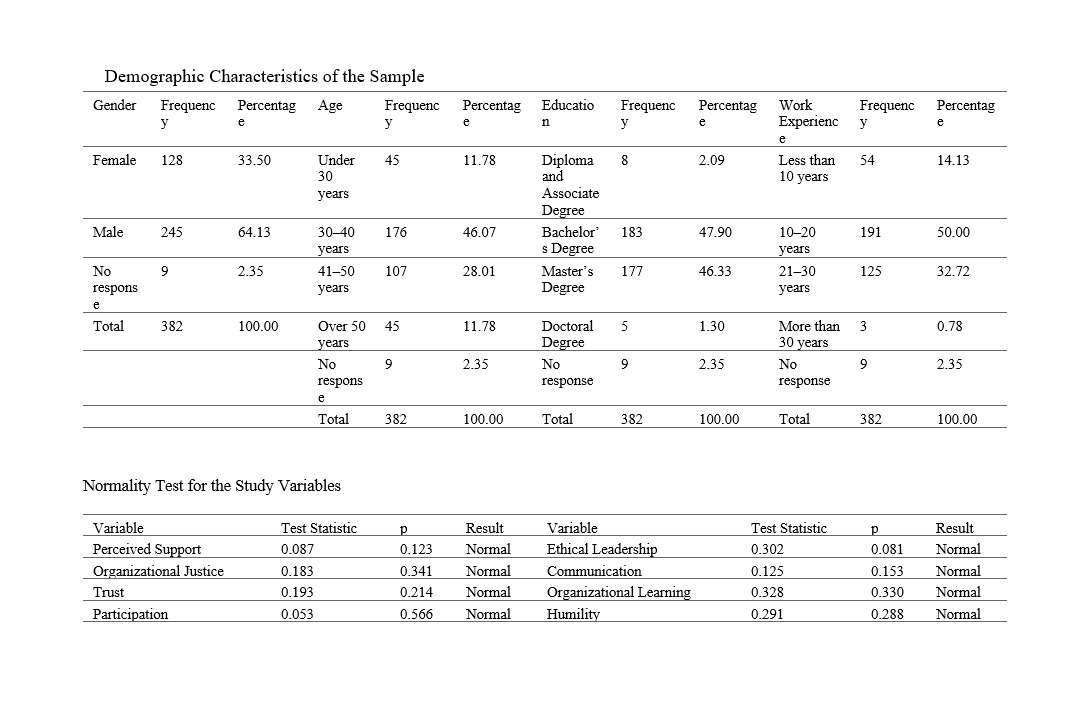
The present study aimed to examine the effect of managers’ soft governance on employees’ knowledge sharing in government organizations of Guilan Province using a structural equation modeling approach. In terms of purpose, the study was developmental, and in terms of methodology, it was descriptive-analytical. The statistical population consisted of managers and employees of government organizations in Guilan Province, and the sample size was determined as 382 participants using Cochran’s formula. Convenience non-probability sampling was employed, and data were collected using a questionnaire. Structural equation modeling was used to analyze the data. The findings indicated that soft governance had a direct and significant effect on knowledge sharing, with a path coefficient of 0.857. In addition, the dimensions of soft governance, including perceived support (0.741), organizational justice (0.632), and participation (0.613), made the greatest contributions to explaining the variance in knowledge sharing. The results indicate that strengthening the soft dimensions of governance can provide an appropriate foundation for facilitating knowledge-sharing processes in government organizations.
References
[1] G. Schiuma, F. Santarsiero, D. Carlucci, and Y. Jarrar, "Transformative Leadership Competencies for Organizational Digital Transformation," Business Horizons, vol. 67, no. 4, pp. 425-437, 2024, doi: 10.1016/j.bushor.2024.04.004.
[2] S. D. Müller, H. Konzag, J. A. Nielsen, and H. B. Sandholt, "Digital Transformation Leadership Competencies: A Contingency Approach," International Journal of Information Management, vol. 75, p. 102734, 2024, doi: 10.1016/j.ijinfomgt.2023.102734.
[3] M. Orkamo, J. Ukko, T. Rantala, and M. Saunila, "Leadership Behaviours to Promote Organisational Performance in Private Sector Digital Transformation-A Systematic Literature Review," Digital Business, p. 100155, 2025, doi: 10.1016/j.digbus.2025.100155.
[4] H. op 't Roodt, E. M. Bracht, R. van Dick, and A. S. Hernandez Bark, "Navigating Through the Digital Workplace: Measuring Leader Digital Competence," Journal of Business and Psychology, vol. 40, no. 1, pp. 179-205, 2025, doi: 10.1007/s10869-024-09947-6.
[5] M. A. Mollah, J. H. Choi, S. J. Hwang, and J. K. Shin, "Exploring a Pathway to Sustainable Organizational Performance of South Korea in the Digital Age: The Effect of Digital Leadership on IT Capabilities and Organizational Learning," Sustainability, vol. 15, no. 10, p. 7875, 2023, doi: 10.3390/su15107875.
[6] M. J. Ahsan, "Unlocking Sustainable Success: Exploring the Impact of Transformational Leadership, Organizational Culture, and CSR Performance on Financial Performance in the Italian Manufacturing Sector," Social Responsibility Journal, vol. 20, no. 4, pp. 783-803, 2024, doi: 10.1108/SRJ-06-2023-0332.
[7] A. S. Jameel, "The Impact of Digital Leadership on Employee Performance in the Education Sector of Iraq: The Mediating Role of Digital Transformation," International Journal of Management and Human Science, vol. 10, no. 1, pp. 75-90, 2026, doi: 10.31674/ijmhs.2026.v10i01.008.
[8] P. Bellis, M. Cunial, and D. Trabucchi, "Mastering Hybrid Worlds Through Digital Leadership: The Role of Agility in Fostering Innovation," Business Horizons, vol. 67, no. 4, pp. 369-380, 2024, doi: 10.1016/j.bushor.2024.04.002.
[9] M. Liu, P. Zhang, Y. Zhu, and Y. Li, "How and When Does Visionary Leadership Promote Followers' Taking Charge? The Roles of Inclusion of Leader in Self and Future Orientation," Psychology Research and Behavior Management, pp. 1917-1929, 2022, doi: 10.2147/PRBM.S366939.
[10] J. Jameson, N. Rumyantseva, M. Cai, M. Markowski, R. Essex, and I. McNay, "A Systematic Review and Framework for Digital Leadership Research Maturity in Higher Education," Computers and Education Open, vol. 3, p. 100115, 2022, doi: 10.1016/j.caeo.2022.100115.
[11] J. Zhou and A. W. C. Tse, "The Effects of Kindergarten Principals' Digital Leadership on Teachers' Technology Integration During the COVID-19 Pandemic in Western China," in 2023 IEEE International Conference on Teaching, Assessment and Learning for Engineering (TALE), 2023: IEEE, pp. 1-8, doi: 10.1109/TALE56641.2023.10398359.
[12] F. Firmansyah, G. Erda, and A. W. Khurniawan, "The Impact of Digital Transformation and Leadership on Organizational Resilience in Distance Education Institution: Higher-Order SEM Approach," Turkish Online Journal of Distance Education, vol. 25, no. 2, pp. 115-129, 2024, doi: 10.17718/tojde.1260433.
[13] Z. Cheng, A. Caliskan, N. B. K. Dinh, and C. Zhu, "A Systematic Review of Digital Academic Leadership in Higher Education," International Journal of Higher Education, vol. 13, no. 4, pp. 38-50, 2024, doi: 10.5430/ijhe.v13n4P38.
[14] Y. Song, "The Preliminary Construction of an Evaluation Index System for Digital Competence of University Leaders in the Context of Digital Transformation," in Artificial Intelligence, Medical Engineering and Education: Proceedings of the 7th International Conference (AIMEE 2023): SAGE Publications, 2024, pp. 607-613.
[15] S. Ratajczak, "Digital Leadership at Universities-A Systematic Literature Review," Forum Scientiae Oeconomia, vol. 10, no. 4, pp. 133-150, 2022.
[16] A. Carvalho, J. Leitão, and H. Alves, "Digital Transformation, State HEI Performance and the Moderating Role of Leadership," International Journal of Leadership in Education, pp. 1-33, 2023, doi: 10.1080/13603124.2023.2281349.
[17] I. Gutu, C. N. Medeleanu, and R. Asiminei, "The Limits of Learning Engagement and Academic Leadership Within the Higher Education Digitalization Process-Analysis by Using PLS-SEM," PLOS ONE, vol. 19, no. 11, p. e0306079, 2024, doi: 10.1371/journal.pone.0306079.
[18] S. Mehmood, "Exploring Digital Leadership, Technology Integration, and Teacher Task Performance in Higher Education Institutions: A Moderated-Mediation Study," Journal of Digitovation and Information Systems, vol. 3, no. 1, pp. 141-155, 2023, doi: 10.54433/JDIIS.2023100026.
[19] K. Ö. Yılmaz, "Digital Maturity Models: A Holistic Framework for Digital Transformation," in Handbook of Research on Digitalization Solutions for Social and Economic Needs: IGI Global Scientific Publishing, 2023, pp. 119-139.
[20] Z. Zhao and Y. Yan, "The Role of Organizational Unlearning in Manufacturing Firms' Sustainable Digital Innovation: The Mechanism of Strategic Flexibility and Organizational Slack," Sustainability, vol. 15, no. 13, p. 10371, 2023, doi: 10.3390/su151310371.
Downloads
Publication Timeline
- Submitted
- Revised
- Accepted
Issue
Section
License
Copyright (c) 2025 Masoumeh Yousefi Qasabsaraei (Author); Masoud Yousefzadeh (Corresponding author); Mohammad Reza Bagherzadeh (Author)

This work is licensed under a Creative Commons Attribution-NonCommercial 4.0 International License.