The Role of Identity Leadership in Enhancing Brand Alignment and Organizational Identity with Emphasis on Organizational Culture, Employee Commitment, and Internal Communication
Keywords:
Identity Leadership, Organizational Culture, Employee Commitment, Internal Communication, Brand-Organizational Identity AlignmentAbstract
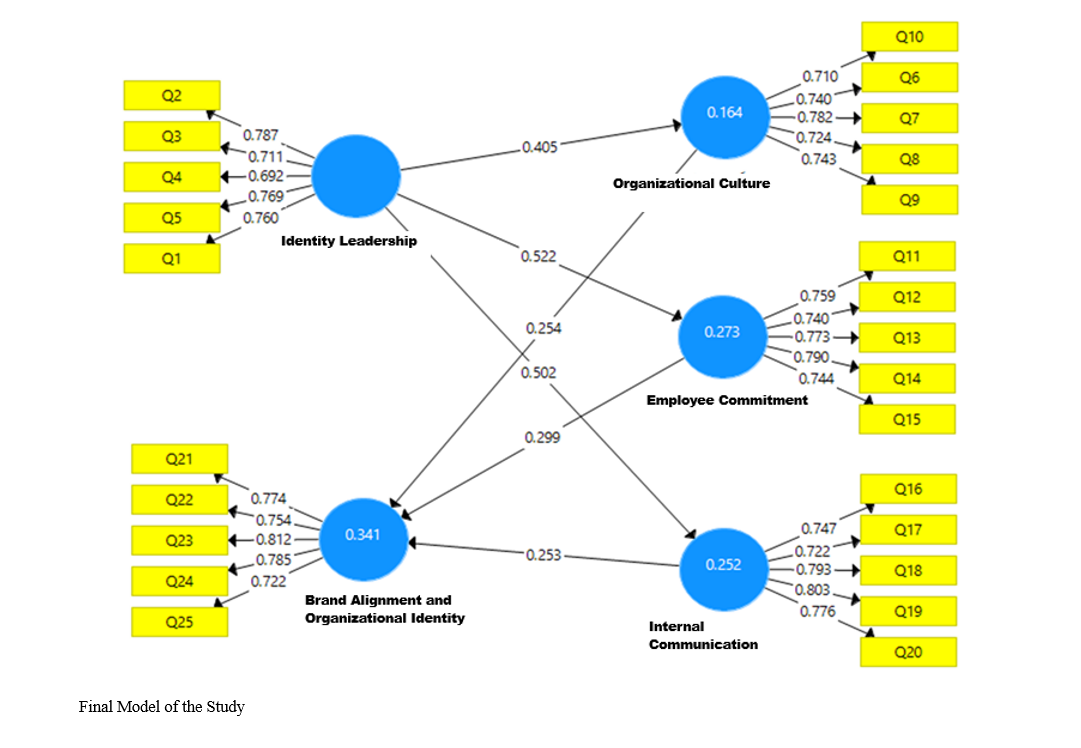
The present study aimed to examine the role of identity leadership in strengthening the alignment between brand and organizational identity by considering the mediating roles of organizational culture, employee commitment, and internal communication. This study was conducted using a quantitative and applied approach with a survey design. The statistical population consisted of employees of banks in Fars Province, from which a sample of 400 participants was selected through random sampling. Data were collected using a 25-item questionnaire based on a five-point Likert scale. The reliability of the instrument was confirmed using Cronbach’s alpha, composite reliability, and average variance extracted (AVE). Data analysis was performed using descriptive statistics and Partial Least Squares Structural Equation Modeling (PLS-SEM). The measurement model was assessed in terms of reliability and convergent and discriminant validity, while the structural model was evaluated using path coefficients, coefficient of determination (R²), effect size (f²), and predictive relevance (Q²). The results indicated that identity leadership has a significant positive effect on organizational culture (β = 0.405, p < 0.01), employee commitment (β = 0.522, p < 0.01), and internal communication (β = 0.502, p < 0.01). Furthermore, organizational culture (β = 0.254, p < 0.01), employee commitment (β = 0.299, p < 0.01), and internal communication (β = 0.253, p < 0.01) were found to have significant positive effects on brand alignment and organizational identity. The model demonstrated acceptable explanatory power, with R² values of 0.164 for organizational culture, 0.273 for employee commitment, 0.252 for internal communication, and 0.341 for brand alignment and organizational identity. Positive Q² values confirmed the predictive relevance of the model. The findings suggest that identity leadership plays a critical role in fostering alignment between brand and organizational identity by enhancing organizational culture, strengthening employee commitment, and improving internal communication processes. These results highlight the importance of identity-based leadership as a strategic mechanism for achieving internal coherence and sustainable organizational performance.
References
[1] P. Milesi, "Identity Leadership, Procedural Justice, and Group Identification in Uncertain Organizational Contexts," Journal of Applied Social Psychology, vol. 52, no. 9, pp. 886-911, 2022, doi: 10.1111/jasp.12897.
[2] C. Peng et al., "How Servant Leadership Predicts Employee Resilience in Public Organizations: A Social Identity Perspective," Current Psychology, vol. 42, no. 35, pp. 31405-31420, 2022, doi: 10.1007/s12144-022-04138-z.
[3] J. Mokhchy, G. Chen, S. Ahmad, Y. A. Khan, J. Zhang, and M. Ahmed, "Dynamic impact of leadership style, knowledge-sharing, and organizational culture on organizational performance," Current Psychology, vol. 44, no. 6, pp. 4097–4112, 2025, doi: 10.1007/s12144-025-07411-z.
[4] M. A. Nadi and Z. Mashaieki, "Analyzing the Relationship Between Organizational Socialization, Leadership Behavior, Organizational Identity, and Organizational Culture with Organizational Citizenship Behavior Among Administrative Staff of Isfahan's Education Department," Applied Sociology, vol. 28, no. 3, pp. 153-176, 2019. [Online]. Available: https://jas.ui.ac.ir/article_21716.html.
[5] M. J. Mousavi Nia, M. Ashaqi, and A. Z. Naami, "The relationship between ethical leadership, organizational identity, and spirituality in the workplace with unethical behavior for the benefit of the organization, mediating job satisfaction among employees of Shahid Chamran University of Ahvaz," Journal of Knowledge and Research in Applied Psychology, no. 88, pp. 215-225, 2022. [Online]. Available: https://www.sid.ir/paper/1032764/fa.
[6] M. Ahmed and M. I. Khan, "Unpacking the Paradoxical Impact of Ethical Leadership on Employees’ Unethical Pro-Organizational Behavior: The Interplay of Employees’ Psychological Capital and Moral Identity," Sage Open, vol. 14, no. 4, 2024, doi: 10.1177/21582440241300194.
[7] L. Zhang, Z. Liu, and X. Li, "Impact of Co-worker ostracism on organizational citizenship behavior through employee self-identity: the moderating role of ethical leadership," Psychology Research and Behavior Management, pp. 3279-3302, 2023, doi: 10.2147/prbm.s415036.
[8] S. M. A. Shah, N. Ahmed, A. U. Haq, and S. Saba, "Leadership for Innovation: Fostering the Culture of Creativity in Organization: A Systematic Literature Review," Journal of Asian Development Studies, vol. 14, no. 2, pp. 945-957, 2025, doi: 10.62345/jads.2025.14.2.72.
[9] K. B. Rahayu, H. Khoiru, and G. Sugiyarti, "Building Organizational Reputation Through Inclusive Leadership and Inclusive Culture: The Mediation Role of Organizational Competitiveness in the Era of Digital Transformation (Case Study on Employees of the Semarang City Regional Revenue Agency)," Saudi Journal of Business and Management Studies, vol. 10, no. 01, pp. 54-63, 2025, doi: 10.36348/sjbms.2025.v10i01.006.
[10] I. Muis, "The Effects of Knowledge Management, Digital Leadership and Organizational Culture on Employee Performance," Sjam, vol. 3, no. 1, pp. 1-16, 2025, doi: 10.38035/sjam.v3i1.411.
[11] F. Aldossari and S. Alanizan, "The Impact of Transformational Leadership on Employee Performance: The Mediating Role of Job Satisfaction and Organizational Commitment," Edelweiss Applied Science and Technology, vol. 9, no. 6, pp. 609-625, 2025, doi: 10.55214/25768484.v9i6.7860.
[12] S. Manoharan et al., "The Impact of Leadership Effectiveness on Employee Commitment and Engagement Within Corporate Workplaces," Management (Montevideo), vol. 3, p. 175, 2025, doi: 10.62486/agma2025175.
[13] U. Yaseen, R. N. Idrees, M. H. Shakil, S. Z. Haider, and J. Khalil, "Influence of academic leadership on organizational commitment of faculty members in private sector universities: mediating role of work engagement," QAE, vol. 33, no. 1, pp. 17-30, 2025-01-02 2025, doi: 10.1108/QAE-04-2024-0072.
[14] R. Sun, J. Y. Q. Li, Y. Lee, and W. Tao, "The role of symmetrical internal communication in improving employee experiences and organizational identification during COVID-19 pandemic-induced organizational change," International Journal of Business Communication, vol. 60, no. 4, pp. 1398-1426, 2023, doi: 10.1177/23294884211050628.
[15] E. Sinitsyna, A. Anand, and M. Stocker, "The Role of Internal Communication on Employee Loyalty—A Theoretical Synthesis," Journal of Asia Business Studies, vol. 18, no. 2, pp. 367-384, 2024, doi: 10.1108/JABS-05-2023-0179.
[16] A. A. Maiwada and B. Oshionebo, "Internal Communication as a Catalyst for Employee Engagement and Performance in Paramilitary Organisations," Budapest International Research and Critics Institute-Journal (BIRCI-Journal), vol. 7, no. 4, pp. 848-862, 2024. [Online]. Available: https://www.researchgate.net/publication/385380183_Internal_Communication_as_a_Catalyst_for_Employee_Engagement_and_Performance_in_Paramilitary_Organisations.
[17] P. F. T. Motsamai and K. Onyenankeya, "Employee perceptions of internal communication in culturally diverse workplaces in South Africa: A systematic literature review," Social Sciences & Humanities Open, vol. 11, p. 101589, 2025, doi: 10.1016/j.ssaho.2025.101589.
[18] S. Ginting, I. Amar, D. Palupiningtyas, F. Khaerunnisa, and Y. Rakkang, "Analysis of Conflict Management and Internal Communication on Employee Satisfaction in Creative Industries in Indonesia," WSSHS, vol. 2, no. 07, pp. 1212-1220, 2024-07-29 2024, doi: 10.58812/wsshs.v2i07.1081.
[19] W. Anggadewi, C. Ayu, P. Ratih, and R. P. Namira, "Employee Involvement in Internal Communication Activities PT. Pertamina Hulu Energi," Jurnal komunikasi ikatan sarjana komunikasi Indonesia, 2024, doi: 10.25008/jkiski.v9i1.1052.
[20] M. Sauda Salim Hamdun Al, Z. K. M. Makhbul, and S. Sinniah, "The Role of Digital Leadership Capability and Organizational Culture on Innovation Ecosystems in Omani E-Commerce Stores," pp. 249-280, 2025, doi: 10.4018/979-8-3693-8171-7.ch009.
[21] R. Renalwin, "The Influence of Learning Organizational Culture, Employee Engagement, Digital Transformation, and Esg on Sustainable Competitive Advantage: The Role of Transformational Leadership at Abc University, Indonesia," International Journal of Social Science Humanity & Management Research, vol. 04, no. 03, 2025, doi: 10.58806/ijsshmr.2025.v4i3n08.
[22] B. Ertanto, W. Bangun, and B. B. Tjandrasa, "Bridging the Digital Divide: The Impact of Digital Leadership on Career Commitment With Work Engagement as a Mediator in the Hospitality Sector," Journal of Economics Finance and Management Studies, vol. 08, no. 01, 2025, doi: 10.47191/jefms/v8-i1-37.
[23] R. Guzman, J. A. R. Ayban, and K. E. Tan, "Leadership Styles and Its Influence on Employee Motivation and Organizational Commitment in Academic Institutions," International Journal of Research and Innovation in Social Science, vol. IX, no. V, pp. 5701-5732, 2025, doi: 10.47772/ijriss.2025.905000440.
[24] A. Rabbi, R. Khan, and S. Ahmed, "Ethical leadership and affective organizational commitment: The mediating role of ethical climate," Journal of Business Ethics, vol. 197, no. 3, pp. 551-568, 2025. [Online]. Available: https://ajajournal.org/aja/article/view/473?articlesBySimilarityPage=7.
[25] H. Abbasi Esfanjani, "The Mediating Role of Socialization and Organizational Identity between Spiritual Leadership and Employee Performance in the Islamic Revolutionary Guard Corps," Public Sector Management Quarterly, vol. 11, no. 2, pp. 21-42, 2023.
[26] G. Amjadi, K. Daneshfard, and A. H. MohammadDavoudi, "Pathology of retaining factors of professional staff with organizational ethics approach in National Oil Company," (in Fa), Ethical Research, vol. 8, no. 4, p. 47, 2018. [Online]. Available: https://www.magiran.com/paper/1851189.
[27] M. Ghiasvand, "Investigating the impact of Facebook usage on the cultural identity of users," Master's thesis in Diplomacy in International Economic Organizations - Cultural and Media Studies, Islamic Azad University, East Tehran Branch, Qiam Dasht, 2018.
[28] A. B. Tan, D. H. v. Dun, and C. P. Wilderom, "Lean Innovation Training and Transformational Leadership for Employee Creative Role Identity and Innovative Work Behavior in a Public Service Organization," International Journal of Lean Six Sigma, vol. 15, no. 8, pp. 1-31, 2023, doi: 10.1108/ijlss-06-2022-0126.
Downloads
Publication Timeline
- Submitted
- Revised
- Accepted
Issue
Section
License
Copyright (c) 2025 Mahdi Sharaf Tadavani (Corresponding author); Rasool Cheraghsahar (Author)

This work is licensed under a Creative Commons Attribution-NonCommercial 4.0 International License.