The Impact of Strategic Leadership Styles and Knowledge Sharing on Employee Performance (Case Study: Employees of Imam Khomeini Airport)
Keywords:
Strategic leadership styles, knowledge sharing, employee performance, Imam Khomeini CustomsAbstract
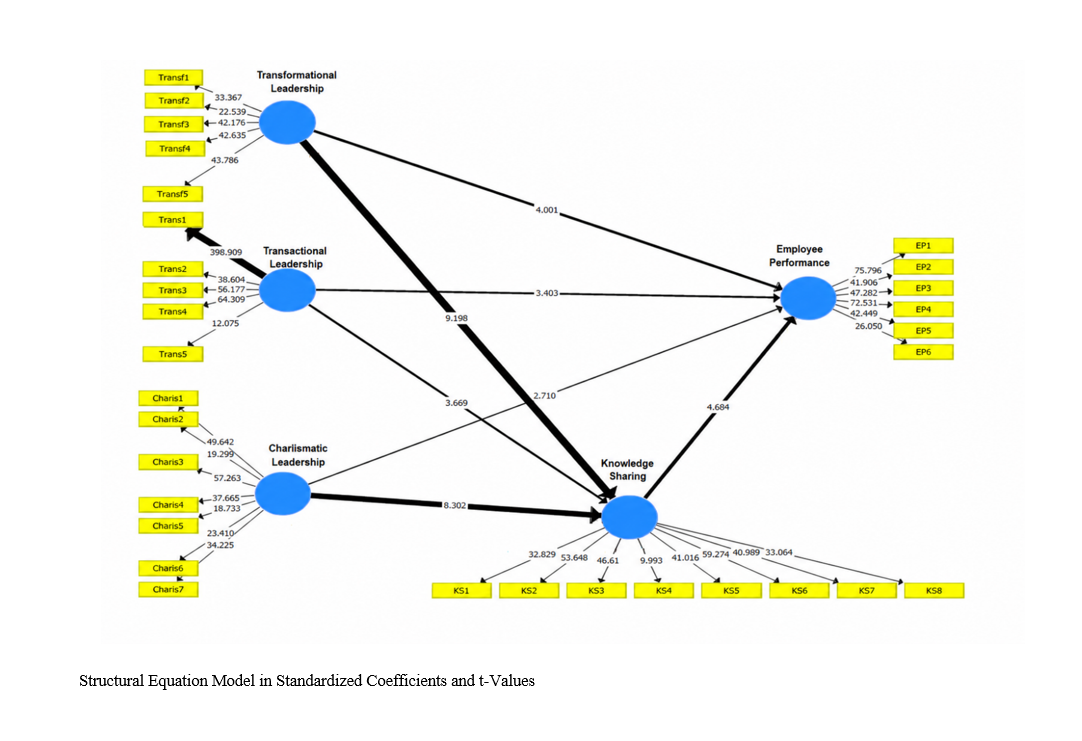
In this regard, the aim of the present study was to investigate the impact of strategic leadership styles and knowledge sharing on employee performance at Imam Khomeini Customs. This study was applied in terms of purpose and descriptive-survey in terms of data collection method. The statistical population of this study consisted of all managers and employees of Imam Khomeini Customs, from whom 197 individuals were selected using Cochran’s formula and convenience sampling. A researcher-developed questionnaire was used to collect the required data. Its validity was finalized after applying the supervisor’s comments, and its reliability was confirmed using Cronbach’s alpha coefficient (greater than 0.70). The findings were analyzed using structural equation modeling and Smart PLS software. The research findings indicated that transformational leadership style affects employee performance at Imam Khomeini Customs. Transactional leadership style affects employee performance at Imam Khomeini Customs. Charismatic leadership style affects employee performance at Imam Khomeini Customs. Transformational leadership style affects knowledge sharing at Imam Khomeini Customs. Transactional leadership style affects knowledge sharing at Imam Khomeini Customs. Charismatic leadership style affects knowledge sharing at Imam Khomeini Customs. Knowledge sharing affects employee performance at Imam Khomeini Customs. The results showed that transformational leadership style (β = 0.271), transactional leadership style (β = 0.232), and charismatic leadership style (β = 0.153) have a positive and significant effect on employee performance. Furthermore, these three leadership styles had a positive and significant effect on knowledge sharing, and knowledge sharing also influenced employee performance (β = 0.288). The mediating role of knowledge sharing in the relationship between leadership styles and performance was confirmed. Customs managers can improve employee performance by strengthening strategic leadership styles and fostering a culture of knowledge sharing.
References
[1] L. A. Odai, Y. Xiao, B. Korankye, and I. Ahakwa, "Navigating digital transformation: the critical role of knowledge sharing and digital transformational leadership in boosting innovation capability in Sub-Saharan Africa," Business Process Management Journal, vol. 32, no. 2, pp. 653-678, 2026.
[2] X. Ding, "Digital leadership, digital platform capability and digital business model innovation of start-ups," Journal of Innovation & Knowledge, vol. 14, p. 100970, 2026.
[3] R. Zarei and Y. Pashazadeh, "The Role of Digital Leadership in Digital Transformation," in Proceedings of the First National Conference on Dynamic Management and Knowledge-Based Economy, 2025: Kazeroon.
[4] S. Sofia and D. Aseanty, "Pengaruh Transformational Leadership, Knowledge Sharing, Dan Work Engagement Terhadap Innovative Work Behavior Pada Karyawan Jasa Marga Group," Modus, vol. 36, no. 2, pp. 176-197, 2024, doi: 10.24002/modus.v36i2.8666.
[5] T. N. Hoang and P. B. Le, "The influence of transformational leadership on knowledge sharing of teachers: the roles of knowledge-centered culture and perceived organizational support," The Learning Organization: An International Journal, vol. 32, no. 2, pp. 328-349, 2025, doi: 10.1108/TLO-08-2023-0144.
[6] S. K. Kim and D. Y. Yoon, "Impact of Empowering Leadership on Adaptive Performance in Hybrid Work: A Serial Mediation Effect of Knowledge Sharing and Employee Agility," Frontiers in Psychology, vol. 16, 2025, doi: 10.3389/fpsyg.2025.1448820.
[7] L. A. Odai, Y. Xiao, B. Korankye, and I. Ahakwa, "Navigating digital transformation: the critical role of knowledge sharing and digital transformational leadership in boosting innovation capability in Sub-Saharan Africa," Business Process Management Journal, 2025, doi: 10.1108/BPMJ-01-2025-0120.
[8] J. Mokhchy, G. Chen, S. Ahmad, Y. A. Khan, J. Zhang, and M. Ahmed, "Dynamic impact of leadership style, knowledge-sharing, and organizational culture on organizational performance," Current Psychology, vol. 44, no. 6, pp. 4097–4112, 2025, doi: 10.1007/s12144-025-07411-z.
[9] I. Muis, "The Effects of Knowledge Management, Digital Leadership and Organizational Culture on Employee Performance," Sjam, vol. 3, no. 1, pp. 1-16, 2025, doi: 10.38035/sjam.v3i1.411.
[10] S. Masih, U. E. Punchanathan, M. M. Naqshbandi, and F. Ahmed, "How inclusive leadership drives change-oriented extra-role behaviors via leader-member exchange and trust in leadership," Global Knowledge, Memory and Communication, 2025.
[11] J. J. Varghese and M. K. Rao, "Unlocking creativity in tech: How resonant leadership fuels creative performance through knowledge sharing in Indian IT firms," Journal of Open Innovation: Technology, Market, and Complexity, vol. 10, no. 4, p. 100432, 2024, doi: 10.1016/j.joitmc.2024.100432.
[12] Z. Hassan, "Mediating Influence of Knowledge Sharing Behaviour of Pharmaceutical Leaders on the Relationship Between Cultural Intelligence Dimensions and Leadership Effectiveness," International Journal of Research and Innovation in Social Science, vol. IX, no. V, pp. 3402-3427, 2025, doi: 10.47772/ijriss.2025.905000264.
[13] N. Saif, S. Ali, I. Shaheen, G. G. G. Goh, and S. Khan, "Revolutionizing Healthcare Leadership the Critical Role of Digital Citizenship in Knowledge Sharing," Scientific Reports, vol. 15, no. 1, 2025, doi: 10.1038/s41598-025-93117-y.
[14] A. Hosseinzadeh, "The Relationship Between Authentic Leadership and Knowledge Sharing: The Mediating Role of Organizational Culture and Organizational Trust," Studies in Industrial and Organizational Psychology, vol. 12, no. 1, pp. 175-190, 2025, doi: 10.22055/jiops.2025.33235.1467.
[15] M. Mansoori, S. M. Hosseini, and H. Zare, "Ethical leadership and knowledge sharing behavior: The mediating role of intrinsic motivation," Journal of Knowledge Management, vol. 29, no. 2, pp. 456-473, 2025, doi: 10.1108/JKM-06-2024-0714.
[16] C. Mubarakh, M. Miswanto, B. Siregar, F. Biyanto, and F. Kartika, "The Strategic Role of Knowledge Management in Mediating the Relationship Between Servant Leadership and Organizational Value," International Journal of Research and Innovation in Applied Science, vol. X, no. I, pp. 335-352, 2025, doi: 10.51584/ijrias.2025.1001027.
[17] I. Shemshadi, "The impact of the knowledge-oriented leadership and culture on innovation and performance of organizational with emphasis on the role of mediator of Practices and process of knowledge management," Transactions on Data Analysis in Social Science, vol. 6, no. 2, pp. 45-59, 2024. [Online]. Available: https://civilica.com/doc/826294/.
[18] J. Shokarriz and M. Khadem Pour, "The Impact of Knowledge Management and Organizational Innovation on Organizational Innovation Considering the Mediating Role of Digital Leadership Capability (A Case Study of Knowledge-Based Companies)," Modern Research Approaches in Management and Accounting, vol. 93, pp. 1321-1329, 2024. [Online]. Available: https://www.majournal.ir/index.php/ma/article/view/2760.
[19] H. Esmaeilian, S. Ahmadzadeh, and M. Bakhshandeh, "Predicting Digital Entrepreneurship Development Based on Entrepreneurial Leadership: Testing a Conceptual Model in Knowledge-Based Companies," Journal of Entrepreneurship Research, vol. 4, no. 3, 2026.
Downloads
Publication Timeline
- Submitted
- Revised
- Accepted
Issue
Section
License
Copyright (c) 2025 Albert Boghosian (Corresponding author); Kimia Azmi (Author)

This work is licensed under a Creative Commons Attribution-NonCommercial 4.0 International License.