Development of a Hybrid XGBoost–Fuzzy Robust DEA Model for Evaluating the Operational and Environmental Efficiency of Petrochemical Companies Considering Undesirable Outputs and Uncertainty
Keywords:
XGBoost, Fuzzy DEA, Robust DEA, Operational Efficiency, Environmental Efficiency, Petrochemical Companies, Undesirable Outputs, UncertaintyAbstract
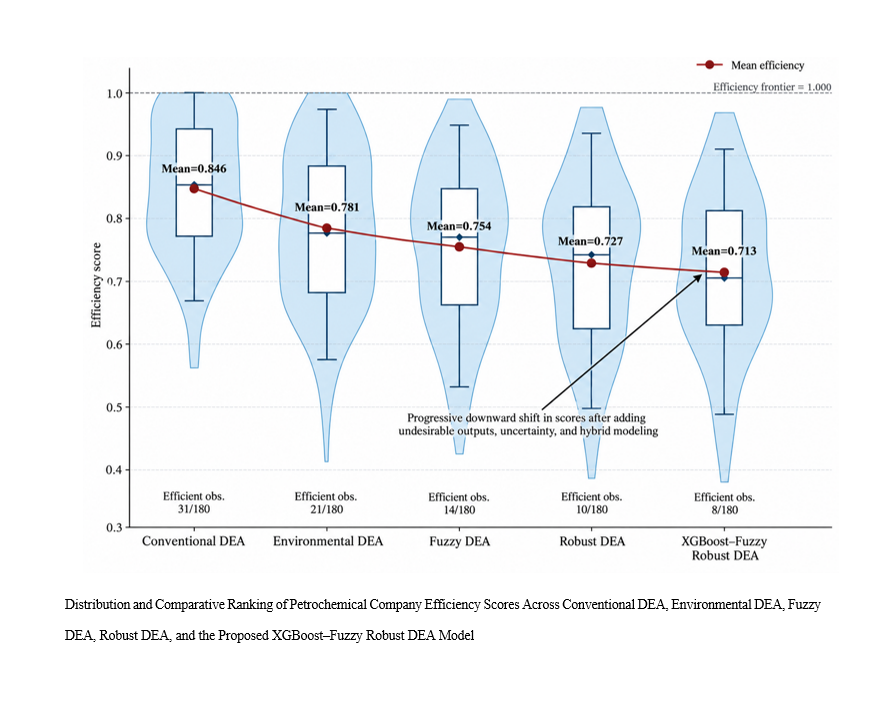
This study aimed to develop a hybrid XGBoost–Fuzzy Robust Data Envelopment Analysis model for evaluating the operational and environmental efficiency of petrochemical companies while simultaneously considering undesirable outputs, nonlinear relationships, and uncertainty in input–output data. This quantitative applied study analyzed 30 petrochemical companies over the 2020–2025 period, yielding 180 company-year observations. Inputs included total assets, number of employees, operating costs, energy consumption, and feedstock consumption, while desirable outputs comprised sales revenue, value added, and marketable production. Undesirable outputs included CO₂-equivalent emissions, air-pollutant emissions, industrial wastewater, and process or hazardous waste. A non-radial slack-based DEA model with variable returns to scale was integrated with fuzzy α-cut analysis and robust optimization to account for uncertainty. XGBoost was applied to model nonlinear efficiency determinants, with five-fold cross-validation used for hyperparameter optimization. Model performance was assessed using R², RMSE, MAE, SHAP importance, Spearman rank correlations, and sensitivity analyses across alternative model specifications. Mean efficiency declined from 0.846 under conventional DEA to 0.781 after incorporating undesirable outputs, 0.754 under fuzzy DEA, 0.727 under robust DEA, and 0.713 under the final hybrid model. The number of efficient observations decreased from 31 to 8. XGBoost achieved a test-set R² of 0.881, cross-validated R² of 0.862, RMSE of 0.047, and MAE of 0.036. Energy intensity and CO₂ emission intensity were the most influential predictors, with SHAP importance values of 0.184 and 0.162, respectively. The correlation between conventional DEA and the hybrid model was ρ = 0.741 (p < 0.001), indicating substantial ranking changes. Removing energy consumption or CO₂ emissions reduced ranking stability more than removing wastewater or hazardous waste. The hybrid XGBoost–Fuzzy Robust DEA model provided a more discriminating and uncertainty-sensitive assessment of petrochemical efficiency than conventional DEA, demonstrating that operational performance should be evaluated jointly with environmental burdens, nonlinear determinants, and data uncertainty.
References
[1] D. Saygin and D. Gielen, "Zero-Emission Pathway for the Global Chemical and Petrochemical Sector," Energies, vol. 14, no. 13, p. 3772, 2021, doi: 10.3390/en14133772.
[2] T. Lei, W. Zhao, S. Ma, C. Lai, and D. Guan, "China’s Petrochemical Plants’ CO 2 Emissions and High-Impact Contributors for Carbon-Neutrality Production," Science Advances, vol. 12, no. 12, 2026, doi: 10.1126/sciadv.adx7784.
[3] M. Wu et al., "Global Trends in the Research and Development of Petrochemical Waste Gas From 1981 to 2022," Sustainability, vol. 16, no. 14, p. 5972, 2024, doi: 10.3390/su16145972.
[4] M. E. Ahmed, A. Mydlarczyk, and A. Al-Haddad, "Efficiency Limiting Factors of Petrochemical Wastewater Treatment Using Hybrid Biological Reactor," Journal of Environmental Engineering and Landscape Management, vol. 30, no. 3, pp. 380-392, 2022, doi: 10.3846/jeelm.2022.17633.
[5] S. Verma, P. Kumar, V. C. Srivastava, and U. L. Štangar, "Application of Advanced Oxidation Processes (AOPs) for the Treatment of Petrochemical Industry Wastewater," pp. 103-128, 2021, doi: 10.1007/978-3-030-83811-9_6.
[6] Y. Yuan et al., "Sustainable Ozonation Using Natural Zeolite-Based Catalysts for Petrochemical Wastewater Treatment," Sustainability, vol. 17, no. 20, p. 9110, 2025, doi: 10.3390/su17209110.
[7] A. B. d. Santos, A. Giacobbo, M. A. S. Rodrigues, and A. M. Bernardes, "Electrodeionization for Wastewater Reuse in Petrochemical Plants," Water, vol. 16, no. 3, p. 401, 2024, doi: 10.3390/w16030401.
[8] J. Hernández‐Fernández, R. Ortega‐Toro, and J. López, "A New Route of Valorization of Petrochemical Wastewater: Recovery of 1,3,5-Tris (4-Tert-Butyl-3-Hydroxy-2,6-Dimethyl Benzyl)–1,3,5-Triazine-2,4,6-(1h,3h,5h)-Trione (Cyanox 1790) and Its Subsequent Application in a PP Matrix to Improve Its Thermal Stability," Molecules, vol. 28, no. 5, p. 2003, 2023, doi: 10.3390/molecules28052003.
[9] N. Alavi, S. Adabi, M. Sadani, A. Eslami, and M. M. Amini, "Mechanochemical Dechlorination of Petrochemical Sludge Through a Planetary Ball Mill and Using Industrial Wastes as Additives," Environmental Progress & Sustainable Energy, vol. 41, no. 4, 2022, doi: 10.1002/ep.13828.
[10] L. F. d. Silva, G. Martins, A. G. Gallego, and R. Palacios‐Bereche, "Simulation Studies of the Existing Cogeneration System and Alternative Conceptions to Improve the Energy Efficiency for an Ethylene Petrochemical Plant," International Journal of Energy Research, vol. 46, no. 14, pp. 20728-20746, 2022, doi: 10.1002/er.8546.
[11] B. Zhao, D. Qin, D. Gao, and L. Xu, "Energy Saving Diagnosis Model of Petrochemical Plant Based on Intelligent Curvelet Support Vector Machine," Soft Computing, vol. 25, no. 24, pp. 15391-15401, 2021, doi: 10.1007/s00500-021-06151-z.
[12] I. Giannikopoulos, A. Skouteris, T. F. Edgar, M. Bâldea, D. T. Allen, and M. A. Stadtherr, "Probing the Impact of an Energy and Transportation Paradigm Shift on the Petrochemicals Industry," Industrial & Engineering Chemistry Research, vol. 61, no. 33, pp. 12169-12179, 2022, doi: 10.1021/acs.iecr.2c00309.
[13] M. K. Aghababaei, A. Hajinezhad, S. F. Moosavian, and R. Fattahi, "Evaluating the Substitution Value of Green Electricity for Advancing Renewable Energy Development Through the Value‐Added Contributions of Iran's Petrochemical Industries: A System Dynamics Approach," Energy Science & Engineering, vol. 14, no. 2, pp. 793-807, 2025, doi: 10.1002/ese3.70382.
[14] V. Ismayilov, N. Gafarov, and S. Valiyeva, "Impact of Investment on Labour Productivity in Azerbaijan's Chemical and Petrochemical Industry," Qubahan Academic Journal, vol. 4, no. 2, pp. 198-213, 2024, doi: 10.48161/qaj.v4n2a211.
[15] H. E. Boukrouma, Y. Zennir, and R. Bendib, "A Systematic Literature Review on Industrial Scheduling Optimization," Algerian Journal of Signals and Systems, vol. 9, no. 4, pp. 222-235, 2024, doi: 10.51485/ajss.v9i4.241.
[16] M. D. Tan, P. Ibarra-González, I. Nikolić, and A. Ramírez, "Determining the Performance and Network Properties of Petrochemical Clusters," pp. 1211-1216, 2023, doi: 10.1016/b978-0-443-15274-0.50193-1.
[17] U. Shalbolova, L. Salykova, K. Bissenov, and S. Makhanov, "Priorities for the Development of the Petrochemical Industry as Part of the Fuel and Energy Complex of Kazakhstan," E3s Web of Conferences, vol. 411, p. 01043, 2023, doi: 10.1051/e3sconf/202341101043.
[18] A. M. Ghaithan, M. A. Khan, A. Mohammed, and L. A. Hadidi, "Impact of Industry 4.0 and Lean Manufacturing on the Sustainability Performance of Plastic and Petrochemical Organizations in Saudi Arabia," Sustainability, vol. 13, no. 20, p. 11252, 2021, doi: 10.3390/su132011252.
[19] J. Jia et al., "Digital Twin Technology and Ergonomics for Comprehensive Improvement of Safety in the Petrochemical Industry," Process Safety Progress, vol. 43, no. 3, pp. 507-522, 2024, doi: 10.1002/prs.12575.
[20] M. Fakhroleslam, "Vira Workspace: A Novel Online Object-Oriented Framework as a SaaS for the Modeling and Simulation of Petrochemical Plant Networks," Acs Omega, vol. 10, no. 37, pp. 42202-42217, 2025, doi: 10.1021/acsomega.5c00403.
[21] O. Maghazei, "Drones in Manufacturing: Opportunities and Challenges," pp. 290-298, 2022, doi: 10.46254/eu05.20220073.
[22] T. S. Ansari and S. A. A. Taqvi, "State‐of‐the‐Art Review on the Applications of Nonlinear and Artificial Intelligence‐Based Controllers in Petrochemical Processes," Chembioeng Reviews, vol. 10, no. 6, pp. 884-906, 2023, doi: 10.1002/cben.202300017.
[23] J. H. Lee, Y. Kim, I. J. Kim, S. B. Hong, and H. S. Yun, "Comparative Analysis of Ultrasonic and Traditional Gas-Leak Detection Systems in the Process Industries: A Monte Carlo Approach," Processes, vol. 12, no. 1, p. 67, 2023, doi: 10.3390/pr12010067.
[24] Y. Chen, "A Superstructure‐based Optimization Model for Polyethylene Furandicarboxylate Production," Aiche Journal, 2025, doi: 10.1002/aic.70079.
[25] J. H. Kim, H. E. Yu, M. H. Kim, and S. Y. Lee, "Beyond Petrochemicals: Challenges and Opportunities in Industrial-Scale Biomanufacturing," Nature Communications, vol. 17, no. 1, 2026, doi: 10.1038/s41467-026-73835-1.
[26] Y. Wang, L. Yao, S. Cui, and Z. Zhu, "Eco-Efficiency Assessment of Chinese Petrochemical Enterprises: A Data Envelopment Analysis Approach," Energy & Environment, vol. 33, no. 6, pp. 1160-1180, 2021, doi: 10.1177/0958305x211065424.
[27] M. Cui and X. Wu, "Effects of Petrochemical Industry Agglomeration And Green Technology Innovation On Eco-Efficiency: An Analysis Based On Provincial Data in China," Polish Journal of Environmental Studies, vol. 33, no. 2, pp. 1043-1055, 2023, doi: 10.15244/pjoes/172761.
[28] V. G. Iyer, "Importance of Strategic Environmental Assessment (Sea) Process and Environmental Health Impact Assessment (Ehia) Process Towards Sustainable Climate Change and Control," Journal of Intelligent Computing and Mathematics, 2024, doi: 10.55571/jicm.2024.01028.
[29] S. Jayaraman, A. Eswaran, V. P. Veeraraghavan, M. A. Fazal, A. Al-Rahbi, and S. R. Sirasanagandla, "Implications of Petrochemical Exposure and Epigenetic Alterations on Human Health," Frontiers in Toxicology, vol. 7, 2025, doi: 10.3389/ftox.2025.1542871.
[30] l. s. Kim, C. Yoon, D. Lee, G. A. Shin, and S. Jung, "A Study on the Sustainability of Petrochemical Industrial Complexes Through Accident Data Analysis," Processes, vol. 12, no. 12, p. 2637, 2024, doi: 10.3390/pr12122637.
[31] J. P. B. Visbal, R. Ortega‐Toro, and J. Hernández‐Fernández, "Application of Risk Management in Applied Engineering Projects in a Petrochemical Plant Producing Polyvinyl Chloride in Cartagena, Colombia," Chemengineering, vol. 9, no. 4, p. 75, 2025, doi: 10.3390/chemengineering9040075.
[32] H. K. Thabet, O. A. A. El‐Shamy, A. M. Ashmawy, and M. A. Deyab, "The Impact of Corrosion Inhibitors in Desalination Systems," Acs Omega, vol. 8, no. 48, pp. 45224-45231, 2023, doi: 10.1021/acsomega.3c07129.
[33] M. Lee et al., "Machine Learning-Based Prediction of Controlled Variables of APC Systems Using Time-Series Data in the Petrochemical Industry," Processes, vol. 11, no. 7, p. 2091, 2023, doi: 10.3390/pr11072091.
[34] Q. Jiang, "Comparison of Additional Empowerment of Carbon Capture Applications in Petrochemical, Construction, Power Industry," E3s Web of Conferences, vol. 424, p. 03005, 2023, doi: 10.1051/e3sconf/202342403005.
[35] J. P. Tilsted, "Degrowing a Synthetic World: A Critical Realist Perspective on Petrochemical Transformation," Environmental Values, vol. 35, no. 3, pp. 204-225, 2025, doi: 10.1177/09632719251357480.
[36] E. Sylvia and Y. Sunitiyoso, "A System Dynamic Model for Indonesian Petrochemical Industry Emission Reduction," International Journal of Energy Sector Management, vol. 18, no. 1, pp. 1-25, 2023, doi: 10.1108/ijesm-07-2022-0006.
Downloads
Publication Timeline
- Submitted
- Revised
- Accepted
Issue
Section
License
Copyright (c) 2026 Seyed Morteza Mousavi (Author); Javad Gerami (Corresponding author); Mohammadreza Mozaffari, Roya M. Pour Ahari, Mohammadreza Feylizadeh (Author)

This work is licensed under a Creative Commons Attribution-NonCommercial 4.0 International License.